To my dear visitors and commenters

Hi, everybody! I've noticed with lots of joy and happiness, that thousands of comments have been written in my posts. It's wonderful that so may people around the world appreciate my work. Therefore, I want to thank you for that and ,at the same time I want to ask you to be this blog's followers. It's fast and easy! Make it be even more visited and spread all over the world! I'm a woman, a teacher of English in Portugal, and I've been away for quite a long time because of my father's health. Unfortunately he died from Covid19 a few months ago. Now I felt it was time to restart my activity in this and other blogs I owe. I've recently created a new one in a partnership with a street photographer, Mr. Daniel Antunes. He's fabulous! https://pandpbydandd.blogspot.com I'd like you to visit it and, who knows, become our followers. The poems, chronicles and thoughts are all mine. Thank you so much! Kisses :-)

Search This Blog

Showing posts with label China. Show all posts

Tuesday, October 20, 2015

Why is ivory so popular in China?

Say NO to ivory trade!

Elephant with a baby elephant
Up to 30,000 African elephants are killed every year by poachers who want to sell their tusks for ivory.
Prince William will go on Chinese TV today to speak out against the use of ivory.

It's a material found in elephant tusks and China buys and sells more of it than anywhere else in the world.
Prince William has spoken passionately about trying to stop the ivory trade in the past and will use his speech to urge the Chinese government to ban it.
Here is Newsround's guide on why the ivory trade is such a big concern and why China seems so obsessed with it.

What is ivory?

Ivory tusks
Elephants are hunted for their tusks, and the ivory is illegally sold all around the world.

Ivory is a hard white material that is found in the tusks of elephants and other tusked animals like hippos and walruses. Although rhinos have similar looking horns, these aren't actually made from ivory. However, rhinos are also illegally hunted for their horns because they are used in lots of medicines in China and the Far East.
Lots of elephants die as a result of hunters taking their tusks because removing the ivory almost always kills the animals.
It's estimated that up to 30,000 African elephants die every year because they are hunted for ivory.
Selling ivory was banned worldwide in 1989, but the ban has been lifted several times, so there is still a lot of ivory on sale. As well as this, a lot of ivory is sold by poachers who kill elephants illegally.

Why is ivory so popular in China?

A carved ivory ship model
Ivory is often used to make elaborate and expensive ornaments in China.

In China and Hong Kong, ivory is seen as precious material and is used in ornaments and jewellery. It's also sometimes used in traditional Chinese medicine.
Some rich Chinese people think that owning ivory makes them look more successful. Others think that ivory will bring them good luck.
China has the biggest ivory trade in the world and wildlife experts believe that around 70 per cent of the world's ivory ends up there.

Are things changing?

A police officer stands guard next to ivory and ivory sculptures before they are destroyed in Dongguan, Guangdong province 6 January 2014
The Chinese government has started cracking down on illegal ivory and has destroyed lots of tusks and ornaments.

This year China agreed to ban ivory tusks and ornaments coming into the country for twelve months.
The government has said it wants to completely ban ivory sales soon but it is still legal to sell older carvings and ornaments.
Some people don't want ivory to be banned in China because they say that carving it is an old Chinese tradition that should carry on.
But more and more people in China disagree. A recent survey found that 95 per cent of people there wanted ivory to be banned to protect the elephants.

From CBBC Newsround

Thursday, August 13, 2015

Dozens killed in Tianjin port blasts

Tianjin: a beautiful modern city, tending to be an eco city

Tianjin from Nanjing Road
 (Heping Kongzhuyuan park in foreground) - TianjinTianjin Skyline 2009 Sep 11
 by Nangua 1 - Tianjin


China explosion: 'I woke in a panic and the sky was red'


Massive explosions have hit China's northern city of Tianjin, killing at least 50 and injuring 500 people.
According to Chinese state media, the blasts occurred when a shipment of explosives blew up in the port city at about 23:30 (16:30 GMT).
An eyewitness has described the moment a huge explosion hit a major port and industrial area in China's northern city of Tianjin.
Monica Andrews says she woke up in a panic and initially thought it was an earthquake.
Her friend Cara Carnello caught the explosion on her mobile phone, it shows a huge fireball and a billowing cloud of smoke.
Footage filmed by a drone shows the devastation caused by the explosions at a warehouse in Tianjin in northern China.
At least 50 people have died and over 500 were injured after two major explosions.
The blast happened in a warehouse storing "dangerous and chemical goods" in the port area.
From BBC News


Drone footage shows Tianjin blast site


Monday, April 06, 2015

The dystopian lake filled by the world’s tech lust

Hidden in an unknown corner of Inner Mongolia is a toxic, nightmarish lake created by our thirst for smartphones, consumer gadgets and green tech, discovers Tim Maughan.

" I’d seen some photos before I left for Inner Mongolia, but nothing prepared me for the sight "
— The alien environment at Baotou lake

(Credit: Liam Young/Unknown Fields)
Black sludge pours into the lake - one of many pipes lining the shore (Credit: Liam Young/Unknown Fields)

From where I'm standing, the city-sized Baogang Steel and Rare Earth complex dominates the horizon, its endless cooling towers and chimneys reaching up into grey, washed-out sky. Between it and me, stretching into the distance, lies an artificial lake filled with a black, barely-liquid, toxic sludge.
Dozens of pipes line the shore, churning out a torrent of thick, black, chemical waste from the refineries that surround the lake. The smell of sulphur and the roar of the pipes invades my senses. It feels like hell on Earth.
Welcome to Baotou, the largest industrial city in Inner Mongolia. I'm here with a group of architects and designers called the Unknown Fields Division, and this is the final stop on a three-week-long journey up the global supply chain, tracing back the route consumer goods take from China to our shops and homes, via container ships and factories.
You may not have heard of Baotou, but the mines and factories here help to keep our modern lives ticking. It is one of the world’s biggest suppliers of “rare earth” minerals. These elements can be found in everything from magnets in wind turbines and electric car motors, to the electronic guts of smartphones and flatscreen TVs. In 2009 China produced 95% of the world's supply of these elements, and it's estimated that the Bayan Obo mines just north of Baotou contain 70% of the world's reserves. But, as we would discover, at what cost?
Element of success
Rare earth minerals have played a key role in the transformation and explosive growth of China's world-beating economy over the last few decades. It's clear from visiting Baotou that it's had a huge, transformative impact on the city too. As the centre of this 21st Century gold-rush, Baotou feels very much like a frontier town.
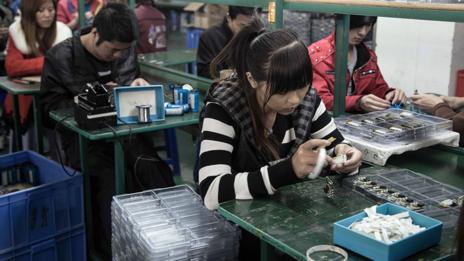
Workers in a factory in Shenzhen make MP3 players (Credit: Kate Davies/Unknown Fields)
In 1950, before rare earth mining started in earnest, the city had a population of 97,000. Today, the population is more than two-and-a-half million. There is only one reason for this huge influx of people - minerals. As a result Baotou often feels stuck somewhere between a brave new world of opportunity presented by the global capitalism that depends on it, and the fading memories of Communism that still line its Soviet era boulevards. Billboards for expensive American brands stand next to revolution-era propaganda murals, as the disinterested faces of Western supermodels gaze down on statues of Chairman Mao. At night, multicoloured lights, glass-dyed by rare earth elements, line the larger roads, turning the city into a scene from the movie Tron, while the smaller side streets are filled with drunk, vomiting refinery workers that spill from bars and barbecue joints.

Even before getting to the toxic lake, the environmental impact the rare earth industry has had on the city is painfully clear. At times it’s impossible to tell where the vast structure of the Baogang refineries complex ends and the city begins. Massive pipes erupt from the ground and run along roadways and sidewalks, arching into the air to cross roads like bridges. The streets here are wide, built to accommodate the constant stream of huge diesel-belching coal trucks that dwarf all other traffic.
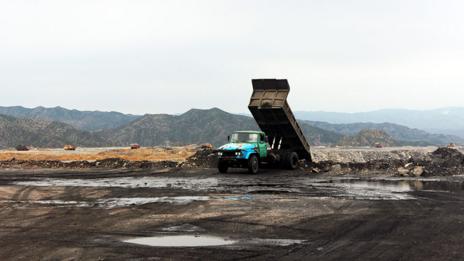
A coal mine in Baotou (Credit: Liam Young/Unknown Fields)
From BBC News

Thursday, February 05, 2015

The world's most-trafficked mammal - and the scaliest

The gentle, solitary pangolin has a tongue as long as its body and curls into a ball when threatened. It is also the world's most trafficked mammal, and threatened with extinction.

Pangolin looking at camera

In front of a drab government building near Vietnam's northern border with China, a young conservationist named Nguyen Van Thai prises open a flimsy wooden crate with a machete.
He lifts out four plastic sacks and places them on the ground. From each sack he pulls out a brownish-black ball with a scaly exterior, roughly the size and weight of an curling stone.
Gradually - and very, very cautiously - one of those balls begins to uncurl, revealing two blackcurrant eyes, a long snout, an even longer tail and a soft pink belly. It's a pangolin, one of the world's more remarkable creatures.
The pangolin is the only mammal wholly covered in scales, and it simply curls itself into an impregnable ball when threatened by predators.
It eats seven million ants and termites a year using a tongue that's almost as long as its body. It has no teeth, so it stores stones in its stomach to grind up its food.
The reason many of us have never heard of pangolins is because they seldom survive in captivity. Only six zoos in the world - and only one in Europe, Leipzig - have any.
Pangolins enjoy one other unfortunate distinction - they are the world's most trafficked mammal.
While the media focuses on the plight of the elephant and the rhinoceros, the celebrities of the natural world, roughly 100,000 pangolins a year are being snatched from the wild and sent to China and Vietnam.
Baby pangolin
In both those countries their meat is considered a delicacy, and their scales are deemed to have magical medicinal properties.
Already there are no pangolins left in great swathes of South East Asia, so Africa's pangolin populations are now being plundered. All eight species are threatened with extinction.
Cape Pangolin in ball
In both those countries their meat is considered a delicacy, and their scales are deemed to have magical medicinal properties.

Already there are no pangolins left in great swathes of South East Asia, so Africa's pangolin populations are now being plundered. All eight species are threatened with extinction.
They resemble artichokes on legs. They are gentle, solitary creatures with an almost comic rolling gait. They carry their young on their tails and curl round them to protect them. They use those prehensile tails to hang from branches, or to stretch out almost horizontally to reach ants' nests.
Pangolin carrying baby pangolin

From BBC News-Magazine

Monday, April 21, 2014

Asian air pollution strengthens Pacific storms

Air pollution in China and other Asian countries is having far-reaching impacts on weather patterns across the Northern Hemisphere, a study suggests.


Beijing haze
A thick haze of pollution envelopes Beijing - but scientists say the toxic air travels much further afield

Researchers have found that pollutants are strengthening storms above the Pacific Ocean which feeds into weather systems in other parts of the world.
The effect was most pronounced during the winter.
Lead author Yuan Wang, from the Jet Propulsion Laboratory at the California Institute of technology, said: "The effects are quite dramatic. The pollution results in thicker and taller clouds and heavier precipitation."

Toxic atmosphere

Parts of Asia have some of the highest levels of air pollution in the world.
In China's capital, Beijing, pollutants frequently reach hazardous levels, while emissions in the Indian capital, Delhi, also regularly soar above those recommended by the World Health Organization.
This has dire consequences for the health of those living in these regions, but there is growing evidence that there are other impacts further afield.
To analyse this, researchers from the US and China used computer models to look at the effect of Asia's pollution on weather systems.
The team said that tiny polluting particles were blown towards the north Pacific where they interacted with water droplets in the air.
Buildings are shrouded in smog in Lianyungang, China
Researchers believe the tiny pollutant particles blow over to the north Pacific Ocean
This, the researchers said, caused clouds to grow denser, resulting in more intense storms above the ocean.
Dr Yuan Wang said: "Since the Pacific storm track is an important component in the global general circulation, the impacts of Asian pollution on the storm track tend to affect the weather patterns of other parts of the world during the wintertime, especially a downstream region [of the track] like North America."
Commenting on the study, Professor Ellie Highwood, a climate physicist at the University of Reading, said: "We are becoming increasingly aware that pollution in the atmosphere can have an impact both locally - wherever it is sitting over regions - and it can a remote impact in other parts of the world. This is a good example of that.
"There have also been suggestions that aerosols over the North Atlantic effect storms over the North Atlantic, and that aerosols in the monsoon region over South Asia can affect circulation around the whole of the world."

Wikipedia

Search results