To my dear visitors and commenters

Hi, everybody! I've noticed with lots of joy and happiness, that thousands of comments have been written in my posts. It's wonderful that so may people around the world appreciate my work. Therefore, I want to thank you for that and ,at the same time I want to ask you to be this blog's followers. It's fast and easy! Make it be even more visited and spread all over the world! I'm a woman, a teacher of English in Portugal, and I've been away for quite a long time because of my father's health. Unfortunately he died from Covid19 a few months ago. Now I felt it was time to restart my activity in this and other blogs I owe. I've recently created a new one in a partnership with a street photographer, Mr. Daniel Antunes. He's fabulous! https://pandpbydandd.blogspot.com I'd like you to visit it and, who knows, become our followers. The poems, chronicles and thoughts are all mine. Thank you so much! Kisses :-)

Search This Blog

Showing posts with label Zoos. Show all posts

Sunday, December 27, 2015

Zoo in effort to save beautiful rare Indonesian magpie

Rare bird experts at a zoo in Cheshire have started a project that they hope will save one of the world's most endangered birds.
Twelve Javan green magpies have moved to Chester Zoo in a bid to save the rare species (Chester Zoo/PA)
The Javan green Magpie, Cissa thalassina from Indonesia has been poached almost to extinction.

    Now, four pairs of the birds have been brought to the UK in the hope that they will breed.Andrew Owen, who looks after the birds at Chester Zoo, hopes the project will stop these types of birds from dying out.
There is thought to be fewer than 100 of the Javan green magpie left in the world, putting the inquisitive bird with distinctive green plumage, black eye feathers and a pink beak on the critically endangered list.

The zoo is hoping to boost survival rates by developing the first captive breeding programme outside of Indonesia, where a passion for keeping caged birds has seen numbers in the wild decimated. As the birds become rarer, their value increases, leaving many species on the brink of disappearing altogether.


The zoo's curator of birds, Andrew Owen, explains: "We really are fighting against time to save the incredibly rare Javan green magpie from extinction. Sadly, there is evidence that the species is fast disappearing in the wild as they have fallen victim to the pet trade and an ever shrinking habitat.

"In fact, they have only been found once in the last 10 years in the wild by ornithologists. By bringing twelve of the birds to the UK, we are hoping our new conservation breeding programme will begin to address the desperate plight of this species and ensure a protected population for the future.
"We've been working with the Cikananga Conservation Breeding Centre in Java for five years and our mission to track down the birds with the beautiful green plumage has included trawling markets and interviewing traders.
"Over time we have managed to rescue a handful of birds and set up a breeding centre and, together, we have been successful in breeding the birds on their country of origin. However, so prized are they in Java, the breeding centre has suffered from a number of break-ins - the magpies being a prime target given their beauty and increasing value on the pet trade."
Press Association

Sunday, September 06, 2015

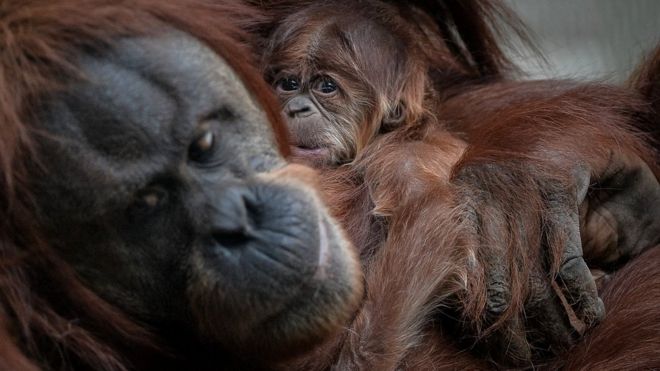
Rare Sumatran orangutan born at Chester Zoo

A rare species of Sumatran orangutan has been born at Chester Zoo.

Baby orangutan clings to its mum
The tiny new arrival is extra special because the species is facing extinction in the wild.
The baby orangutan hasn't got a name yet but it will be joining a family of four older brothers and sisters.
Sumatran orangutans are from Indonesia and lots of their homes are being destroyed as forest are chopped down for wood.(CBBC newsround)
Keepers at the zoo said they were doing their early morning checks when they spotted the tiny newcomer in the arms of its mother, 28-year-old Subis.
Sumatran orangutans are found only on the island of Sumatra in Indonesia where it is estimated that less than 6,500 remain.


The species has come under threat due largely to the destruction of its habitat for logging, wholesale conversion of forest to palm oil plantations and hunting, say the zoo.
Tim Rowlands, curator of mammals, said: "Subis herself was born here in 1986 and has since had four other young, but this is the first Sumatran orangutan to be born here at the zoo in just under three years so the team is absolutely thrilled.
"To watch Subis cradling her new arrival is a truly wonderful sight and we just hope that the pair help us to raise a little more awareness of their cousins in the wild that face enormous threats on a day-to-day basis. Sadly, without continued conservation work the Sumatran orangutan could become the first great ape to become extinct in the wild." (home.bt.com)


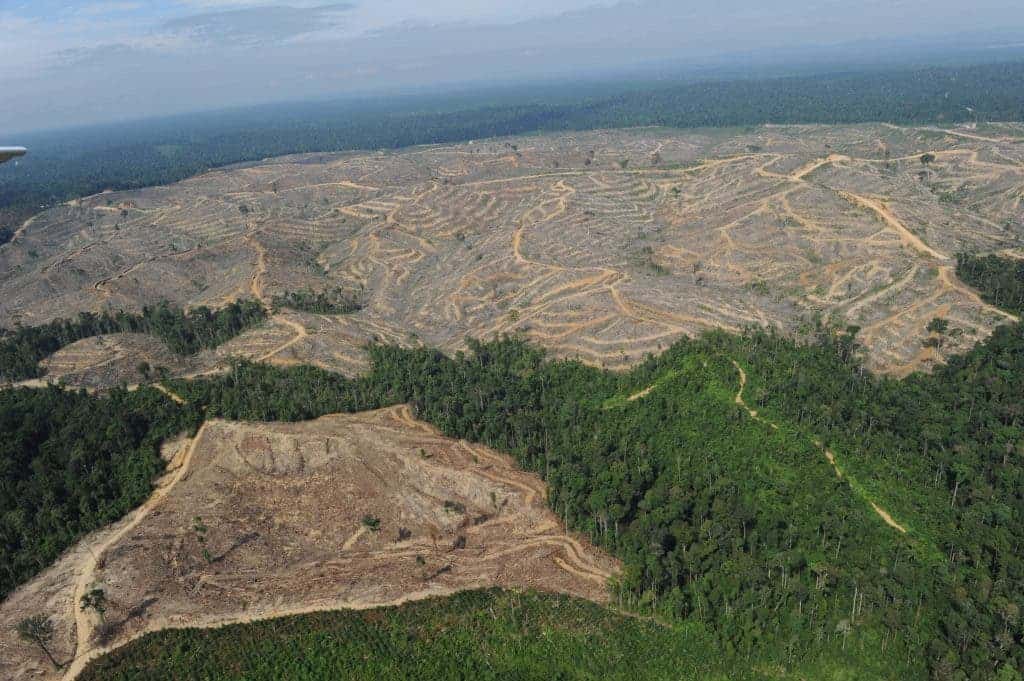
Along with orangutans other species are being threatned in Sumatra. Rhinos, tigers, elephants among others, are victims of the palm oil world's demand. Palm trees are being massively logged off shrinking these are others animals' habitat and  preventing them from a free healthy life in the wild. Palm oil is more and more an important ingredient in tooth paste, soaps and in almost everything that foams and even in various food like frying oils. Cosmetics and cleaning products are two other uses for palm oil. Due to its importance to industry these animals' habitat is being destroyed and therefore in a while they'll have nowhere to go. They´ll die or will be killed by humans who see their properties invaded by famished animals.

Friday, August 07, 2015

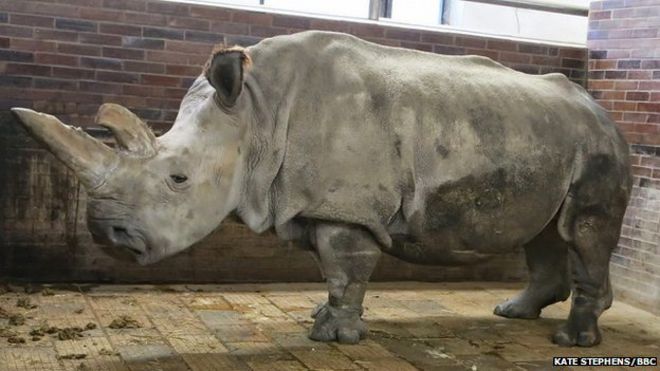
Death of rare Northern White Rhino leaves four alive

One of the last five Northern White Rhino left in the world has died.


Northern white rhino
Nabire, a 31-year-old female, died at a zoo in the Czech Republic on Monday.She had a cyst inside her body and vets had no way to treat it.
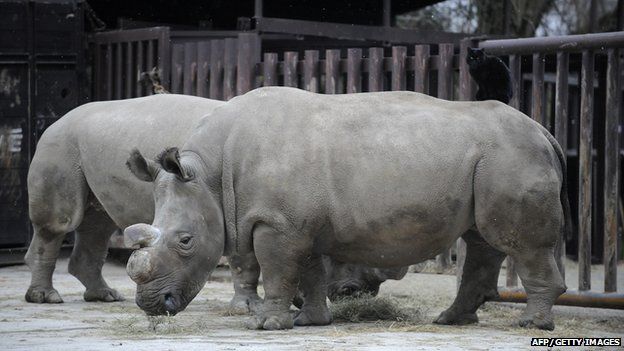
Rhino
The animals are hunted for their horns
Her death leaves just three females and one male alive; one of them at the San Diego Zoo and three at the Ol Pejeta Conservancy reserve in Kenya.
The sub-species has been on the brink of extinction for years because of hunting and habitat loss.
Hunters sell their tusks to countries like China, where some people believe ivory has healing powers.
From CBBC Newsround

Thursday, July 23, 2015

Lisbon Zoo welcomes new inhabitants


Unusually, two flamingos were born at the Lisbon Zoo recently. It is usually just one a year but this time they have two instead. The Lisbon Zoo definitely has the best living and procreating conditions, not only for flamingos, but for dozens of other important species among the which we may find really endangered species and others at risk of extinction such as elephants, rhinos, the Persian leopard,the spiked turtle, the golden parakeet, and many others including African Impalas, the marmoset Emperor, and so on. This Zoo is really worth a visit for the hundreds of species it keeps and grows, the warm climate we can find in Lisbon, the dolphins and sea lions shows held daily, the lung it is in a cosmopolitan city like Lisbon and the many attractions it provides due to the exchange programms to which it is associated and that allows tourists and common visitors to enjoy at any time of year.
 Every animal's habitat is carefully chosen and taken care so that every species can easily breed and live nearly with the same natural conditions they have in the wild. The Lisbon Zoo keeps the only Okapi calf born in Europe.
Mª Dulce Branquinho


Thursday, February 26, 2015

Animals rescued from overcrowded Mexico zoo

More than 100 animals have been rescued from an overcrowded private zoo in Mexico, after complaints from visitors.

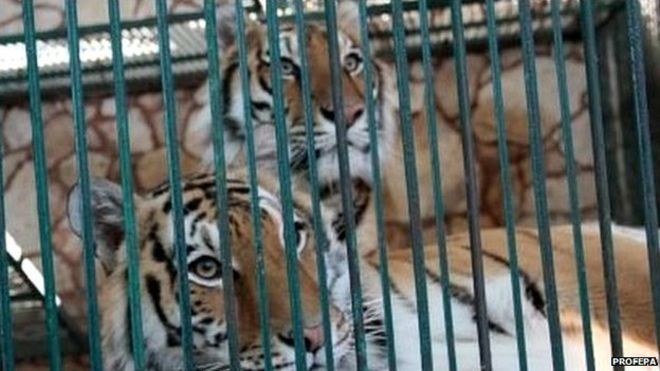
Tigers in a cage at the Club de los Animalitos
Mexican environmental officials who raided the property found animals in cramped cages piled on top of each other.
Animals such as lions, bears and tigers, bears were being kept in terrible conditions at the zoo.
Officials who seized the creatures said they would try to find suitable new homes for the animals.
The zoo is owned by a senior Mexican politician, Sergio 

From CBBC newsround


Inspectors also found irregularities with the zoo's master plan and other paperwork, along with deficiencies in feeding, veterinary care and staff levels for a collection of such size.
The cramped conditions were said to have provoked aggressive behavior, fights and injuries to some animals.
A total of 101 were seized: 92 as a result of "serious breaches of proper treatment," and nine whose legal provenance could not be established.
They included more than 40 big cats, a half-dozen monkeys, two grizzly bears, antelope, bison and birds.
From Yahoo News
Gomez


Monday, December 08, 2014

African penguins close to extinction in the wild

They're a favourite attraction at any zoo, but in the wild, African penguins are at risk of extinction


The population of African penguins fell 70% between 2001 and 2013 and is continuing to decline.
With less than 18,000 breeding pairs left in the wild in South Africa, African penguins are an endangered species.
Every winter, hundreds of African penguin chicks, that have been abandoned by their parents foraging for food, are rescued by a rehabilitation centre in South Africa.

It's part of a project led by Bristol Zoo.
This year, African penguin chicks are coming in early and in their hundreds from the colonies.
The rehabilitation centre is already helping to care for 430 and this number is growing.


From CBBC newsround

Wednesday, November 19, 2014

Rare baby anoa calf born at zoo


Check out this cute baby anoa calf, which has been born at Chester Zoo in England.


The calf called Lasola has been busy exploring her new surroundings with her Mum.
Already standing up this little calf is bouncing around her surroundings, exploring the enclosure with her mum, a miniature version of the water buffalo this species is nicknamed the 'Demon' of the forest.
Labelled as an endangered species, an estimate total of around 2,500 of mature anoas are left in the wild, though little is known about this animal as they are shy and secretive, and only live in pairs instead of in herds like cattle do.
Anoa are the world's smallest species of wild cattle and are usually found in forests and swamps in Indonesia.
They've been listed as an endangered species with around two thousand estimated to be left.
From 
CBBC newsround- http://www.bbc.co.uk/newsround/30093128
Whizba-https://www.whizba.com/index.php/natural-world/animal-world/item/2032-chester-zoo-welcomes-rare-anoa-calf

Wikipedia

Search results