To my dear visitors and commenters

Hi, everybody! I've noticed with lots of joy and happiness, that thousands of comments have been written in my posts. It's wonderful that so may people around the world appreciate my work. Therefore, I want to thank you for that and ,at the same time I want to ask you to be this blog's followers. It's fast and easy! Make it be even more visited and spread all over the world! I'm a woman, a teacher of English in Portugal, and I've been away for quite a long time because of my father's health. Unfortunately he died from Covid19 a few months ago. Now I felt it was time to restart my activity in this and other blogs I owe. I've recently created a new one in a partnership with a street photographer, Mr. Daniel Antunes. He's fabulous! https://pandpbydandd.blogspot.com I'd like you to visit it and, who knows, become our followers. The poems, chronicles and thoughts are all mine. Thank you so much! Kisses :-)

Search This Blog

Showing posts with label Recycling. Show all posts

Thursday, April 07, 2016

The island in Cancun built on recycled plastic bottles

A British man in the Mexican tourist area of Cancun is looking to get legal recognition for the island home that he has built almost entirely out of recycled materials.
Richard Sowa created the island in 2007 out of reclaimed wood, held up on a bed of thousands of empty plastic drinks bottles.
He says it is ''a way of turning the trash of the world into paradise''. (from BBC News)


Friday, November 06, 2015

The artist who 'paints' with recycled plastic


The materials needed to make art can be expensive, too expensive for some.
But one artist in South Africa has found a way to combine his artistic passion and his love for recycling.
Mbongeni Buthelezi collects plastic bags from the streets around his Johannesburg studio and melts them to create a unique kind of art - he calls it "plastic fantastic".
Video journalist: Christian Parkinson
From BBC News- Magazine

Friday, November 21, 2014

Poo-powered Bio-Bus hits road in Bath and Bristol

Check out this new form of poo-blic transport!

Britain's first bus powered entirely by poo and food waste has hit the road


The Bio-Bus is a shuttle service between Bath and Bristol Airport.
It runs on a gas called biomethane, which is generated through the treatment of sewage and food waste.
The bus has 40 seats, and can travel up to 186 miles on one tank of gas, which needs the annual waste of around five people to produce.
Bio-Bus
Engineers think the Bio-Bus could be a greener way of running public transport.
From CBBC newsround

Monday, August 04, 2014

Around the world, discarded tires tread again

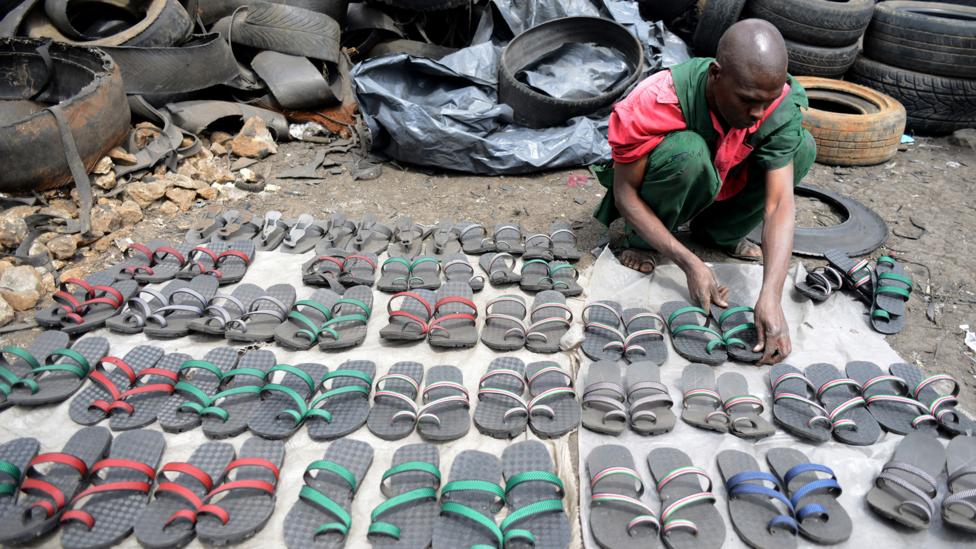
It may seem incongruous to think of discarded rubber car tires as the source of fetching but functional footwear or fashion-forward furniture.

In Kenya, recycled tires become tough, inexpensive sandals called akalas
In Kenya, discarded tires become tough, inexpensive sandals called akalas.
 (Simon Maina/AFP/Getty Images)

But from Kenya to India to Detroit to Sweden, clever and eco-minded niche entrepreneurs are turning one of industrialized society’s most ubiquitous and difficult-to-dispose-of waste products (an estimated 1.5 billion tires are discarded each year worldwide) into weirdly appealing – and super-tough – items with a little bit of, um, soul.
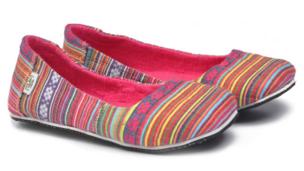
These shoes from e-tailer soleRebels feature hand-cut outsoles made from discarded tires.
From e-tailer soleRebels, the $80 "tooTOOs" shoe. (soleRebels.com)
Enterprising locals in Kenya have made a cottage industry out of hand-crafting so-called akala sandals from the “pelts” of old car tires. They sell on the streets of Nairobi for anywhere from $2 to $5 a pair – considerably less than retail footwear sold nearby, and boasting 10 times the longevity.
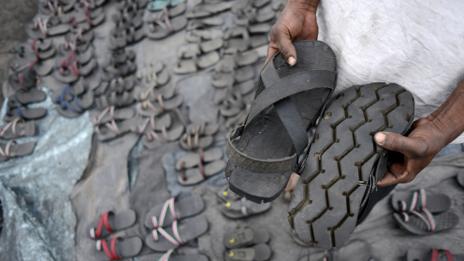
In fact, Maasai tribesmen, who roam southern Kenya and northern Tanzania, have commonly worn these durable sandals – also known as “thousand-milers” – for decades to walk through brush tougher than rhino hide. And the footwear is trending mainstream as you read this, at e-tailers like Maasai Treads and Akala Sandals and soleRebels, whose $80 "tooTOOs" womens shoes, which feature outsoles made of hand-cut discarded tire treads, are pictured above.
Then there is Detroit Threads, where the Reverend Faith Fowler ripped a page from the thousand-miler pagebook. At Cass Community Social Services in Detroit, she employs dozens of workers who turn old tires – the group’s Green Industries division collects about 35,000 discards a year – into $25 flip-flops with some serious tread life. Aimed at urban hipsters who are tired of the same old look, the sandals are designed by students at the University of Michigan in Ann Arbor and the College for Creative Studies in Detroit.
In Mumbai, India, ground-floor entrepreneur Anu Tandon Vieira established The Retyrement Plan, where workers morph old tires and other recycled waste materials into weatherproof outdoor furniture that will inflate the ambience of any patio or three-season room.
On a whole other plane, a Swedish company, Apokalyps Labotek, is making durable and stylish flooring out of the 4m tires discarded nationally there each year. The company grinds the tires into a powder and through some sort of modern alchemy, mixes it with recycled plastic and – voilà! – creates parquet flooring as tough as a thousand-miler sandal. Tread lightly? No way.
Now, it’s true that Bridgestone and other tire companies are trying to develop an airless, recyclable tire that would end the disposal dilemma posed by rubber tires, which are tougher to get rid of than a Volkswagen Beetle. But rest easy – there’s no need to rush out and stock up on akalas. It’s estimated that billions of old car tires remain stockpiled around the world, so this is one recyclable resource that’s not disappearing any time soon.
Kenyans commonly refer to akala sandals as "thousand-milers". 

(Simon Maina/AFP/Getty Images)

From BBC-http://www.bbc.com/autos/story/20140802-discarded-tires-tread-again

Saturday, November 23, 2013

Aluminium: The metal that just keeps on giving

Two hundred years ago, no-one knew aluminium existed. Today it is everywhere - in cans, window frames, packaging, even car bodies. New uses for it are constantly being discovered - but it's possible that one day we'll be able to stop mining the ore, and rely completely on recycling.

crushed aluminium cans
A couple of months from now you could be driving these around on the streets

Aluminium has a split personality.
It may look dull, but it is one of the most reactive metals in the periodic table.
"Aluminium fires are quite terrifying," says Andrea Sella, chemistry professor at University College London.
"When you take aluminium and you burn it, you get a very, very intense fire."
From that point of view, it may not be ideal for aircraft construction - but this disadvantage is outweighed by its strength, flexibility and exceptional lightness.
The soft, malleable metal's alter ego is aluminium oxide, which forms a skin on the pure metal the moment it is exposed to air (and makes it unlikely that an aircraft will catch fire).
This oxide is so hard that it is used to make sandpaper and other abrasive materials.

Aluminium - key facts

Aluminium - symbol, atomic number and weight
  • Soft, non-magnetic metal
  • Symbol: Al
  • Atomic number: 13
  • Weight: 26.98
  • 3rd most abundant element in Earth's crust after oxygen and silicon
  • Found mainly as bauxite
  • Yearly primary aluminium production: 53.4m tonnes
  • Increasingly recycled
  • Used in transport, packaging, construction and household goods
Among gemstones, sapphires - crystals formed from the oxide - are second only to diamonds in their hardness.
Indeed, there is a growing industry for manufacturing industrial sapphires the size of a large bucket, suitable for use in bullet-proof glass, aeroplane windows and soon -unscratchable smartphone displays.
Although Aluminium is the third most abundant element in the earth's crust, it was not isolated until 1825, and remained so scarce that it was valued more highly than silver for decades.
The reason it remained hidden for so long, unlike gold or silver, is that it is too reactive to be occur in its pure form.
Instead it is found as bauxite, a reddish-brown ore named after the French town Les Baux, where it was first discovered.
Bauxite is found across the globe, and mining it is the easy part. Far trickier is extracting the metal. It was not until 1886 that a Frenchman and an American both cracked it.
Bauxite is processed at the Compagnie des Bauxites de Guinee  factory, Kamsar, Guinea Bauxite is mined all over the world, from Australia to Brazil to India to Guinea
You have to melt the bauxite in another mineral called cryolite, and then pass an electric current through it, separating the oxygen atoms from the aluminium. It takes four tonnes of bauxite to produce one tonne of aluminium.
The process is highly energy-intensive and therefore expensive.

Baked sapphire

Freshly baked industrial sapphire
  • Naturally-occurring sapphires can take 50,000 years to form
  • Now they can be baked in a week, in ovens made of molybdenum and tungsten - which unlike steel do not melt at 2,200C
  • A sapphire hard drive is reported to have been developed that can store information on nuclear waste dumps for up to a million years - enough time for safe radioactive decay
But recycling aluminium uses a fraction of the energy.
"Beverage cans get recycled within 60 days, so a can of soda is back on the shelves 60 days later," says Nick Madden, who is responsible for buying raw metal for Novelis, the world's biggest manufacturer of rolled aluminium sheets.
Once you have the metal, you can re-use it again and again, almost indefinitely.
"It is one of the few materials that is genuinely 100% recyclable," Madden says.
In theory, a day may come when we have mined all we need, and we can just keep re-using what we already have.
"If demand stops growing, and scrap comes back from older uses like buildings in the future, then that will start to reduce the required primary consumption," says Madden.
For now, though, demand is growing, and carmakers are one reason why. Lighter car bodies mean more fuel efficiency, better acceleration and braking, and lower carbon emissions.
Range Rover car bodies and workers at Jaguar Land Rover, Solihull, UK A new aluminium Range Rover in the making - minus the family
Novelis has seen a 25% increase in demand from the motor industry in the last year, most of it coming from one of its biggest customers, Jaguar Land Rover, which has just begun manufacturing Range Rovers with aluminium.

The new car uses use 25% less fuel partly because its body is 39% lighter, helping to reduce the car's total weight by 420kg (925lb).
"That's the equivalent of five people," says Nick Rogers, the Range Rover vehicle line director.
"So, if you imagine driving around with all your family in the car - you feel the weight of the vehicle.
"When you get in the new Range Rover Sport, all of your family has gone."
Currently, Novelis obtains almost 50% of its aluminium used to make a new Range Rover from junk - empty cans, scrapped vehicles, demolition sites - and it aims to raise that to 80% by 2020.
One challenge is to ensure that more aluminium finds its way into the recycling loop.
"In the UK, I believe the recycle rate [of household aluminium waste] is about 75%," Madden says.
Whether bauxite mining is still needed in our grandchildren's day may depend on the proportion we succeed in recycling, and whether we keep coming up with new uses for aluminium - either the light, malleable metal, or the hard almost unscratchable sapphire.

From BBC news


Saturday, July 13, 2013

The recycling technology being embraced by manufacturers

More and more of us are recycling our waste at home in a bid to save resources - but could manufacturers do more themselves, by using recycled products as their raw materials in the first place?


First up, a recycling bicycle, or 'The Ingenio', as its creator, Victor Monserrate calls it. The Puerto Rican design student at London's Royal College of Art has created a customised bicycle that turns discarded plastic containers into a plastic thread. This is more valuable to the people who scour scrap yards in developing countries, because it can be sold on to craftsmen to make objects like chairs and baskets. He hopes NGOs will help him to roll out the device.
When he found out that carpet producers waste about 7% of the wool they use, New Zealander Dan Mclaughlin was inspired to create something new with it: he calls it 'BioWool'. It is a polymer created by combining waste wool with a bioresin. With funding from the James Dyson Foundation, he has begun work on putting this into production, with a range of applications possible.
Finally, Rob McDougall of Italian lighting manufacturers Artemide showed off his company's collaboration with Japanese fashion designer Issey Miyake and his Reality Lab. Together they have created a range of lights called 'IN-EI'. The fabric of the lights looks like paper, and the lights themselves appear constructed like origami - but they are in fact made from recycled plastic bottles.
Video Journalist: Dougal Shaw
From BBC magazine

Wikipedia

Search results