To my dear visitors and commenters

Hi, everybody! I've noticed with lots of joy and happiness, that thousands of comments have been written in my posts. It's wonderful that so may people around the world appreciate my work. Therefore, I want to thank you for that and ,at the same time I want to ask you to be this blog's followers. It's fast and easy! Make it be even more visited and spread all over the world! I'm a woman, a teacher of English in Portugal, and I've been away for quite a long time because of my father's health. Unfortunately he died from Covid19 a few months ago. Now I felt it was time to restart my activity in this and other blogs I owe. I've recently created a new one in a partnership with a street photographer, Mr. Daniel Antunes. He's fabulous! https://pandpbydandd.blogspot.com I'd like you to visit it and, who knows, become our followers. The poems, chronicles and thoughts are all mine. Thank you so much! Kisses :-)

Search This Blog

Showing posts with label Space. Show all posts

Saturday, February 20, 2016

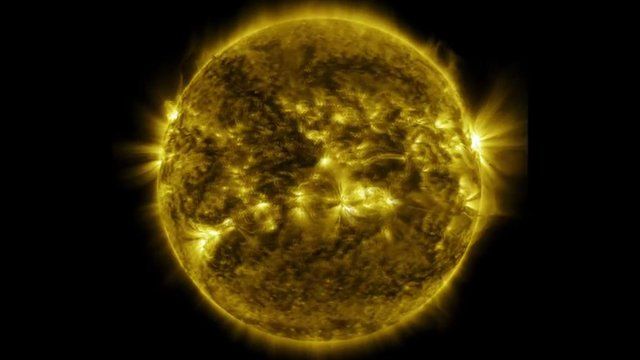
Awesome time-lapse of the sun over a year


This amazing timelapse footage of the sun was filmed over a whole year by the NASA
It was released to mark the six year anniversary of Nasa's Solar Dynamics Observatory, which was set up to capture changes in the sun. A photo was taken every 12 seconds over the course of a year.
(CBBC Newsround)


NASA’s Solar Dynamics Observatory (SDO) is always following the sun as it orbits the Earth. As part of its ongoing mission, the SDO captures high-resolution images of the sun at regular intervals, allowing scientists to monitor solar activity such as sun spots, solar flares, and coronal mass ejections. NASA’s multi-year mission just completed its sixth year of data collection and commemorated that milestone by releasing a stunning time-lapse video of the past year in review.
The six-minute video shows the sun over a period of just over a year, starting from January 1, 2015 and ending on January 28, 2016. The first half of the video shows the time-lapse with some celestial-inspired background music, while the second half explains the features and wavelengths that you are seeing. The ultra-high-definition images are shown on YouTube at a rate of approximately 30 frames per second with a resolution of 3,840 by 1,260 pixels. Each frame of the video corresponds to 2 hours of time on Earth. On its website, NASA also provides a downloadable version of the video that has a 59.94 fps frame rate with each frame representing one hour.

Friday, February 12, 2016

Einstein's gravitational waves 'seen' from black holes 100 years after his prediction

Scientists have made a huge discovery about the universe - they have detected the waves made after two black holes collided.

Black holes can't be seen, but scientists know they exist because of the way they move things around them in the universe.
In a far away galaxy, two black holes smashed together more than a billion years ago.
The shock waves from this crash have just reached earth, and scientists were able to detect the signal for the first time.

Prof. Stephen Hawking says discovery of gravitational waves provides ‘completely new way


They have observed the warping of space-time generated by the collision of two black holes more than a billion light-years from Earth.
The international team says the first detection of these gravitational waves will usher in a new era for astronomy.
It is the culmination of decades of searching and could ultimately offer a window on the Big Bang.
The research, by the Ligo Collaboration, has been published today in the journalPhysical Review Letters.
The collaboration operates a number of labs around the world that fire lasers through long tunnels, trying to sense ripples in the fabric of space-time.
From BBC News

Wednesday, January 20, 2016

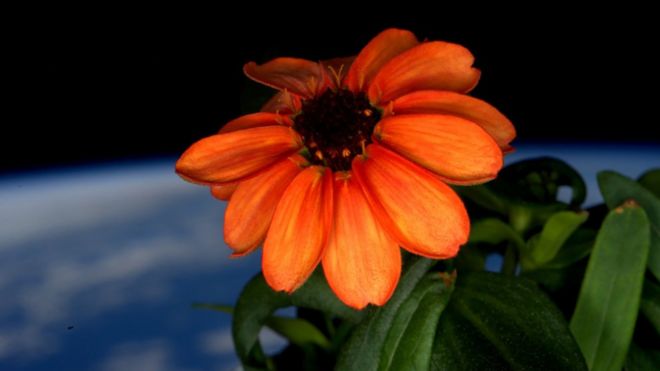
First flower blooms in space on International Space Station

Astronauts have grown the first flower in space on-board the International Space Station.

Zinnia blooming in space
The zinnia flower is the first to grow in space
The orange zinnia flowers can be eaten and were grown in the 'Veggie' laboratory, which was installed on the space station in 2014.
Growing their own food in space is a big step for astronauts because it means they could go on longer missions in the future.
They've grown lettuce before but the zinnia is the first to bloom flowers.
It shows that it may be possible to grow other flowering crops like tomatoes.
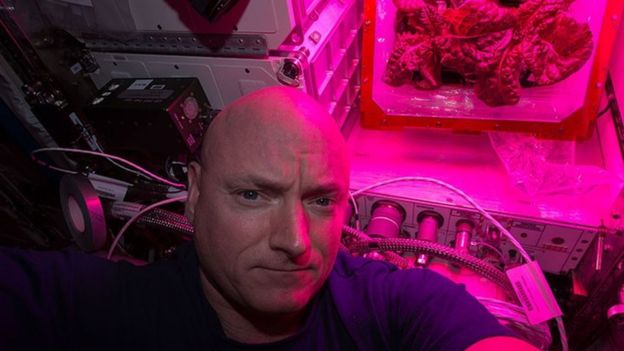
Scott Kelly with lettuce on ISS
Scott Kelly took this selfie with his crop of lettuce in the Veggie Laboratory
Growing plants in space might be trickier than you think - watering flowers is much more difficult in a place without gravity!
Another problem was that the high levels of moisture in the air inside the space station led to mould growing on some leaves.
The astronauts cleaned the plants, cut away the mouldy leaves, and set up a fan to try and dry out the crop. But the high speed fan did its job a bit too well, and the plants got too dry.
Astronaut Scott Kelly took charge of the flowers, and worked hard to revive them over Christmas, and on 12 January, a few petals started to peak out.
When the flowers finally bloomed, Scott shared the photo saying 'first ever flower grown in space makes its debut!'
From CBBC Newsround

Wikipedia

Search results