To my dear visitors and commenters

Hi, everybody! I've noticed with lots of joy and happiness, that thousands of comments have been written in my posts. It's wonderful that so may people around the world appreciate my work. Therefore, I want to thank you for that and ,at the same time I want to ask you to be this blog's followers. It's fast and easy! Make it be even more visited and spread all over the world! I'm a woman, a teacher of English in Portugal, and I've been away for quite a long time because of my father's health. Unfortunately he died from Covid19 a few months ago. Now I felt it was time to restart my activity in this and other blogs I owe. I've recently created a new one in a partnership with a street photographer, Mr. Daniel Antunes. He's fabulous! https://pandpbydandd.blogspot.com I'd like you to visit it and, who knows, become our followers. The poems, chronicles and thoughts are all mine. Thank you so much! Kisses :-)

Search This Blog

Saturday, January 24, 2015

The Great Barrier Reef- Australia

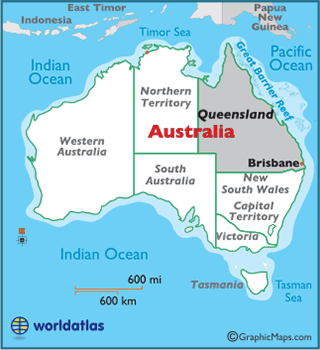
locator map of Queensland

The Great Barrier Reef is the world's largest coral reef system composed of over 2,900 individual reefs and 900 islands stretching for over 2,300 kilometres (1,400 mi) over an area of approximately 344,400 square kilometres (133,000 sq mi). The reef is located in the Coral Sea, off the coast of Queensland, Australia.


The Great Barrier Reef can be seen from outer space and is the world's biggest single structure made by living organisms. This reef structure is composed of and built by billions of tiny organisms, known as coral polyps. It supports a wide diversity of life and was selected as a World Heritage Site in 1981. CNN labeled it one of the seven natural wonders of the world. The Queensland National Trust named it a state icon of Queensland.


A large part of the reef is protected by the Great Barrier Reef Marine Park, which helps to limit the impact of human use, such as fishing and tourism. Other environmental pressures on the reef and its ecosystem include runoff, climate change accompanied by mass coral bleaching, and cyclic population outbreaks of thecrown-of-thorns starfish. According to a study published in October 2012 by the Proceedings of the National Academy of Sciences, the reef has lost more than half its coral cover since 1985.
The Great Barrier Reef has long been known to and used by the Aboriginal Australian and Torres Strait Islander peoples, and is an important part of local groups' cultures and spirituality. The reef is a very popular destination for tourists, especially in the Whitsunday Islands and Cairns regions. Tourism is an important economic activity for the region, generating over $3 billion per year.
In November 2014, Google launched Google Underwater Street View in 3D of the Great Barrier Reef.
In Wikipedia

Wednesday, January 21, 2015

Protecting Great Barrier Reef 'needs A$785m' fund

Australia's Great Barrier Reef needs an investment of at least A$785m ($643m, £426m) over five years to protect it from pollution, a report says.

Great Barrier Reef
Scientists have long been warning of threats to the unique wildlife in the Great Barrier Reef

Climate change and water pollution were acting as a "double whammy" on the reef's health, said the report compiled by natural resource management groups.
The report called for co-operation from farmers and rigorous coastal planning.
The reef, a major tourist destination and a rich marine habitat, faces many threats to its eco-system.
Rising sea temperatures and pollution from agriculture are believed to be among the biggest dangers.
Among other threats, the latest report highlighted the destruction of coral by outbreaks of Crown of Thorns starfish, which were caused by nitrogen run-offs from farms.
Great Barrier Reef
The Great Barrier Reef is the world's largest coral reef
The Reef Regions Investment Plan, prepared by six natural resource management groups operating in the state of Queensland, found that floodplains, their wetlands, and estuaries and their habitats were the most degraded parts of the reef's eco-system.
"Managing, repairing and protecting the reef is not a start-stop-restart activity," said the authors of the report.
They called for secure investment, as well as five-yearly progress reviews and the "readjustment of priorities and investment profile in the context of review findings".
The report also reviewed the Australian government's plan to protect the reef, the Reef 2050 Long-Term Sustainability Plan.
It suggested that many of the targets in the plan are ambitious, especially without further investment.
The reef's environment is expected to come under further strain with the proposed expansion of ports to export coal.
From BBC News

Tuesday, January 20, 2015

India's tiger population sees 30% increase

India says it now has almost a third more tigers than it did four years ago.


A Royal Bengal Tiger pauses in a jungle clearing in Kaziranga National Park, east of Guwahati, India - 21 December 2014
India said it was willing to donate tiger cubs to the international community to help conservation efforts
Presenting the findings of the latest tiger census, Environment Minister Prakash Javadekar said the tiger population had risen from 1,706 in 2011 to 2,226 in 2014.
He said a number of government initiatives to streamline tiger conservation were behind the increase.
India is estimated to be home to around 70% of the world's tigers.
Mr Javadekar described the results of the census as a "huge success story".
'Great news'
"Never before has such an exercise been taken on such a massive scale where we have unique photographs of 80% of India's tigers," he told journalists in New Delhi.

"While the tiger population is falling in the world, it is rising in India. This is great news," he added.
Tiger conservation practices that had proved successful in India could be adopted elsewhere, he suggested.
He also said India was willing to donate tiger cubs to the international community and play a key role in global tiger conservation.
Wildlife campaigners had been expressing concerns over dwindling numbers of tigers for some time.
The Times of India says that as recently as 2008, census figures showed a tiger population of just 1,411.
From BBC news

Saturday, January 17, 2015

Wind power 'adds resilience to UK energy market'

Wind turbine, Scotland (Image: PA)
Installing more wind turbines will make the UK's energy market more resilient to global fossil fuel price shocks, an independent report has concluded.

Dwindling domestic gas and coal supplies mean the nation would become dependent on volatile imports, it adds.The report, by Cambridge Econometrics for RenewableUK, said wind power saved the UK £579 million in fossil fuel costs in 2013.The UK is recognised for having the best wind resource in Europe."One of the main messages from this report is that in a scenario with a higher content of wind energy, you are less reliant on fossil fuels," explained co-author Sophie Billington, a researcher from Cambridge Econometrics.
"This is a key message, particularly when you consider that the UK - for the past five years or so - has imported more gas than it has produced domestically."
She told BBC News that under a high gas scenario (gas power plants replacing end-of-life coal and nuclear plants) and a 40% increase in gas prices by 30%, electricity prices would increase by 8%.However, under a high wind scenario (wind farms replacing end-of-life coal and nuclear plants), electricity prices would still rise but by only 4%.
"For the wind scenario, you have higher upfront capital costs but fewer uncertain variable costs, leading to more price resilience," Ms Billington added.
The report said that the UK electricity sector had undergone a substantial change in recent decades, shifting from a coal-based system to a more balanced mix "encompassing nuclear and gas-fired power stations, as well as emerging renewable energy technologies".
It observed: "Over the next 10 to 20 years, the energy sector will need to be re-shaped again if the UK's targets to reduce CO2 emissions are to be met."
Offshore wind turbine (Image: PA)
The UK is a world leader in offshore wind, with as much generation capacity as the rest of the world combined
In 2008, the UK established the world's first legally binding climate change target, requiring governments to reduce greenhouse gas emissions by at least 80% from 1990 levels by 2050.
Rob Norris, RenewableUK's head of communications, said that currently there were "not enough renewables in the system to meet those targets".
He told BBC News: "The crucial thing is that energy policy is a long-term game and at the moment we only really know what the government support will be out to 2020.
"What you really need is a long-term vision out to 2030 so then you can plan, especially when it comes to things like large offshore developments."
Mr Norris said he advocated a "rich energy mix so then you do not put all your eggs in one basket".
He added: "If you have different technologies, including renewables, competing against each other then the cost is driven down for the consumer."
From BBC Sci/Environement


Friday, January 16, 2015

The geese that can conquer Mount Everest

Bar-headed goose in flight (Photo Nyambayar Batbayar)

A tracking study has revealed the secrets of the Himalayan flight of the bar-headed goose - the world's highest bird migration.
The geese have been recorded at heights of more than 7,000m (23,000 ft) and mountaineers have claimed they have seen the birds fly over Mount Everest.
Their ability to fly in such extreme conditions has fascinated scientists for decades, as the BBC's science reporter Victoria Gill reports. (BBC News)


A pale grey goose with an orange beak and legs and two striking black bars on the head. It lives in central Asia. It is monotypic (males and females look the same) and mates for life.
The bar-headed goose is famous as it is widely believed to make the highest altitude migration on earth. While there was an anecdotal report of a flock of bar-headed geese being heard flying over Mt Makalu (the fifth highest mountain on earth), an unconfirmed report of them being seen flying over Everest has become legend. Such a migration would be incredibly demanding – at altitude the ambient pressure is dramatically reduced, meaning that there is less oxygen available and that the air can support less lift for flight (particularly for species that flap, like geese). This has puzzled biologists and physiologists for years:
"there must be a good explanation for why the birds fly to the extreme altitudes... particularly since there are passes through the Himalaya at lower altitudes, and which are used by other migrating bird species" Black & Tenney (1980).
As part of a large international research project, led by Bangor University and primarily supported by the BBSRC (grant BB/F015615/1) and the Max Planck Institute, bar-headed geese have now been GPS tracked flying over the Himalaya and data reveal that they do not normally fly higher than 6,300 m elevation, flying through the Himalayan passes rather than over the peaks of the mountains. This altitude is clearly still very impressive (equivalent to Everest Camp II) and challenges even the fittest human climbers. Without proper acclimatisation to such altitudes, mammals suffer from high altitude related sickness very quickly, and in some cases this can be fatal.

Bar-headed geese don’t need the wind

It has also been long believed that bar-headed geese use jet stream tail winds to facilitate their flight across the Himalaya. Surprisingly, latest research has shown that despite the prevalence of predictable tail winds that blow up the Himalayas (in the same direction of travel as the geese), bar-headed geese spurn the winds, waiting for them to die down overnight, when they then undertake the greatest rates of climbing flight ever recorded for a bird, and sustain these climbs rates for hours on end.

How can they cope?

Bar-headed geese are known to have a suite of physiological adaptations to help them deal with the low Oxygen (hypoxia) conditions at altitude:
  1. Bar-headed geese have a slightly larger wingspan and lower wing loading than other similar goose species (Lee et al. 2008), yielding greater lift and reducing the power required for flight (Pennycuick 1972).
  2. Their flight muscle is better supplied with fresh oxygenated blood than other waterfowl (Fedde et al. 1985, Snyder et al. 1984, Scott et al. 2009).
  3. Bird lungs are superior to mammalian lungs, having a counter exchange system, which extracts O2 much more efficiently (Ramirez et al. 2007) and they are larger in bar-headed geese than in other species of waterfowl (Scott et al. 2009).
  4. In hypoxic conditions, bar-headed geese can hyperventilate 7.2 times faster than their rate at sea level, and suffer no ill effects as a result of this (which increases blood pH – in humans this makes us restrict blood flow to the brain, causing a dizzy sensation).
  5. Bar-headed geese can also increase cardiac output (heart rate and volume of blood pumped) in hypoxia to 5 times the rate at sea-level when resting (Black & Tenney 1980, although note this can also occur in low altitude bird species too).
  6. Their haemoglobin is also adapted to load more O2 to the blood than most other vertebrates (Hiebl & Braunitzer 1988, Weber et al 1993, Liang et al. 2001).

More information


Wikipedia

Search results