To my dear visitors and commenters

Hi, everybody! I've noticed with lots of joy and happiness, that thousands of comments have been written in my posts. It's wonderful that so may people around the world appreciate my work. Therefore, I want to thank you for that and ,at the same time I want to ask you to be this blog's followers. It's fast and easy! Make it be even more visited and spread all over the world! I'm a woman, a teacher of English in Portugal, and I've been away for quite a long time because of my father's health. Unfortunately he died from Covid19 a few months ago. Now I felt it was time to restart my activity in this and other blogs I owe. I've recently created a new one in a partnership with a street photographer, Mr. Daniel Antunes. He's fabulous! https://pandpbydandd.blogspot.com I'd like you to visit it and, who knows, become our followers. The poems, chronicles and thoughts are all mine. Thank you so much! Kisses :-)

Search This Blog

Saturday, January 31, 2015

Poor outlook for Borneo's mammals

Half of Borneo's mammals will see their habitats shrink by at least a third by 2080, according to a study.

The Sunda clouded leopard Neofelis diardi photographed in the Deramakot Forest Reserve in Sabah Malaysian Borneo
The Sunda clouded leopard photographed in the Deramakot Forest Reserve in Sabah Malaysian Borneo

By then, twice as many mammals as now will be at risk of extinction, say conservationists.
Climate change, loss of rainforest and hunting is a threat to many rare mammals on the island.
But there is hope for species like the orang-utan if action is taken to focus conservation efforts on upland areas, scientists report in Current Biology.
Borneo is the world's third largest island, accounting for 1% of the world's land yet about 6% of global biodiversity.
The island has already lost over half its forests, a third disappearing in the last three decades.
A team led by researchers at the Durrell Institute of Conservation and Ecology, University of Kent, UK, used modelling and satellite images to predict where rainforest will be lost over the next 65 years, based on predictions of climate change and changes in land use.
Working with institutes in Germany, Australia and Indonesia, they mapped the likely suitable habitat for each of 81 Bornean mammals.
They found that deforestation and climate change would lead to 30-49% of mammals losing at least a third of their habitat by 2080.
Endangered Bornean orang-utan  photographed in a mining area in Kalimantan, Indonesian Borneo
Endangered Bornean orang-utan photographed in a mining area in Kalimantan, Indonesian Borneo
This would put at least 15 carnivores, 8 primates and 21 bat species at risk of extinction by 2080, almost doubling the proportion of threatened mammals on the island, according to the research.
But there is hope that better forestry management for conservation outside existing reserves could curb this loss, said lead researcher Dr Matthew Struebig.
"Only a modest amount of additional land on Borneo (~28,000 km2, or 4% of the island) would be needed to safeguard many mammal species against threats from deforestation and climate change."
The logging industry had a major role to play in conservation, given that they manage much of the land, he added.
And since deforestation and climate change is likely to have the biggest impact on lowland forests, it made sense to target efforts to forests at higher elevations.
Special efforts are needed for species like the flying fox and otter civit that would be unable to adapt to higher altitudes, said Dr Struebig.
"It is not so much that species would be doomed, but more that their area requirements would unlikely be met in the land available for conservation," he explained.
Writing in the journal Current Biology, the researchers described the outlook as "pessimistic", but said improving conservation outside existing reserves could help meet biodiversity goals.
From BBC News

Wednesday, January 28, 2015

Beavers allowed back in the wild in south west England

The first beavers found living in the wild in England for 500 years, will be allowed to stay where they are.


The animals, on the River Otter in Devon in south west England, can remain in the wild, as long as they're free of disease.
Beavers were hunted to extinction in England five centuries ago, because their fur and oil were very valuable.
This is the first time permission's been given to re-introduce a mammal previously extinct in England.
The animals, on the River Otter in Devon in south west England, can remain in the wild, as long as they're free of disease.Beavers were hunted to extinction in England five centuries ago, because their fur and oil were very valuable.This is the first time permission's been given to re-introduce a mammal previously extinct in England.
beavers in the River Otter


At least three youngsters and eight adults have been spotted living wild in the River Otter, DevonOne theory is that it was the work of "beaver bombers" - wildlife campaigners who illegally release animals in to the wild.

Five-year trial

The government has decided to allow the Devon Wildlife Trust to manage these animals, for a five-year trial.

The animals must first be caught and tested to make sure they are a European species, and free from a parasite called tapeworm..

'Not an easy decision'

Beavers are known as the engineers of the waterways and can have a massive impact on their environment as they fell trees to build their dams and lodges.Their dams slow the rivers which filters the water and this provides other places for wildlife to thrive.

tree trunk gnawed by beavers

Beavers gnaw trees like this to get to young green shoots at the top
However other people say that blocking up the river with dams in some places, could cause problems with flooding and could harm fish migration.

From CBBC newsround

Saturday, January 24, 2015

The Great Barrier Reef- Australia

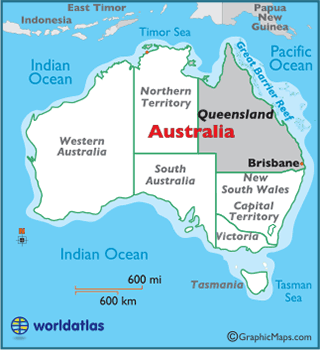
locator map of Queensland

The Great Barrier Reef is the world's largest coral reef system composed of over 2,900 individual reefs and 900 islands stretching for over 2,300 kilometres (1,400 mi) over an area of approximately 344,400 square kilometres (133,000 sq mi). The reef is located in the Coral Sea, off the coast of Queensland, Australia.


The Great Barrier Reef can be seen from outer space and is the world's biggest single structure made by living organisms. This reef structure is composed of and built by billions of tiny organisms, known as coral polyps. It supports a wide diversity of life and was selected as a World Heritage Site in 1981. CNN labeled it one of the seven natural wonders of the world. The Queensland National Trust named it a state icon of Queensland.


A large part of the reef is protected by the Great Barrier Reef Marine Park, which helps to limit the impact of human use, such as fishing and tourism. Other environmental pressures on the reef and its ecosystem include runoff, climate change accompanied by mass coral bleaching, and cyclic population outbreaks of thecrown-of-thorns starfish. According to a study published in October 2012 by the Proceedings of the National Academy of Sciences, the reef has lost more than half its coral cover since 1985.
The Great Barrier Reef has long been known to and used by the Aboriginal Australian and Torres Strait Islander peoples, and is an important part of local groups' cultures and spirituality. The reef is a very popular destination for tourists, especially in the Whitsunday Islands and Cairns regions. Tourism is an important economic activity for the region, generating over $3 billion per year.
In November 2014, Google launched Google Underwater Street View in 3D of the Great Barrier Reef.
In Wikipedia

Wednesday, January 21, 2015

Protecting Great Barrier Reef 'needs A$785m' fund

Australia's Great Barrier Reef needs an investment of at least A$785m ($643m, £426m) over five years to protect it from pollution, a report says.

Great Barrier Reef
Scientists have long been warning of threats to the unique wildlife in the Great Barrier Reef

Climate change and water pollution were acting as a "double whammy" on the reef's health, said the report compiled by natural resource management groups.
The report called for co-operation from farmers and rigorous coastal planning.
The reef, a major tourist destination and a rich marine habitat, faces many threats to its eco-system.
Rising sea temperatures and pollution from agriculture are believed to be among the biggest dangers.
Among other threats, the latest report highlighted the destruction of coral by outbreaks of Crown of Thorns starfish, which were caused by nitrogen run-offs from farms.
Great Barrier Reef
The Great Barrier Reef is the world's largest coral reef
The Reef Regions Investment Plan, prepared by six natural resource management groups operating in the state of Queensland, found that floodplains, their wetlands, and estuaries and their habitats were the most degraded parts of the reef's eco-system.
"Managing, repairing and protecting the reef is not a start-stop-restart activity," said the authors of the report.
They called for secure investment, as well as five-yearly progress reviews and the "readjustment of priorities and investment profile in the context of review findings".
The report also reviewed the Australian government's plan to protect the reef, the Reef 2050 Long-Term Sustainability Plan.
It suggested that many of the targets in the plan are ambitious, especially without further investment.
The reef's environment is expected to come under further strain with the proposed expansion of ports to export coal.
From BBC News

Tuesday, January 20, 2015

India's tiger population sees 30% increase

India says it now has almost a third more tigers than it did four years ago.


A Royal Bengal Tiger pauses in a jungle clearing in Kaziranga National Park, east of Guwahati, India - 21 December 2014
India said it was willing to donate tiger cubs to the international community to help conservation efforts
Presenting the findings of the latest tiger census, Environment Minister Prakash Javadekar said the tiger population had risen from 1,706 in 2011 to 2,226 in 2014.
He said a number of government initiatives to streamline tiger conservation were behind the increase.
India is estimated to be home to around 70% of the world's tigers.
Mr Javadekar described the results of the census as a "huge success story".
'Great news'
"Never before has such an exercise been taken on such a massive scale where we have unique photographs of 80% of India's tigers," he told journalists in New Delhi.

"While the tiger population is falling in the world, it is rising in India. This is great news," he added.
Tiger conservation practices that had proved successful in India could be adopted elsewhere, he suggested.
He also said India was willing to donate tiger cubs to the international community and play a key role in global tiger conservation.
Wildlife campaigners had been expressing concerns over dwindling numbers of tigers for some time.
The Times of India says that as recently as 2008, census figures showed a tiger population of just 1,411.
From BBC news

Wikipedia

Search results