To my dear visitors and commenters

Hi, everybody! I've noticed with lots of joy and happiness, that thousands of comments have been written in my posts. It's wonderful that so may people around the world appreciate my work. Therefore, I want to thank you for that and ,at the same time I want to ask you to be this blog's followers. It's fast and easy! Make it be even more visited and spread all over the world! I'm a woman, a teacher of English in Portugal, and I've been away for quite a long time because of my father's health. Unfortunately he died from Covid19 a few months ago. Now I felt it was time to restart my activity in this and other blogs I owe. I've recently created a new one in a partnership with a street photographer, Mr. Daniel Antunes. He's fabulous! https://pandpbydandd.blogspot.com I'd like you to visit it and, who knows, become our followers. The poems, chronicles and thoughts are all mine. Thank you so much! Kisses :-)

Search This Blog

Showing posts with label Environmental disasters. Show all posts

Friday, March 18, 2016

Great Barrier Reef coral 'bleaching' level increased

Authorities in Australia have raised the threat level for coral 'bleaching' in the Great Barrier Reef, after divers found that lots of coral had died.

Divers
The Great Barrier Reef is the world's largest living structure, and is home to thousands of plants and animals - it is so big it can even be seen from space.
Divers have found that an increase in the sea's temperature has been putting the coral which grows there under a lot of stress causing 'bleaching', which means a loss of colour.
bleached coral

What is bleaching?

Many types of coral have a special relationship with tiny algae that live in the coral.
These tiny algae produce about 90% of the food the coral needs to grow, and give them their bright colours.
Bleaching happens when sea temperatures get too high or low, causing the algae to get 'stressed out' and leave the coral.
This turn the coral white and leaves it very vulnerable.
An increase of just one degree Celsius for four weeks can cause bleaching. If this continues for more than eight weeks, the coral can die.
diver looking at coral bleaching

Has this happened before?

In 2002 the surface temperature of the sea water in the Great Barrier Reef increased by around 2-3 degrees causing one of the worst bleaching incidents on record, affecting more than 60% of the coral.
While some coral reefs can recover from bleaching in a few years, others don't recover at all.
The Great Barrier Reef Marine Park Authority have now raised the bleaching threat level, and have said that there is a very high risk of mass coral bleaching this month.
The Australian government said it is working closely with the marine rangers to help keep an eye on the coral for the next few months to see how it is doing.
From CBBC Newsround

Friday, March 04, 2016

Poaching for ivory stabilises but elephant decline continues

The number of elephants being killed for their ivory has stabilised but overall species numbers have continued to decline.

elephant
Another elephant killed for its tusks, this time in the Democratic Republic of Congo

Data produced for 2015 shows that poachers are still killing more elephants than are born every year.
The report also highlighted a rising trend in poaching in South Africa's Kruger National Park, considered one of the safest havens.
But there was positive news from Eastern Africa where elephant number have outpaced poachers for the fourth year in a row.

Peak deaths

The Convention on the Trade in Endangered Species of Wild Fauna and Flora(CITES) compiles an authoritative set of figures on the annual trends in elephant numbers.
Called MIKE (Monitoring the Illegal Killing of Elephants), the latest data indicate that the rise in the numbers of elephant deaths, witnessed since 2006, peaked in 2011.
Since then the numbers have stabilised but the level remains "unacceptably high overall".
In 2015, the programme recorded the deaths of 14,606.
The researchers estimate that half of these were illegally killed putting the population well above the sustainability threshold, where deaths outweigh births.
"African elephant populations continue to face an immediate threat to their survival from unacceptably high levels of poaching for their ivory, especially in Central and West Africa where high levels of poaching are still evident," said John Scanlon, CITES Secretary General.
"There are some encouraging signs, including in certain parts of Eastern Africa, such as in Kenya, where the overall poaching trends have declined, showing us all what is possible through a sustained and collective effort with strong political support."


Kruger elephant
An elephant in Kruger National Park in South Africa, which saw a rise in killings in 2015
The mixed picture for the iconic species continued in Southern Africa. The overall levels of poaching remained below the sustainability threshold, but an upward trend in killing was seen in Kruger National Park for the first time.
CITES have demanded that the 19 countries most heavily involved in the killing of elephants or the consumption of ivory produce national ivory action plans to show how they plan to tackle the issue.
From BBC News- Science / Environment


Friday, December 04, 2015

COP21: Vanuatu voices from disappearing islands

Vanuatu is on the front line in the climate change debate, with rising sea levels putting the very future of the low-lying archipelago in jeopardy.

Islanders hope some sort of deal can be reached at the climate change conference Paris to make sure that whatever happens, their home will be as well prepared as possible.
They raised their concerns with the BBC's Matthew Price. (BBC Science/Environment)


Saturday, October 10, 2015

Flammable foam hits the streets of Bangalore-India

Absolutely unbelivable!

An invasion of toxic waste has floated on to the streets of Bangalore and while it looks like fresh snow there is nothing pleasant about this fluffy white cloud.
Toxic foam from the Indian city's giant Bellandur Lake was made after pollution in the lake was disrupted by rain showers.
Bellandur is highly polluted by a consistent flow of raw sewage and chemical waste which builds up and lays underneath the surface of its water.


The foam comes from the vast and highly polluted Bellandur Lake.

  • It is caused by ammonia, phosphate and low dissolved oxygen in the water
  • The white mixture has also been known to catch fire due to the grease in it
  • Bangalore residents have started up a Facebook page to save the lake

  • From MailOnline ( Daily Mail)


  • Tuesday, October 06, 2015

    Wild mammals 'have returned' to Chernobyl

    Removing humans from what is now the exclusion zone around the damaged Chernobyl nuclear reactor has allowed wildlife to return, researchers say.

    Wild boar in Chernobyl exclusion zone (c) Valeriy Yurko
    The team carried out a long-term survey of mammals including wild boars


    They say a long-term census of mammals in the area has shown that wildlife numbers are likely to be "much higher than they were before the accident".
    Professor Jim Smith of the University of Portsmouth led the study, published in the journal Current Biology.
    He stressed that this "does not mean that radiation is good for wildlife".
    "It's just that the effects of human habitation, including hunting, farming, and forestry, are a lot worse," Prof Smith said.
    With the help of with colleagues from the Polesky State Radioecological Reserve in Belarus, the researchers examined data from aerial surveys that counted large mammals including roe deer, elk, wild boar and wolves.
    Roe deer near Chernobyl nuclear power plant (c) Tatyana Deryabina
    Tracks in the snow allowed the researchers to estimate roe deer populations in the exclusion zone
    They also carried out tracking studies in the winter - using footprints in snow to calculate the numbers of different mammal species. And measuring the levels of radioactive contamination in those tracks.
    "The numbers of animals we see in Chernobyl is similar to the populations in uncontaminated nature reserves," Prof Smith said.
    The number of wolves was particularly striking - up to seven times higher than in nearby nature reserves of a comparable size. Prof Smith attributed this to the lack of hunting in the exclusion zone.
    A 30km exclusion zone now surrounds the infamous Chernobyl nuclear power plant. And Prof Smith says the picture from this study reveals what happens in terms of wildlife conservation "when you take humans out of the picture".
    Wolf in Chernobyl exclusion zone (c) Valeriy Yurko
    Researchers think wolves in the exclusion zone have thrived thanks to a lack of hunting
    But, he said, the study did not look at the health effects of radiation on individual animals.
    That is something that Prof Tim Mousseau from the University of South Carolina, has spent many years trying to unpick in his studies of wildlife - particularly bird populations - in the exclusion zone.
    Prof Mousseau said the study was a "very positive move forward in conducting research concerning the potential health and environmental impacts of nuclear accidents".
    "Much more research on this is desperately needed," he added.
    But Prof Mousseau is also troubled by "the characterisation that Chernobyl and the surrounding area is teeming with wildlife".
    "This study only applies to large mammals under hunting pressure, rather than the vast majority of animals - most birds, small mammals, and insects - that are not directly influenced by human habitation," 
    From BBC News- Science/ Environment

    Saturday, July 18, 2015

    Polar bears fail to adapt to lack of food in warmer Arctic

    Polar bears are unable to adapt their behaviour to deal with the food losses associated with warmer summers in the Arctic.

    polar bear
    Polar bears across the Arctic region face a shortage of food in the summer due to increased melting of ice

    Scientists had believed that the animals would enter a type of 'walking hibernation' when deprived of prey.
    But new research says that that bears simply starve in hotter conditions when food is scarce.
    The authors say that the implications for the survival of the species in a warmer world are grim.
    Back in 2008 polar bears were listed as a threatened species in the US. At that time, the Secretary of the Interior noted that the dramatic decline in sea ice was the greatest threat the bears faced.
    Polar bears survive mainly on a diet of seals that they hunt on the sea ice - but increased melting in the summer reduces seal numbers and as a result the bears struggle to find a meal.
    Some researchers have argued that polar bears would deal with a reduced calorie intake by entering a low-activity state termed 'walking hibernation', similar to the way that many species of bear cope with winter.
    To test this idea, scientists embarked on a dangerous and expensive trial where they attached satellite collars and surgically implanted logging devices to track the bears' movements and to record physiological details.
    They studied more than two dozen bears in the Beaufort Sea, north of Alaska.
    null
    Researchers studied a range of physiological features including samples of breath
    They concluded that in the summer seasons, the bears didn't slow down, they simply starved when food was short.
    "Their metabolism is very much like a typical food limited mammal rather than a hibernating bear," said John Whiteman from the University of Wyoming, the paper's lead author.
    "If you or I were to be food-limited for weeks on end we would look like the bears' data."
    While the bears may not be able to change their behaviour when it comes to food, they do seem to have a significant adaption that helps them to cope with swimming in cold water.
    "They have this ability to temporarily allow the outermost portion of the core of the body to cool off substantially and this protects the innermost vital organs - there was not an expectation of that, it was very surprising," said Whiteman.
    The researchers detailed the extraordinary swimming ability of the bears in their study, with one female surviving a nine day, 400 mile swim from shore to ice.
    When she was re-captured some seven weeks later, the bear had lost 22% of her body mass, as well as her cub.
    The scientists say that despite this strong performance in cold water, it doesn't compensate for the lack of food and the inability of the bears to slow down their metabolism in response.
    "We've uncovered what seems to be a fascinating adaptation for swimming in cold arctic waters, but I don't think that is going to play as big a role in determining their fate as the loss of hunting opportunities will," said Whiteman.
    "We think this data also points towards their eventual decline."
    The costs of the study were steep, requiring around 200 people, and the hiring of an icebreaker and helicopters. The researchers believe that the endeavour is unlikely ever to be repeated,
    "The cost was extremely high for such a study but our results are indisputable so I doubt anyone will feel the need to repeat this," said Prof Merav Ben-David, from the University of Wyoming, another author.
    The paper has been published in the journal Science.
    From BBC News Science/ Environment

    Saturday, May 16, 2015

    Arctic pollution rules 'not enough'

    New guidelines have been passed to prevent pollution from ships in polar waters.


    The Jonathan Arctica, one of the world's first Polar class supply ships, at shipyard in Gdansk, Poland, 22 April 2015

    The Polar Code, passed at a meeting in London of the International Maritime Organization (IMO), ban ships from releasing oil, sewage, chemicals and waste into the sea.
    The measures are set to come into force in 2017.
    But environmentalists say the regulations do not go far enough.
    WWF said a strong, legally binding Polar Code was particularly urgent in the Arctic, where new sea routes are expected to open up in coming decades.
    IMO member states should "honour the original vision of the Polar Code, which saw environmental protection as a priority," said Rod Downie, WWF-UK's Polar Programme Manager.
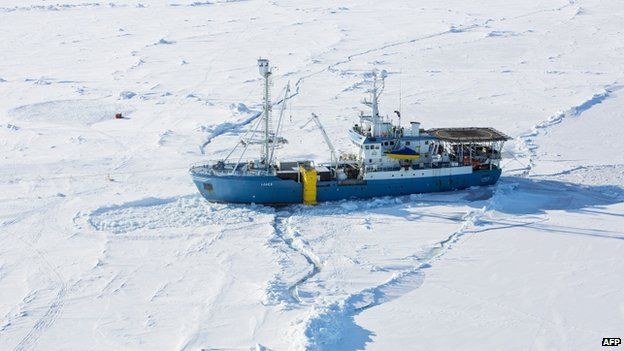
    Norwegian research vessel Lance at 83 degrees north in the Arctic Ocean
    "That means additional measures to reduce the risk of invasive marine species, more stringent requirements for oil spill response, banning the use and restricting carriage of heavy fuel oil by ships in the Arctic, reducing air emissions and black carbon, and addressing underwater noise," he said
    .

    Ice retreat
    The IMO is the United Nations agency with responsibility for the safety and security of shipping and the prevention of marine pollution by ships.
    A spokesperson for the IMO said many of the things not specifically addressed in the Polar Code are addressed, or will be addressed, by other measures.
    The Arctic is the fastest warming region of the planet.
    If the polar ice retreats it could speed up the rise in global temperatures and change the world's weather patterns.
    It could also open up a faster route for commercial cargo ships between Europe and Asia, and boost trade in ports in Arctic countries such as Russia, Norway and Canada.

    From BBC Science/ Environment

    Saturday, April 11, 2015

    Dolphins stranded on Japan beach


    Nearly 150 melon-headed whales, a species of dolphin, have become stranded on a beach in Japan.
    They were found along a 4km (2.5 mile) stretch of beach in the Ibaraki prefecture, north-east of Tokyo.
    Efforts are under way to try to rescue the animals.
    "We see one or two whales washing ashore a year, but this may be the first time we have found over 100 of them on a beach," a coastguard official told the AFP news agency.
    About 50 animals of the same species beached themselves in a similar area in 2011.
    The reason for the beaching is unclear, but researchers from the National Museum of Nature and Science travelled to the beach to investigate.
    From BBC News


    Friday, February 13, 2015

    Plastic waste heading for oceans quantified

    About eight million tonnes of plastic waste find their way into the world's oceans each year, say scientists.

    Plastic waste
    Any walk along a beach will produce a sizeable haul of plastic waste

    The new study is said to be the best effort yet to quantify just how much of this debris is being dumped, blown or simply washed out to sea.
    Eight million tonnes is like covering an area 34 times the size of New York's Manhattan Island to ankle depth.
    The details were released at the annual meeting of the American Association for the Advancement of Science (AAAS).
    Dr Jenna Jambeck, the study’s lead author from the University of Georgia, had another way to try to visualise the scale of the problem.
    The quantity entering the ocean is equal to about five plastic grocery bags full of plastic for every foot of coastline in the world,” she told BBC News.
    Unseen pollution
    Researchers have for some time now reported on the mass of plastic caught up in ocean currents, just going round and round.
    What is slightly shocking about this new study, also published in Science Magazine, is that it helps quantify all the plastic in our oceans - not just the material seen floating on the sea surface or sitting on beaches.
    The newly published estimate is 20 to 2,000 times greater than the reported mass of plastic trapped in high concentration in ocean gyres.
    It is clear now that large quantities of debris must be hidden on the seafloor or have been weathered into tiny fragments that are just not apparent to casual surveys. The latter are being ingested by marine animals with unknown consequences.
    Micro-plastic
    Plastics will break down into tiny, persistent fragments that can then be ingested by animals
    In doing its analysis, the team pulled together international data on population, waste generation and management (and mismanagement). The group then modelled scenarios for the likely sums of plastic getting into the ocean environment.
    For 2010, the estimated range runs from 4.8 to 12.7 million tonnes. Eight million tonnes is the mid-scenario. It is a few percent of the total plastic waste generated that year.
    In doing its analysis, the team pulled together international data on population, waste generation and management (and mismanagement). The group then modelled scenarios for the likely sums of plastic getting into the ocean environment.
    For 2010, the estimated range runs from 4.8 to 12.7 million tonnes. Eight million tonnes is the mid-scenario. It is a few percent of the total plastic waste generated that year.
    Jenna Jambeck
    Jenna Jambeck's study tries to quantify the inputs. It is not a census of what is out there
    From BBC News

    Wednesday, February 11, 2015

    Blast fishing destroying Tanzania's marine habitats

    blast_fishing


    The rich marine life off Tanzania's coast is coming under threat because of blast fishing, according to environmentalists.
    The technique sees fishermen use explosives to maximise their catch.
    Although illegal, the practice is used along the entire Tanzanian coastline from Mtwara to Tanga, and off north Zanzibar.

    From BBC News

    Friday, February 06, 2015

    Galapagos emergency over stranded ship

    Ecuador has announced a state of emergency in the Galapagos Islands, a week after a cargo ship with hazardous materials ran aground there.

    A Galapagos giant tortoise. File photo
    The Galapagos are home to unique animal species such as the giant tortoise

    The Floreana - which ferries food and other supplies to the Unesco world heritage site - was also carrying 45,000 litres (10,000 gallons) of fuel.
    Booms have been used to contain a fuel spill in the pristine waters.
    The islands - famous for their unique flora and fauna - lie some 1,000km (600 miles) off Ecuador's Pacific coast.
    The emergency "will allow authorities to have immediate [financial] means to deal with the situation", a Galapagos National Park spokesman told the AFP news agency.
    The ship's hull was reportedly destroyed in the incident on 28 January.
    Rescue teams are now trying to refloat and remove the vessel.
    This is not the first such incident. Last year, another cargo ship ran aground.
    And in 2001, an oil spill devastated marine iguana populations.
    From BBC News

    Wednesday, February 04, 2015

    Australian study says fences could halt cane toad menace

    Special fences built around dams in arid parts of Australia could help eradicate the menace of cane toads, according to new research.

    The toads, regarded as poisonous pests, are drawn to the dams by the need for water and die in large numbers if fences hold them back, scientists said.
    The animals were brought to Australia in the 1930s to get rid of beetles.
    They have since spread from Queensland into the Northern Territories, New South Wales and Western Australia.
    Their numbers have grown because they have almost no natural predators and their toxins kill native animals that normally feed on frogs.
    Various methods to eradicate the toads have been tried, including mass culls by teams of volunteers, but have only had limited success.
    Now a study led by experts at the University of New South Wales (UNSW) says toad-proof fences around dams may stem their spread because most areas the toads will invade in future are semi-arid or arid.
    The dams are built to provide water for livestock but are a magnet for the toads.
    Cane toad fitted with a tracking device
    Some cane toads are fitted with tracking devices to plot their spread
    Numbers "suppressed"
    Researchers built small fences from shade cloth around three dams in the Victoria River region of the Northern Territory and maintained them for a year.
    They found that the toads were unable to jump over them or burrow under.
    "The toads were still attracted to the water but they died en masse while attempting to settle at the fenced dams," said the study's lead author, UNSW Associate Professor Mike Letnic.
    "Their numbers remained suppressed for a further year. By comparison, there were 10 to 100 times more toads living at the unfenced dams that were used as controls in the study," he said.
    The team has suggested that livestock farmers and wildlife agencies work together to fence out the toads or replace the dams with water tanks.
    "If conducted strategically, excluding toads from man-made water sources could effectively control their populations across large areas of Australia," said Prof Letnic.
    The research team included scientists from the University of Technology, Sydney, and the University of Melbourne.
    Cane toads are native to South America but were introduced to Australia in 1935 to control beetles that infested sugar cane.
    From BBC News-Sci/Environment


    Friday, December 12, 2014

    Bangladeshis tackle Sunderbans oil spill with sponges

    Villagers in Bangladesh, South-East Asia, have used pots, pans and sponges to help clear thousands of litres of oil, three days after it spilled into a nature reserve.

    The oil is threatening the Bangladeshi part of the world's largest mangrove forest


    The oil spilled after a tanker carrying 350,000 litres collided with another vessel, spreading the oil across nearly 40 miles of waterways.Footage shows villagers scooping oil from rivers and birds covered in black liquid in the Sundarbans area.
    Bangladeshi villagers try to collect oil, handout photograph received from the World Conservation Society on December 12, 2014
    Villagers have been asked to help the government clear the spill
    The Sunderbans is a Unesco heritage site, which means it is an area of great importance.Its mangrove forest and rivers are home to a huge number of plant and animal life, much of it unique to the area.The oil leaked into the river at a sanctuary for rare dolphins.
    Oil from a Bangladeshi oil-tanker is seen on the Shela River in the Sundarbans in Mongla
    A thick, black sheen spread in the days after the tanker crash, covering nearly 40 miles of waterways
    Experts say the impact on wildlife could be devastating.But government officials say they still cannot give a prediction of how much damage has been caused.
    From CBBC newsround

    Friday, December 05, 2014

    UK winter storms: Nursing sick orphaned seal pups back to sea


    A year ago, the worst storm surges in more than 60 years left the UK's east coast severely battered.
    The storms coincided with grey seal pupping season, which happens in early December. Dozens of the young animals were separated from their mothers in the strong seas.
    In the space of three days, the number of seal pups admitted to the RSPCA East Winch Wildlife Centre more than doubled to over 100, as 58 greys joined the 50 juvenile common seals who had been there since the summer.
    One year on, with winter approaching, workers and volunteers at the centre are bracing themselves in case of another influx.
    But the problem is not just weather - the centre is seeing increasing numbers of sick common seals (all but three of the current residents) but cannot pinpoint the reason.

    From BBC news

    Wednesday, November 05, 2014

    Plan bee: New measures to protect pollinators

    The British government has made an agreement with landowners including Network Rail and the Highways Agency to restore bee-friendly habitat throughout England.

    Honeybee on a flower (c) Ethel M Villalobos
    Honeybees and other pollinating insects have been in decline for decades

    It is part of a 10-year National Pollinator Strategy.
    But some conservation groups say the plan does not go far enough.
    It includes countryside stewardship schemes, worth a total of £900m, to provide financial incentives for farmers to plant pollinator-friendly crops and let meadows grow.
    The plan is to be announced on Tuesday by Environment Secretary Elizabeth Truss.
    It will be the key policy announcement of her first major speech as environment secretary.
    The coalition has been criticised for some of its actions on the natural environment, including the controversial badger cull and a plan to sell off forests, which was ultimately scrapped. So Ms Truss will look to move the debate forward.
    She will say in her keynote speech that "our health, our jobs and our future prosperity and security depend on nature in this country".


    Policy for pollinators
    Ms Truss told BBC News that the new strategy was "all about helping our pollinators survive and thrive". Farmland, which covers most of England's land area, is the main focus.
    "Pollinators are really important for food and farming - for our rural economy, which is worth £210bn per year," she told BBC News.
    "The most important part of the strategy is the stewardship scheme, which has a specific pollinator element incentivising farmers to plant wild flowers, have pollinator friendly crops, and to carry out their activities in a pollinator-friendly way."
    The charity Buglife and Friends of the Earth both broadly welcomed the plan, but said that it did not go far enough on the regulation of pesticides.
    Referring to a 2013 decision by the European Commission to restrict the use of a group of neonicotinoid pesticides that were found to be harmful to honeybees, Buglife chief executive Matt Shardlow said it was time for the government to bring in new regulations to govern the testing of new chemicals.
    "We're not against pesticides entirely," he told BBC News. "But we're keen that there's better testing, so the ones that are ultimately used aren't damaging to bees."
    Public help sought
                                    
    Buglife's Matt Shardlow shows the BBC's Victoria Gill around a rooftop in the heart of Manchester that has been designed specifically to attract urban bees.
    To make space across an increasingly urban landscape for insects, the government has secured commitments from landowners including Network Rail and the Highways Agency, which has agreed to undertake work to "enhance the grassland" on its verges.
    Mr Shardlow pointed out that these pollinator-friendly urban spaces were vital and he encouraged the public to help.
    "It is time now for everyone to come together around this national strategy; for government to deliver tens of thousands of hectares of restored wildflower habitats in the countryside, creating a network of B-Lines so that pollinators can move across the landscape effectively.
    "And for local authorities to transform roadside verges and public spaces into buzzing, colourful wildlife havens; and for the public to find space in their lawns to let the flowers bloom."
    From BBC Sci/Environment

    Saturday, October 18, 2014

    New viruses 'killing amphibians' in Spain

    A deadly new disease has emerged that is wiping out amphibians, scientists report.

    Common Midwife Toad
    The common midwife toad is one of several species that have been hit by the new strains of Ranavirus

    A number of viruses have been found in northern Spain that are killing frog, toad and newt species. Infected animals can suffer from ulcers on their skin and die from internal bleeding.
    Researchers fear the strains, which belong to the Ranavirus group, have already spread to other countries.
    Lead author Dr Stephen Price, from University College London, said: "Until the outbreaks, we didn't really know about this lineage of virus.
    "But since these die-offs began, we've started to see them elsewhere - in China in giant salamanders, and it looks like they are emerging in places like France and the Netherlands as well."
    Common midwife toad haemorrhaging
    The viruses cause internal haemorrhaging and some animals have large open sores on their skin
    Dead amphibians were first spotted in the Picos de Europa National Park, in Spain, in 2005.

    An investigation by a team of researchers found that a range of new viruses were the cause.
    Two of the viruses, called CMTV-like Ranaviruses, were infecting large numbers of animals.
    What is unusual is that they can jump between a range of species, killing off frogs, toads and newts.
    Dr Price said: "In the Picos de Europa National Park, we've seen major population collapses in three species: the common midwife toad, the common toad and the alpine newt. But we also found all the common amphibian species in the park were highly susceptible and experiencing disease and mortality.
    "It is a pretty graphic disease with a high kill-rate. We've shown these viruses have caused simultaneous declines in several species of host."
    Alpine newt
    Alpine newts have also been killed by the viruses in Spain
    The researchers believe the virus can even spread to reptiles.
    "We recorded a snake that had been feeding on amphibians infected with disease, and it showed signs of the virus," said Dr Price.
    Conservationists are especially worried about these new viruses because 41% of all amphibians already face extinction, according to the International Union for Conservation of Nature (IUCN).
    Another disease, called the chytrid fungus, has spread around the world, killing off many populations.
    Scientists fear that if the new viruses spread, they could have a devastating effect on these already vulnerable animals.
    The research was carried out by scientists at UCL, the Zoological Society of London, Queen Mary University of London, the Museum of Natural Science in Madrid, and the Picos de Europa National Park.
    From BBC News

    Wikipedia

    Search results