To my dear visitors and commenters

Hi, everybody! I've noticed with lots of joy and happiness, that thousands of comments have been written in my posts. It's wonderful that so may people around the world appreciate my work. Therefore, I want to thank you for that and ,at the same time I want to ask you to be this blog's followers. It's fast and easy! Make it be even more visited and spread all over the world! I'm a woman, a teacher of English in Portugal, and I've been away for quite a long time because of my father's health. Unfortunately he died from Covid19 a few months ago. Now I felt it was time to restart my activity in this and other blogs I owe. I've recently created a new one in a partnership with a street photographer, Mr. Daniel Antunes. He's fabulous! https://pandpbydandd.blogspot.com I'd like you to visit it and, who knows, become our followers. The poems, chronicles and thoughts are all mine. Thank you so much! Kisses :-)

Search This Blog

Showing posts with label rainforests. Show all posts

Sunday, October 10, 2021

Facebook to act on illegal sale of Amazon rainforest

By Joao Fellet and Charlotte Pamment

BBC Brasil

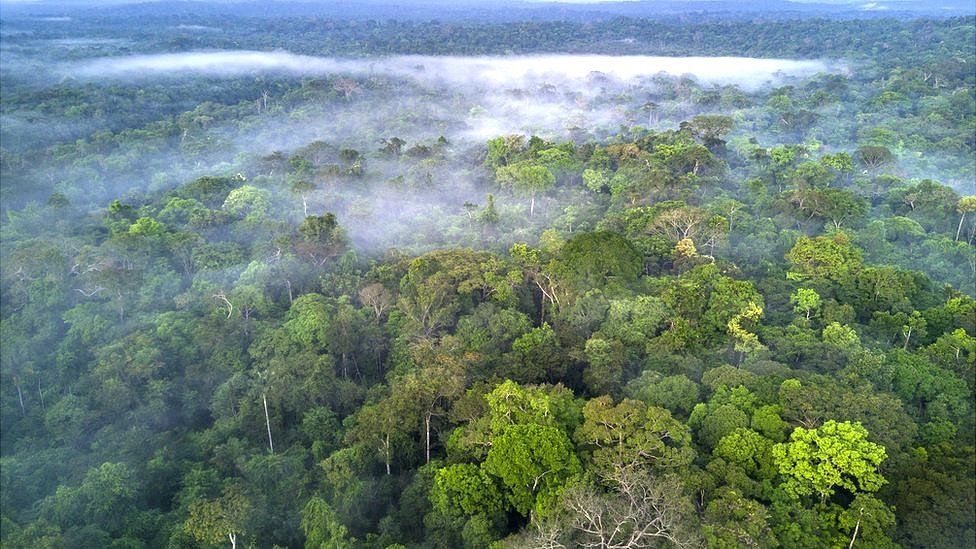
    The Amazon rainforest is home to one in 10 known species on Earth
Facebook says it will begin clamping down on the illegal sale of protected areas of the Amazon rainforest on its site.

The social media giant changed its policy following a BBC investigation into the practice.

The new measures will apply only to conservation areas and not to publicly owned forest.

And the move will be limited to the Amazon, not other rainforests and wildlife habitats across the world.

According to a recent study from the think tank Ipam (Instituto de Pesquisa Ambental da Amazonia), a third of all deforestation happens in publicly-owned forests in the Amazon.

Facebook said it would not reveal how it planned to find the illegal ads but said it would "seek to identify and block new listings" in protected areas of the Amazon rainforest.


Illegal deforestation exposed

In February, the BBC Our World documentary Selling the Amazon revealed that plots of rainforest as large as 1,000 football pitches were being listed on Facebook's classified ads service.
Alvim Souza Alves was trying to sell land for about £16,400

Many of the plots were inside protected areas, including national forests and land reserved for indigenous peoples.

Read More

Friday, February 05, 2016

'Wrong type of trees' boost warming

The assumption that planting new forests helps limit climate change has been challenged by a new study.

oak tree
The replacement of broad leaf species like oak with conifers has increased warming say researchers
Researchers found that in Europe, trees grown since 1750 have actually increased global warming.
The scientists believe that replacing broadleaved species with conifers is a key reason for the negative climate impact.
Conifers like pines and spruce are generally darker and absorb more heat than species such as oak and birch.
The authors believe the work has implications for current efforts to limit rising temperatures through mass tree planting.

Management issues

Europe's green canopy was dramatically thinned between 1750 and 1850, when the forested area diminished by 190,000 sq km.
Ironically the greater use of fossil fuels, particularly coal, slowed the timber rush, and from 1850 to the present day, Europe's forests grew by some 386,000 sq km and now cover 10% more land than before the industrial revolution.
However, the form and content of these new woods differed considerably from what went before.
In the distant past, these forests ran wild - but in the modern world, some 85% of Europe's trees are managed by humans. And over the past 150 years, foresters have adopted a scientific approach to woodlands - planting faster growing, more commercially valuable trees such as a Scots pine and Norway spruce.
The rapid re-forestation of great swathes of European has generally been seen as a good thing due to the trees' ability to soak up carbon, something that has become particularly relevant in recent decades.
But the new study questions the positive impact of all these new trees on the climate.
The research team reconstructed 250 years of forest management history in Europe - and found that the way forests are controlled by humans can lead to far less carbon being stored than would have been the case when nature was in charge.
trees
Under human management, Europe's forests have expanded but store less carbon
Removing trees in an organised fashion tends to release carbon that would otherwise remain stored in forest litter, dead wood and soil.
Choosing conifers over broadleaved varieties also had significant impacts on the albedo - the amount of solar radiation reflected back into space.
"Even well managed forests today store less carbon than their natural counterparts in 1750," said Dr Kim Naudts who carried out the study while at the Laboratory of Climate Science and Environment in Gif-sur-Yvette, France.
Speaking to Science in Action on the BBC World Service, she said: "Due to the shift to conifer species, there was a warming over Europe of almost 0.12 degrees and that is caused because the conifers are darker and absorb more solar radiation."
The researchers say that the increase in temperature equates to 6% of the global warming attributed to the burning of fossil fuels. They say that is a significant amount and believe that similar impacts are likely in regions where the same type of afforestation has taken place.
Many governments have made planting trees a key part of their plans for dealing with climate change; China is building a "great green wall" of trees, set to cover around 400 million hectares when complete.
The authors suggest the world should look carefully at both the types trees that we are planting and the ways in which they are managed.
"We shouldn't put our hopes on forests to mitigate what is an emission problem," said Dr Naudts.
"Our results indicate that in large parts of Europe, a tree planting programme would offset the emissions but it would not cool the planet, especially not if the afforestation is done with conifers."
The researchers believe that consideration should be given to a programme of replacement. As the conifers are harvested, more broadleaved species could replace them.
The study has been published in the journal Science.
From BBC News

Thursday, September 03, 2015

'Three trillion' trees on Earth

There are just over three trillion trees on Earth, according to a new report.


Trees
Experts say there are around 3,040,000,000,000 trees on Earth

The figure is eight times as big as the previous best guess, which counted perhaps 400 billion at most.
The new total of 3,040,000,000,000 trees represents roughly 420 trees for every person on the planet.
A team from Yale University in America carried out the research and collected information from over 400,000 forest plots around the world.
woods in Hampshire
Humans are removing about 15 billion trees a year, it is estimated
The new number will now help with a wide range of research - everything from studies that look at animal and plant habitats to climate issues.
What is clear from the study is the influence humans now have on the number of trees on Earth.
The team estimates we are removing about 15 billion trees a year, with roughly only five billion being planted back.
From CBBC Newsround

Sunday, June 21, 2015

Earth 'entering new extinction phase' - US study

The Earth has entered a new period of extinction, a study by three US universities has concluded, and humans could be among the first casualties.


The dried out sea bed of the Soyang River in Chuncheon, Gangwon Province, northeastern South Korea, 16 June 2015
Climate change and deforestation are among the reasons we may be facing an extinction event
The report, led by the universities of Stanford, Princeton and Berkeley, said vertebrates were disappearing at a rate 114 times faster than normal.
The findings echo those in a report published by Duke University last year.
One of the new study's authors said: "We are now entering the sixth great mass extinction event."
The last such event was 65 million years ago, when dinosaurs were wiped out, in all likelihood by a large meteor hitting Earth.
"If it is allowed to continue, life would take many millions of years to recover and our species itself would likely disappear early on," said the lead author, Gerardo Ceballos.
null
Pollination by bees could disappear within three generations, the report warns
The scientists looked at historic rates of extinction for vertebrates - animals with backbones - by assessing fossil records.
They found that the current extinction rate was more than 100 times higher than in periods when Earth was not going through a mass extinction event.
Since 1900, the report says, more than 400 more vertebrates had disappeared.
Such a loss would normally be seen over a period of up to 10,000 years, the scientists say.
The study - published in the Science Advances journal - cites causes such as climate change, pollution and deforestation.
Given the knock-on effect of ecosystems being destroyed, the report says benefits such as pollination by bees could be lost within three human generations.
null
Extinction may be more gradual than when the dinosaurs died, the report says
Stanford University professor Paul Ehrlich said: "There are examples of species all over the world that are essentially the walking dead.
"We are sawing off the limb that we are sitting on."
The International Union for Conservation of Nature (IUCN) says at least 50 animals move closer to extinction every year.
Around 41% of all amphibians and 25% of mammals are threatened with extinction, it says.
null

Most at risk: the lemur

According to the IUCN, the lemur faces a real struggle to avoid extinction in the wild in the coming years.
The group says that 94% of all lemurs are under threat, with more than a fifth of all lemur species classed as "critically endangered".
As well as seeing their habitat in Madagascar destroyed by illegal logging, lemurs are also regularly hunted for their meat, the IUCN says.
Last year, a report by Stuart Pimm, a biologist and extinction expert at Duke University in North Carolina, also warned mankind was entering a sixth mass extinction event.
But Mr Pimm's report said the current rate of extinction was more than 1,000 times faster than in the past, not 114, as the new report claims.
The new report's authors said it was still possible to avoid a "dramatic decay of biodiversity" through intensive conservation, but that rapid action was needed.
From BBC News

Saturday, April 18, 2015

Demand for rubber 'threatens forests'

The global demand for rubber tyres is threatening protected forests in Southeast Asia, according to a study.

Protected areas are being lost to rubber plantations
Tropical forests are being cleared for rubber plantations, putting endangered birds, bats and primates at risk, say UK researchers.
By 2024, up to 8.5 million hectares of new rubber plantations will be needed to meet demand, they report in Conservation Letters.
This could have a "catastrophic" impact on wildlife, they warn.
Species such as the endangered white-shouldered ibis, yellow-cheeked crested gibbon and clouded leopard could lose precious habitat, said the team led by Eleanor Warren-Thomas, from the School of Environmental Sciences at the University of East Anglia.
"The tyre industry consumes 70% of all natural rubber grown, and rising demand for vehicle and aeroplane tyres is behind the recent expansion of plantations. But the impact of this is a loss of tropical biodiversity," she said.
"We predict that between 4.3 and 8.5 million hectares of new plantations will be required to meet projected demand by 2024. This will threaten significant areas of Asian forest, including many protected areas."
Eight-point-five million hectares is about the size of the land area of Austria.

Biodiversity concern

Rubber is the most rapidly expanding tree crop within mainland Southeast Asia.
Concern has been growing among conservationists that switching land use to rubber cultivation can harm soil, water and biodiversity.
The banteng is found in the forests of Cambodia
The first review of the effects on biodiversity and endangered species found the problem was comparable to oil palm and was linked to the growing tyre market.
The study focussed on four biodiversity hotspots in which rubber plantations are expanding:
  • Sundaland (Malay Peninsula, Borneo, Sumatra, Java, and Bali)
  • Indo-Burma (Laos, Cambodia, Vietnam, most of Myanmar and Thailand, and parts of Southwest China, including Xishuangbanna and Hainan Island)
  • Wallacea (Indonesian islands east of Bali and Borneo but west of New Guinea, plus Timor Leste)
  • The Philippines.
It found that numbers of bird, bat and beetle species can decline by up to 75% in forests that have been converted to rubber.

Sustainability initiatives

The researchers, from UEA and the University of Sheffield, are calling on tyre manufacturers to support initiatives such as certification schemes.
Commenting on the study, Dr Matthew Struebig of the Durrell Institute of Conservation and Ecology, University of Kent, UK, said certification standards for the rubber industry were key to protecting forests.

"There's a lot we can do as scientists and the public to make rubber production more wildlife-friendly," he said.
"It can range from agro-forestry - mixing rubber with other trees - to retaining patches of natural vegetation along rivers or in small conservation set-asides, as is done in organic farming in Europe.
"The onus is on the rubber industry to develop a certification standard that is credible, for the public to support that, and for scientists to help develop ways to manage the rubber crop in an environmentally friendly way."
The research is published in the journal Conservation Letters.
From BBC Science


Saturday, November 08, 2014

Jumbo-gardeners: How elephants affect weather


The tropical forests of Congo help create downpours many miles away. What’s a key element in this forest flourishing? 
The elephant!


The tropical rainforests of Africa and Asia play a crucial role in keeping our planet healthy. They moderate our climate, absorb the carbon we produce, and act as a major source of atmospheric moisture – which can fall as rain many miles away.
One of the biggest tropical forests in the world is in Congo. Its huge size and incredible biodiversity is partly thanks to an unlikely ally – the elephant.
In this film, The Nature Conservancy’s lead scientist Dr M Sanjayan, Dr Valerie Kapos of the UN Environment Programme, and tropical field biologist and conservationist Dr Ian Redmond reveal the crucial role that elephants play in keeping these forests strong and resilient, and how elephants are the most important player when it comes to the diversity of tree species in the rainforest. 

From BBC-Future

Wikipedia

Search results