To my dear visitors and commenters

Hi, everybody! I've noticed with lots of joy and happiness, that thousands of comments have been written in my posts. It's wonderful that so may people around the world appreciate my work. Therefore, I want to thank you for that and ,at the same time I want to ask you to be this blog's followers. It's fast and easy! Make it be even more visited and spread all over the world! I'm a woman, a teacher of English in Portugal, and I've been away for quite a long time because of my father's health. Unfortunately he died from Covid19 a few months ago. Now I felt it was time to restart my activity in this and other blogs I owe. I've recently created a new one in a partnership with a street photographer, Mr. Daniel Antunes. He's fabulous! https://pandpbydandd.blogspot.com I'd like you to visit it and, who knows, become our followers. The poems, chronicles and thoughts are all mine. Thank you so much! Kisses :-)

Search This Blog

Showing posts with label global warming. consequences. Show all posts

Friday, December 11, 2015

COP21: Final push for climate deal amid 'optimism'

Negotiators at the Paris summit aim to wrap up a global agreement to curb climate change on Saturday - a day later than expected.

Messages on climate change outside Le Bourget in Paris where talks are taking place
"We are nearly there. I'm optimistic," said French Foreign Minister Laurent Fabius, who is chairing the summit.
Efforts to forge a deal faltered on Friday, forcing the talks to overrun.
UN Secretary General Ban Ki-moon said the negotiations were the "most complicated, most difficult, but, most important for humanity".
Mr Fabius told reporters in Paris that he would present a new version of the draft text on Saturday morning at 0800 GMT, which he was "sure" would be approved and "a big step forward for humanity as a whole".
"We are almost at the end of the road and I am optimistic," he added.
The summit is entering a final push to try to secure a global agreement that would stake out a long-term strategy for dealing with climate change. However, there are still some unresolved issues.

What are the sticking points?


Children display giant letters reading
  • Climate finance: How do countries pay for efforts to reduce, stop and cope with the effects of climate change?
  • Differentiation: Related to the finance problem is how do we "differentiate" between developed countries, who can afford to donate money, and developing countries who need support? Richer nations want emerging economies to take on more of the burden of cutting emissions, and providing finance to the very poor nations hit by the impacts of higher temperatures.
  • Overall goal: What is the overall target? Should nations try to limit global rises in temperature to 2C or 1.5C or by "well below 2C" - above what they were in pre-industrial times? The global average temperature has already risen by roughly 1C.

Sunday, December 06, 2015

India to ban old trucks and buses to curb pollution

India will ban trucks and buses more than 15 years old to curb record pollution levels, the government says.

Sometimes we have good news too!

Trucks are seen parked in an open plot near a national highway on the outskirts of Ahmedabad, India, December 2, 2015.
Commercial trucks account for more than half of vehicle emissions in India
India's capital, Delhi, is experiencing hazardous levels of pollution due to diesel emissions, construction dirt and the burning of crop stubble in farms around the city.
Air pollution causes more than 600,000 premature deaths in India each year.
India has 13 of the world's 20 most polluted cities, the World Health Organization (WHO) reported last year.
The ban will come into effect in April and will be announced in more detail in the next two weeks.
It will include commercial trucks, which account for more than half of India's vehicle emissions.
"It [air pollution] will get worse every year unless we do something," road transport and highways secretary Vijay Chhibber told Reuters.
However, other measures will have to be implemented if India wants to significantly change emissions, experts say.
"Taxes on cars and parking charges should be raised to curtail usage, and public transport should be expanded," said Vivek Chattopadhyay, a pollution expert at the Centre for Science and Environment in Delhi.
New car sales are soaring in India, with 1,400 extra cars taking to the capital's streets every day.
Last week India said it would require vehicles to abide by stricter emissions standards by 2019, three years ahead of the previous deadline.


Earlier this month, on the night of Diwali, the Hindu festival of lights, air pollution in Delhi reached 40 times the limit recommended by the WHO.

From BBC News

Friday, December 04, 2015

COP21: Vanuatu voices from disappearing islands

Vanuatu is on the front line in the climate change debate, with rising sea levels putting the very future of the low-lying archipelago in jeopardy.

Islanders hope some sort of deal can be reached at the climate change conference Paris to make sure that whatever happens, their home will be as well prepared as possible.
They raised their concerns with the BBC's Matthew Price. (BBC Science/Environment)


Saturday, September 26, 2015

What is a carbon footprint? What can you do about yours?

carbon footprint is historically defined as "the total sets of greenhouse gas emissions caused by an organization, event, product or individual." (Wikipedia)


  Wright, Kemp, and Williams, writing in the journal Carbon Management, have suggested a more practicable definition:
A measure of the total amount of carbon dioxide (CO2) and methane (CH4) emissions of a defined population, system or activity, considering all relevant sources, sinks and storage within the spatial and temporal boundary of the population, system or activity of interest. Calculated as carbon dioxide equivalent (CO2e) using the relevant 100-year global warming potential (GWP100).
Greenhouse gases (GHGs) can be emitted through transport, land clearance, and the production and consumption of food, fuels, manufactured goods, materials, wood, roads, buildings, and services. For simplicity of reporting, it is often expressed in terms of the amount of carbon dioxide, or its equivalent of other GHGs, emitted.
Most of the carbon footprint emissions for the average U.S. household come from "indirect" sources, i.e. fuel burned to produce goods far away from the final consumer. These are distinguished from emissions which come from burning fuel directly in one's car or stove, commonly referred to as "direct" sources of the consumer's carbon footprint. ( in Wikipedia)

Tuesday, August 11, 2015

Global warming threatens extinction for UK butterflies

Global warming could drive drought sensitive butterfly species to extinction in the UK by 2050, according to new research.


Green veined white butterfly
The Green Veined White butterfly is one of the species at risk of extinction from drought
Scientists found that even the lowest expected levels of warming could decimate populations.
However the researchers found that restoring connections between butterfly habitats could help modify the worst impacts.
The research has been published in the journal Nature Climate Change.
Although many people believe that butterflies are creatures that love the warmth, periods of extremely hot and dry weather can significantly reduce populations.
In this study, British researchers looked at the impact of an extreme drought event in 1995 on butterfly species. This was the most arid summer since records began in 1776.
They identified six species, including the Cabbage White and the Speckled Wood butterflies, that were particularly sensitive to heat.
They then looked at what might happen to these creatures under different levels of warming up to 2100.
If emissions of carbon dioxide continue on a "business as usual" model, and warming is more extreme, then extinctions of some of these species could begin in England as early as 2050.
speckled wood butterfly
Restoring habitat connections could help mitigate the worst warming impact on butterflies
"We looked at the extent to which populations crashed from the drought and how long it takes them to recover," said lead author Dr Tom Oliver from Nerc Centre for Ecology and Hydrology.
"What we're asking is, as droughts become more frequent whether the return time of the drought was more frequent than the recovery of the butterflies."
"And when that was the case you'd get this gradual population erosion and in those places you'd get local extinctions."
The researchers say that areas of the south east of England would be worst affected.
However they argue that under less extreme warming conditions, changes to butterfly habitats could ameliorate the worst impacts.
The team found that restoring connections between habitats that have been fragmented by human activities such as agriculture, was capable of making a big difference.
Under a low emissions scenario, bridging these connections could improve the probability of butterfly survival by 50%.

"If our habitats are very fragmented, the impacts will be much more severe. In places where it isn't those populations might persist," said Dr Oliver.
"It allows us to buy time until we get those global emission cuts in place."
The researchers believe their study is a conservative estimation of how warming might impact these fragile species.


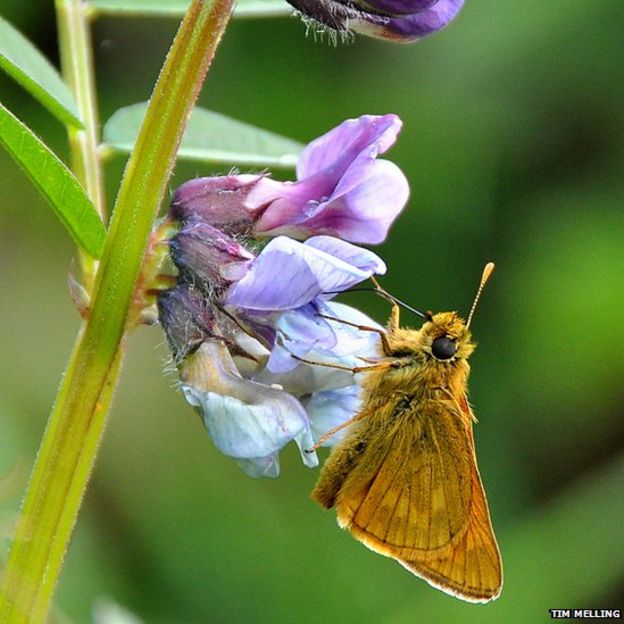
Large Skipper butterfly

Extinctions of species like the Large Skipper could happen by 2050 under some warming scenarios
They are concerned that, because of landscape changes in the UK throughout the 20th century, populations of some of the threatened species might be too low for them to recover from frequent droughts.The authors say that even people who are not impressed by the aesthetic appeal of butterflies should still be concerned about their demise.
"Butterflies are important culturally as part of our natural heritage, but there are other functions that could be impacted by their extinction including pollution, pest control and decomposition of waste," said Dr Oliver.
"Those un-swayed by the beauty and importance of having butterflies in the countryside ought to be concerned about the disruption to these functions provided by these species."
 From BBC Science/Encironment

Wikipedia

Search results