To my dear visitors and commenters

Hi, everybody! I've noticed with lots of joy and happiness, that thousands of comments have been written in my posts. It's wonderful that so may people around the world appreciate my work. Therefore, I want to thank you for that and ,at the same time I want to ask you to be this blog's followers. It's fast and easy! Make it be even more visited and spread all over the world! I'm a woman, a teacher of English in Portugal, and I've been away for quite a long time because of my father's health. Unfortunately he died from Covid19 a few months ago. Now I felt it was time to restart my activity in this and other blogs I owe. I've recently created a new one in a partnership with a street photographer, Mr. Daniel Antunes. He's fabulous! https://pandpbydandd.blogspot.com I'd like you to visit it and, who knows, become our followers. The poems, chronicles and thoughts are all mine. Thank you so much! Kisses :-)

Search This Blog

Showing posts with label Wildlife experts. Show all posts

Tuesday, February 09, 2016

How do you prepare orangutans to go back into the wild?

Orangutans living at a sanctuary in Indonesia are being prepared for release back into the wild.


Forest fires and poaching have led to a decrease in the population.
Some baby orangutans don't have parents to teach them how to look after themselves.
International Animal Rescue has more than 100 of the animals at its sanctuary in Ketapang in western Kaliman province.
It's set up a forest school so the oraguntans can play and learn how to survive in the wild.
It can take up to eight years for the babies to be ready to be released.
From CBBC Newsround


Saturday, January 30, 2016

Big Garden Birdwatch: Thousands expected to join RSPB weekend

More than half a million people are expected to take part in an annual UK birdwatch this weekend and record species spotted in gardens and parks.

Photo of blue tits
The survey will monitor birds including the blue tit
The RSPB Big Garden Birdwatch tracks species like starlings and song thrushes, which have declined by 80% and 70% since the survey began in 1979.
The unusual weather this winter could affect which birds are seen in gardens.
The RSPB said it was likely there would be fewer birds because they have been less reliant on garden feeders.
December was the warmest and wettest month in the UK in more than 100 years, before a cold snap was followed by warmth in January.
The RSPB said it would be interesting to see how this had affected the long tailed tit, which is badly affected by harsh winters, and if there were lower numbers of species from the continent, including finches and blackbirds.

'Quieter gardens'

RSPB wildlife adviser Ben Andrew said: "If the UK experiences a continuation of these milder temperatures, those taking part in Big Garden Birdwatch may notice their gardens quieter than in other years.
"The milder weather means there is more food available in the wider countryside, with birds being less reliant on garden feeders."
However, Mr Andrew added it was still important to keep garden feeders stocked so that birds could find food whatever the weather.
The birdwatch, which takes place over the next two days, encourages people to spend at least an hour spotting birds and then report their sightings to the RSPB.
This lets them to learn more about changes in numbers.
From CBBC Newsround

Wednesday, January 06, 2016

Australian Monitor lizards trained not to eat toxic cane toads

Scientists have worked out a radical solution for Australia's deadly cane toad problem.

Goanna
Goanna numbers have dramatically declined in Australia

They have trained wild monitor lizards, known locally as goannas, not to eat the toxic cane toads.
They did this by feeding the reptiles smaller, younger and less poisonous cane toads. Many that tried the toads once did not make the same mistake again.
The study is published in a Royal Society journal, called Biology Letters.
Lead researcher Georgia Ward-Fear, from the University of Sydney, said: "We've been very surprised by the results, by the amount of time that some of these lizards have actually retained this knowledge and survived in the presence of a high-density of cane toads, which is basically unheard of in the wild."
Cane toad
Smaller cane toads are less of a toxic mouthful than the adult goannas
Cane toads were introduced to Australia in the 1930s to control sugar cane pests. But their numbers have rapidly increased, killing many of the continent's animals, because they are poinonous.
Among the hardest hit are the yellow-spotted monitors (Varanus panoptes). Their population is estimated to have plummeted by 90%. When the toads invade a new area, these yellow-and-black-spotted reptiles feast on the amphibians, and die.
Radiotracking
The research team used radiotrackers to monitor the lizards' survival rates
The scientists say the study suggests goannas have the ability to learn from experience and keep that knowledge over a long period of time.
One of the scientists, Dr Ward-Fear, said: "This study provides the proof of principle that this strategy could be very effective. Employing it in the wild could potentially have a really large positive impact on the goanna population."
From CBBC Newsround

Tuesday, April 21, 2015

Arran diver wins prestigious environmental award

A diver from the Isle of Arran has won one of the world's most prestigious environmental awards.

Howard surveying the seabed
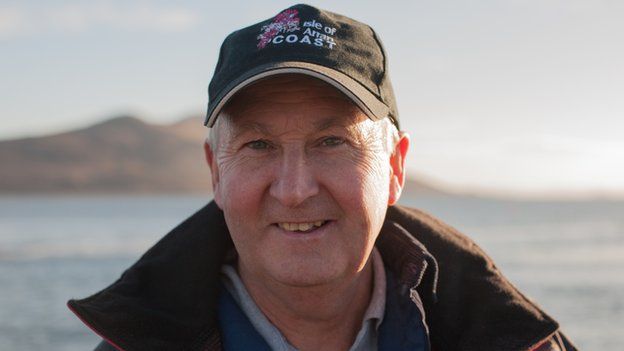
Howard Wood is to receive the Goldman Environmental Prize at a ceremony in San Francisco later.
It is in recognition of his work over 20 years to protect the island's marine environment and allow it to recover.
The prize, worth $175,000 (£117,000), can be spent by the winner "to pursue their vision of a renewed and protected environment".
Mr Wood was one of the founders of the Community of Arran Seabed Trust (Coast) and played a key role in the campaign to set up the country's first no take zone, which prohibits fishing in part of the island's Lamlash Bay.
Mr Wood told BBC Scotland the news had come "completely out of the blue".
Howard Wood
Speaking before travelling to San Francisco, he said: "The work of Coast goes back to before 1995, when we could see that the seabed around Arran was being basically dredged away.

"We wanted to have a trial area to find out what happens when you close a small area to all fishing.
"It took us years to get there, but we did get there in 2008."
Since then, the no take zone has allowed the seabed to regenerate.
A recent study showed there had been an increase in the size of scallops and an increase in the number of juvenile scallops in the area.
Coast is actively promoting sustainable fishing methods such as creeling, hand diving for scallops and angling.
It has recently led a successful campaign to establish one of Scotland's first marine protected areas (MPAs).
Coast is also calling on the Scottish government to implement tougher restrictions, to ensure effective protection for the south Arran marine protected area.
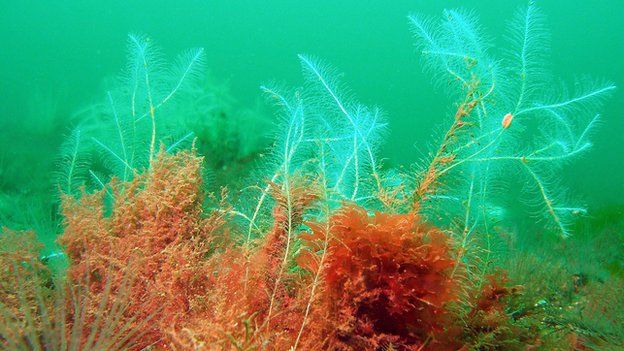
Seabed recovering in no take zone
This area of seabed is recovering in a 'no take' zone
A network of MPAs was designated in Scottish waters in July 2014, but campaigners say very few statutory measures to manage the damaging effects of bottom-towed fishing have so far been implemented for these areas.
Mr Wood said: "Scotland has a legacy of vested interests controlling access to public marine resources and there is still a great deal of work to be done to overturn decades of mismanagement.
"If people really understood how Scotland's marine resources have been plundered over the years, they would be appalled."
The Scottish government has congratulated Mr Wood on his award and defended its record.
Dredged seabed
In comparison to the recovering seabed, this is the scene of a dredged seabed.
A spokesman said: "Scotland's Marine Protected Areas network, which includes the largest MPA in the EU, helps protect and enhance our marine environment so that the rich diversity of life in the waters around Scotland, and the benefits they bring, can be enjoyed for generations to come.
"We recently consulted on potential management measures for MPAs and will shortly implement measures that take account of all views received.
"The current preferred management approach would achieve the conservation objectives of the protected features and reduce the footprint of trawling and dredging considerably."
Mr Wood is one of six winners of this year's Goldman Environmental Prize, who are drawn from Kenya, Myanmar, Haiti, Canada, Honduras and Scotland.
From BBC Science

Monday, April 06, 2015

Rede squirrels' Lake District comeback


Being able to guarantee seeing a red squirrel in the Lake District would be "wonderful", Bob Cartwright from the Westmoreland Red Squirrel charity has said.
He added that he would "defy anyone not to love red squirrels" as they have been spotted in Windermere after a sixteen year absence.
Their rapid decline has been blamed on the success of the imported grey squirrel, which spreads a "pox virus" which kills the red squirrels.
This clip is originally from 5 live Breakfast on April 6 2015.
From BBC Science/ Environment


Saturday, October 04, 2014

Suffolk Wildlife Trust, plans biggest 'bug hotel'

Work has begun on what is hoped will be the world's biggest bee and 'bug hotel'.

Jason Alexander, bug houses, and Foxburrow Farm
Jason Alexander is building 'Bug City' at Suffolk Wildlife Trust's Foxburrow Farm reserve in England

Bug expert Jason Alexander is working with Suffolk Wildlife Trust to build 'Bug City', a habitat designed for insects.
He is asking children to help build parts of the structure, which will be kept at the trust's Foxburrow Farm site, near Woodbridge
Cubs in Framlingham
Cubs in Framlingham helped Jason Alexander build the first level
"It will be a safe place for insects and other animals to sleep, breed and hibernate," Jason said.
The bug hotel is being created using logs, bamboo canes, pine cones and "anything else which you may find in your garden".
Part of the bug hotel
The aim is to use recyclable materials where possible
Individual sections created by the volunteers will be joined together to create the hotel, which Jason hopes will be about 3ft (1m) high and more than 45ft (14m) long.

Biggest bee house

Guinness World Records says the largest bee house, made from bamboo, is in London and measures 42ft (13m).
Suffolk Wildlife Trust said a recently published study found about 46% of European bumblebee species were in decline, with 24% at risk of extinction.
Kerry Stranix, from the trust, said: "This project will raise awareness of the vital role played by invertebrates in our ecosystem, from pollinators to sources of food for many other species."
Work on Bug City is due to continue until February
From CBBC Newsround.

Wednesday, March 05, 2014

Rewilding with big beasts 'could help' UK nature

Reintroducing wild animals to parts of the UK could help restore our environment to a more natural state, a new report suggests.

A wolf

Large animals like hippos, rhinos and the straight-tusk elephant all once lived in the UK but have disappeared.
Researchers think bringing back such bigger beasts could help aid recovery.
"Looking at which species are missing can help us understand which natural processes are not functioning," said Dr Chris Sandom from Oxford University.
Dr Sandom, who worked on the study, continued: "We propose the process of rewilding to help restore natural processes, like predation and pollination by insects."
Lions
Lions used to roam the UK
Today in the UK we still have some larger herbivores but few big predators like lions.
Dr Sandom said: "In Britain today we have many medium sized herbivores like the red deer.
"In some places they're seen as a problem because they eat saplings, which prevents the regeneration of woodlands.
"Reintroducing predators like the lynx or wolf might be appropriate in some areas," he said.

Rewilding has been tried before

It's an idea that has already been tried on a smaller scale - animals like beavers and sea eagles have already been reintroduced in parts of Britain.
But this study doesn't mean we'll have rhino roaming our countryside any time soon.
The scientists studied beetle remains and found there were a lot more dung beetles in Europe 120,000 years ago.
That suggests there were many more large herbivores roaming Europe before humans arrived.
After humans arrived in the UK woodland beetles were much more common, which suggests the big herbivores had gone.
The study was published in the journal Proceedings of the National Academy of Sciences.
From CBBC Newsround

Wednesday, October 16, 2013

A program designed to ensure the long term survival of the Tasmanian Devil means that four young devils have made the trans Pacific journey to San Diego Zoo.

Tasmanian devils

They're usually found living in the wild on the Australian island state of Tasmania but these Tasmanian devils are getting to use to life in their new home in San Diego.
It's the only zoo in the US to have them.
Bradley, Bixby, De-Vos and Usmar are the first Tasmanian devils to be housed in a US zoo.
They have just made the journey to San Diego Zoo fromTaronga Western Plains Zoo near Dubbo in New South Wales, and are now settling into their new home.The San Diego Zoo is currently the only zoo in the U.S. with Tasmanian devils, however it is hoped that this will be the beginning of a significant program in the country.The four devils will be on exhibit in the Zoo's Australian Outback display, beginning on Thursday, October 24, after completing a mandatory 30-day quarantine.Presenter Belinda King spoke to senior keeper at the San Diego Zoo, Jennifer Roesler, about her travels to Western Plains Zoo to learn about the mammals, and accompany them back to the US.The San Diego Zoo is a partner of the Save the Tasmanian Devil Program, collaborating with research institutes and zoos to research the facial tumor disease.Tasmanian devils face extinction in the wild due to devil facial tumor disease, and the delivery of the devils to San Diego is aimed at increasing awareness of the species and inspiring support for Tasmanian devil conservation.

Sunday, September 15, 2013

Battle to save rare high brown fritillary butterfly


BBC programme, Inside Out, looks at efforts to save one of the country's rarest and most threatened butterflies, the high brown fritillary.

Since the 1970s national numbers of the butterfly have declined by 90% with the destruction of its traditional moor and woodland edge habitat.
In Devon, one of the high brown fritillary's few remaining strongholds, there are now thought to be only a handful of breeding sites left.
Devon Wildlife Trust is making huge efforts to save the butterfly through habitat management and conservation work.
The BBC's Nick Baker travels to the River Dart in Devon in search of the elusive high brown fritillary and talks to a conservation expert about its long term chances of survival.
The full programme is on BBC One South West at 19:30 on Monday, 16 September (tomorrow)
From CBBC newsround

Wednesday, July 03, 2013

David Attenborough receives '32nd' honorary degree

Sir David Attenborough
Wildlife expert Sir David Attenborough has been given an honorary degree from Queen's University in Belfast, adding to the huge list he already has.
You don't study for honorary degrees, but they're awarded by universities to recognise the work people have done.
Sir David, 87, was given this one for his services to science and broadcasting.
It's reported that it's actually the natural history film-maker's 32nd honorary degree!
But he's staying modest and when asked about how many he had he cleverly avoided answering.
He just smiled and said "it was rude to count."
The TV legend, 87, who had emergency heart surgery last month, received the tribute at Queen’s University, Belfast, for his services to science and broadcasting.
Sir David, famous for programmes such as A Life On Earth and The Living Planet, said: “My work has been devoted to documenting the natural world, and to explaining its importance to humanity and its vulnerability. I am greatly honoured that Queen’s University should have endorsed that message.”

Awards


From Wikipedia

Wikipedia

Search results