To my dear visitors and commenters

Hi, everybody! I've noticed with lots of joy and happiness, that thousands of comments have been written in my posts. It's wonderful that so may people around the world appreciate my work. Therefore, I want to thank you for that and ,at the same time I want to ask you to be this blog's followers. It's fast and easy! Make it be even more visited and spread all over the world! I'm a woman, a teacher of English in Portugal, and I've been away for quite a long time because of my father's health. Unfortunately he died from Covid19 a few months ago. Now I felt it was time to restart my activity in this and other blogs I owe. I've recently created a new one in a partnership with a street photographer, Mr. Daniel Antunes. He's fabulous! https://pandpbydandd.blogspot.com I'd like you to visit it and, who knows, become our followers. The poems, chronicles and thoughts are all mine. Thank you so much! Kisses :-)

Search This Blog

Showing posts with label Rare events. Show all posts

Wednesday, January 20, 2016

First flower blooms in space on International Space Station

Astronauts have grown the first flower in space on-board the International Space Station.

Zinnia blooming in space
The zinnia flower is the first to grow in space
The orange zinnia flowers can be eaten and were grown in the 'Veggie' laboratory, which was installed on the space station in 2014.
Growing their own food in space is a big step for astronauts because it means they could go on longer missions in the future.
They've grown lettuce before but the zinnia is the first to bloom flowers.
It shows that it may be possible to grow other flowering crops like tomatoes.
Scott Kelly with lettuce on ISS
Scott Kelly took this selfie with his crop of lettuce in the Veggie Laboratory
Growing plants in space might be trickier than you think - watering flowers is much more difficult in a place without gravity!
Another problem was that the high levels of moisture in the air inside the space station led to mould growing on some leaves.
The astronauts cleaned the plants, cut away the mouldy leaves, and set up a fan to try and dry out the crop. But the high speed fan did its job a bit too well, and the plants got too dry.
Astronaut Scott Kelly took charge of the flowers, and worked hard to revive them over Christmas, and on 12 January, a few petals started to peak out.
When the flowers finally bloomed, Scott shared the photo saying 'first ever flower grown in space makes its debut!'
From CBBC Newsround

Sunday, January 10, 2016

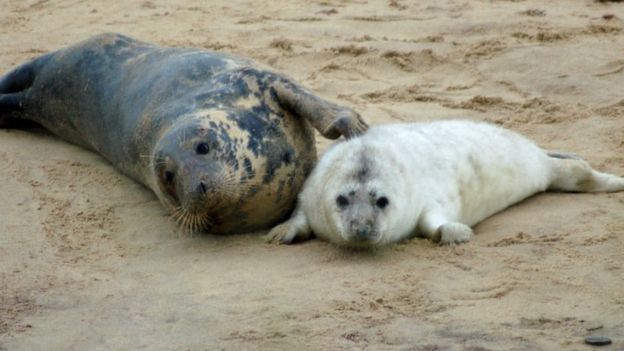
Horsey beach seal births top 1,000 for first time

A record number of grey seal births at a Norfolk beach shows a "major change" in behaviour as the animals become used to humans, marine experts have said.

Seals at Horsey, Norfolk
Seal pups are weaned by their mothers for about three weeks before they enter the sea

The 1.5 mile (2.4km) stretch of dunes at Horsey has hosted 1,018 births so far this winter compared to the previous winter when there were 804. Dr Dave Thompson, biologist at the Sea Mammal Research Unit (SMRU), said: "The colony growth is spectacular.
"These animals used to only breed on islands or sandbanks."
Seal at Horsey, Norfolk
Grey seals are able to shelter in the dunes at Horsey where volunteers try to prevent visitors from disturbing the breeding site
Seals at Horsey, Norfolk
The Sea Mammal Research Unit said grey seals used to breed only on sandbanks or islands not accessed by humans
Colonisation began in 2003 at Horsey, which is privately-owned with public access.
The Friends of Horsey Seals volunteers erect ropes and warning signs and patrol the beach to try to ensure seals are not disturbed during the November to January breeding season.

'Tolerant of humans'

Seals at Horsey, Norfolk
Peter Ansell, of the Friends of Horsey Seals group, said: "It's a milestone for us, given that it's a beach with public access.

"We have no idea when seal numbers will peak, but presume this will be governed by the food chain, of whicht hey are at the top."                                         Grey seal pups will fend for themselves after they have shed their white fur
The SMRU, based at St Andrew's University, monitors the size of the UK seal population.
Its statistics showed the number of pups had risen from 36,816 in 2002 to 51,293 in 2012 - the last year of its fully collated figures from the UK's main breeding sites.
Mr Thompson said pup births at sites in the northern part of the North Sea were static and the trend was for growth in the southern end.
"The Horsey colony growth is spectacular and it shows they've become more tolerant of humans in the vicinity," he said.
"The growth in the southern North Sea is so rapid that it has to be partly down to immigration from northern breeding sites with the seals deciding the habitats are more suitable."
From BBC News

Wednesday, December 30, 2015

Stranded whale rescued from Chile beach

A blue whale has been rescued after getting stranded on a beach in the port city of Iquique in northern Chile, South America.
Fishermen and beach-goers, along with the police and the navy, helped get the 20-metre-long mammal safely back out to deeper water.


The blue whale (Balaenoptera musculus) is a marine mammal belonging to the baleen whales (Mysticeti). At 30 metres (98 ft) in length and 180 tonnes (200 short tons) or more in weight, it is the largest extant animal and is the heaviest known to have existed.


Long and slender, the blue whale's body can be various shades of bluish-grey dorsally and somewhat lighter underneath.There are at least three distinct subspecies: B. m. musculus of the North Atlantic and North Pacific, B. m. intermedia of theSouthern Ocean and B. m. brevicauda (also known as the pygmy blue whale) found in the Indian Ocean and South Pacific Ocean. B. m. indica, found in the Indian Ocean, may be another subspecies. As with other baleen whales, its diet consists almost exclusively of small crustaceans known as krill.
Blue whales were abundant in nearly all the oceans on Earth until the beginning of the twentieth century. For over a century, they were hunted almost to extinction by whalers until protected by the international community in 1966. A 2002 report estimated there were 5,000 to 12,000 blue whales worldwide, in at least five groups. More recent research into the Pygmy subspecies suggests this may be an overestimate.[16] Before whaling, the largest population was in the Antarctic, numbering approximately 239,000 (range 202,000 to 311,000).There remain only much smaller (around 2,000) concentrations in each of the eastern North Pacific, Antarctic, and Indian Ocean groups. There are two more groups in the North Atlantic, and at least two in the Southern Hemisphere. As of 2014, the Californian blue whale population has rebounded to nearly its pre-hunting population.
in Wikipedia


Friday, November 20, 2015

Endangered pygmy hippo born at zoo

A rare baby pygmy hippo has been born at Bristol Zoo.

It is now three weeks old and has been enjoying splashing around in the water with its parents.

Pygmy hippos are an endangered species, with fewer than 2,000 left in the wild, as they face threats from hunting and people destroying the forests they live in.
Pygmy hippos only grow to be around 80cm tall, which is half the height of their cousin the Hippopotamus.
Lynsey Bugg, assistant curator of mammals at the zoo, said: "The calf is looking very strong and it certainly feeds well."
The role of zoos in keeping these species alive is very important. In fact, without their work and preserverance many species would no longer have any elements to represent them and therefore the world would be poorer and less balanced.
From CBBC Newsround

Friday, October 23, 2015

Snow leopards face 'new climate change threat'

Warmer temperatures are threatening to shrink the habitat of the snow leopard and weaken their struggle against extinction, a report says.

Snow leopard
Snow leopards are a species in crisis, the WWF report says

Conservation charity WWF says more than a third of the animal's mountain living areas could become uninhabitable because of climate change.
It says plants and trees there are not able to survive in warmer temperatures.
The report describes snow leopards as one of the most beautiful and enigmatic big cats.
"But it is also one of the most elusive and endangered," it says.

WWF says that the animal is threatened not just because of climate change but also because of a combination of other factors including:


Snow leopard in Mongolia
The WWF report is accompanied by rare camera trap images of snow leopards in Mongolia

Snow leopard
Snow leopards have been described by WWF as one of the world's most majestically beautiful and enigmatic big cats
Climate change will exacerbate most of these threats, the report says, further increasing the pressure on snow leopards and reducing them to unsustainable numbers in many areas.
"The Himalayas region will face a major crisis if we choose to ignore climate change. Not only do we risk losing majestic species such as the snow leopard, but hundreds of millions of people who rely on water flowing from these mountains may be affected," WWF-UK's Snow Leopard Programme Lead Rebecca May said.
The charity says that India, Nepal and Bhutan's success in increasing the number of endangered species such as tigers and rhinos could be replicated for snow leopards
Snow leopard

Snow leopards

  • Native to the mountains of Central and South Asia, it is estimated that there are some 4,000 to 6,000 worldwide
  • Usually found at elevations of 3,000-4,500m (11,480-14,760ft)
  • Solitary creatures, they usually hunt at dawn and dusk and are able to kill prey up to three times their own weight
  • Mostly feed on wild animals, but will also prey on livestock
  • Their spotted coats change with the seasons - from a thick, white fur to keep them warm and camouflaged in winter to a fine yellow-grey coat in summer
  • Retaliatory killings by farmers are not uncommon but are rarely reported

From BBC News- science/Environment

Wednesday, August 12, 2015

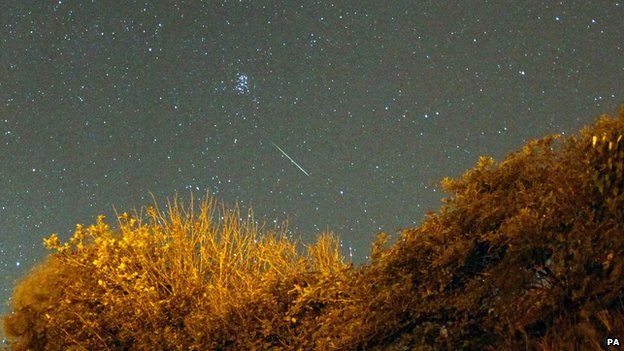
Guide: How to watch the Perseid meteor shower

Stargazers are getting ready to enjoy the spectacular Perseid meteor shower.

Time exposure photograph of polar stars during a meteor shower.
Time exposure photograph of polar stars during a meteor shower
Up to 100 shooting meteors an hour will streak across the sky in the beautiful natural firework show, visible around the world.
Those hoping to catch a glimpse of the shower shouldn't be disappointed this year.
Astronomers say they're expecting extra-dark skies which will create perfect stargazing conditions.
The Perseids
Up to 100 shooting meteors per hour will streak across the sky

What causes the Perseid meteor shower?

The Perseids are actually tiny pieces of the Swift-Tuttle comet that can be seen every year when the Earth passes through a cloud of the comet's debris.
They're bits of ice and dust, which can be as small as a grain of sand or as big as a pea.
The fragments were left behind when Swift-Tuttle passed close to Earth in 1992.
The meteors appear to come from a point in the constellation of Perseus, hence the name Perseid.
They hit the Earth's atmosphere at a whopping speed of 134,000 mph, but don't pose any danger to us on Earth.
Perseid meteor shower
It's best to find a wide open space away from tall buildings, trees and artificial light

When and how can I see it?

The celestial show is expected to hit its peak overnight on Wednesday.
Unlike some other cosmic events, spectators don't need special technology to watch the Perseids unfold.
It's best to find a wide open space away from tall buildings or trees, and with as little light as possible. The more of the sky you can see, the better.
This year the Moon's glow will not interfere with meteor-watching, as it will be approaching its darkest or "new" phase, experts say.
From CBBC newsround

Thursday, July 23, 2015

Lisbon Zoo welcomes new inhabitants


Unusually, two flamingos were born at the Lisbon Zoo recently. It is usually just one a year but this time they have two instead. The Lisbon Zoo definitely has the best living and procreating conditions, not only for flamingos, but for dozens of other important species among the which we may find really endangered species and others at risk of extinction such as elephants, rhinos, the Persian leopard,the spiked turtle, the golden parakeet, and many others including African Impalas, the marmoset Emperor, and so on. This Zoo is really worth a visit for the hundreds of species it keeps and grows, the warm climate we can find in Lisbon, the dolphins and sea lions shows held daily, the lung it is in a cosmopolitan city like Lisbon and the many attractions it provides due to the exchange programms to which it is associated and that allows tourists and common visitors to enjoy at any time of year.
 Every animal's habitat is carefully chosen and taken care so that every species can easily breed and live nearly with the same natural conditions they have in the wild. The Lisbon Zoo keeps the only Okapi calf born in Europe.
Mª Dulce Branquinho


Saturday, April 11, 2015

Dolphins stranded on Japan beach


Nearly 150 melon-headed whales, a species of dolphin, have become stranded on a beach in Japan.
They were found along a 4km (2.5 mile) stretch of beach in the Ibaraki prefecture, north-east of Tokyo.
Efforts are under way to try to rescue the animals.
"We see one or two whales washing ashore a year, but this may be the first time we have found over 100 of them on a beach," a coastguard official told the AFP news agency.
About 50 animals of the same species beached themselves in a similar area in 2011.
The reason for the beaching is unclear, but researchers from the National Museum of Nature and Science travelled to the beach to investigate.
From BBC News


Sunday, March 15, 2015

Spain: Rare Iberian lynx tracked in Madrid region

The critically endangered Iberian lynx has returned to the Madrid region of Spain for the first time in decades, it's reported.
An Iberian lynx
Conservation efforts have successfully raised the Iberian lynx population to more than 300, but many have been killed on Spanish roads
It's more than 40 years since the species has set foot in the region, but now one has been tracked near a town just 50km (31 miles) south of the Spanish capital, El Pais reports. The male lynx, called Kentaro, was born in captivity and released along with seven others in Toledo in late 2014. Since then he's been quite the adventurer, travelling about 100km and crossing several motorways, according to conservationists. "Not all lynxes are this adventurous. They tend to stay close to where they were born," says Ramon Perez de Ayala from the World Wildlife Fund (WWF). But Kentaro has "packed his bags and set off on his travels," he says. "We've been lucky because the roads he has crossed are well fenced and he hasn't been run over. He will have followed the fences until he found a bridge, and then crossed over there." Kentaro wears a GPS collar which allows conservationists to track his whereabouts.
The Iberian Lynx is the world's most endangered feline, and the only breeding populations are both in southern Spain. Traffic is one of the the biggest dangers for the species - according to El Pais, at least 21 lynxes were hit and killed on Spanish roads in 2014, and 14 died the year before. The WWF wants Spain's regional governments to put in place special measures which would help protect lynxes, including fencing off roads and motorways.

From BBC news

Thursday, July 24, 2014

Amur leopards born at Twycross Zoo


It's really good news!


A pair of Amur leopards, which are said to be the rarest big cats in the world, have been born in Leicestershire.
Twycross Zoo said its new cubs were born in June and could one day be reintroduced into the wild.
There are about 50 wild Amur leopards in China and south-eastern Russia but they are close to extinction because of poaching and illegal logging.
From BBC News

Monday, July 14, 2014

Freak hailstorm hits a beach in Siberia

Swimmers and sunbathers were forced to run for cover when a freak hailstorm hit a beach in Siberia, Russia, on Saturday.

Seconds earlier: The hailstorm happened on a day which saw temperatures rising to 37C
Dozens were seen taking cover from the hail under sun umbrellas and beach side shacks with corrugated roofing.Towels, beach mats and personal possessions were sent flying by heavy winds.Heavy winds hit the sandy beach in Novosibirsk late on Saturday afternoon as hundreds were cooling off from the hot summer's day by swimming in the Ob, the fifth longest river in the world.Bathers said that minutes before the storm there was no clue about the dramatic cloudburst to come. 
Swimmers and sunbathers were forced to run for cover when hit a freak hailstorm hit a beach in Siberia, Russia, on Saturday.

Bathers ran out of the Ob River clutching their heads as hail the size of golf balls fell from the sky.
Sunbathers run for cover as storm of giant hailstones hits a beach on the Ob River in Siberia

Bathers ran oof the Ob River clutching their heads as hail the size of golf balls fell from the sky.

'It was an attack from the heavens': The shocking moment a Siberian beach was hit by a freak hailstorm on one of the hottest days of the summer

From
  •  BBC News
  • Mail online

Friday, February 07, 2014

Weird jellyfish found on Australia beach

Scientists are getting excited about a huge new species of jellyfish that washed up on a beach in Australia.

Jellyfish

It was discovered by a family last month and stretches 1.5m wide.
It's a type of lion's mane jellyfish, but scientists are trying to classify which species it is and give it a name.
In recent years there have been huge blooms of jellyfish in the waters near where this one was found, but no one knows why.
Dr Gershwin from Australia's national science agency said: "We're very keen to find out why jellyfish are blooming in such super-abundances in these southern waters," she said.
From CBBC newsround

Tuesday, December 31, 2013

'Podcam' shows life of dolphins in BBC Spy in the Pod series

Film-makers have infiltrated the ocean with secret cameras to capture dolphin behaviour in the wild as it has never been seen before.
They enlisted a menagerie of creatures, such as a molluscs, sea turtle and squid, with hidden lenses to get up close and personal for a new BBC natural history programme.
From BBC Sci / Environment
 Watch the video and see them spinning out of water.
 Fantastic!


The acrobatic spinner dolphin is the most common small cetacean in many tropical open seas, where it can be seen spinning high in the air (hence its common name) or riding the bow waves of boats . The small and slender spinner dolphin varies geographically in colouration and size, but can be identified by its relatively long, slender beak and triangular dorsal fin . The most common colour pattern is three-part: dark grey on the back, lighter grey along the sides, and white or very light grey underneath. A darker grey stripe runs from the eye to the flipper, bordered above by a narrow, light line .

Spinner dolphins are well known for their acrobatics and aerial behaviours. A spinner dolphin comes out of the water, front first, and twists its body as it ascends in the air. After it reaches its maximum height, the dolphin descends back into the water, landing on its side. A dolphin can make two to 5.5 spins in one leap. The swimming and rotational speed of the dolphin spinning underwater affects the number of spins it can do while airborne. These spins may serve several functions. Dolphins may also make nose-outs, tail slaps, flips, head slaps, "salmon leaps", and side and back slaps.

Also known as
long-beaked dolphin, long-snouted dolphin.
French
Dauphin Longirostre.
Spanish
Delfín Tornillón, Estenela Giradora.
Size
Length: 129 – 235 cm 
Weight
23 – 78 kg 


Sunday, November 10, 2013

Huge huntsman spider found in UK bike warehouse

A giant spider common in Australia has been found in a UK BMX warehouse.

Huntsman spider

The seven-inch-long huntsman spider is believed to have been locked up for six weeks in a container from Taiwan.
Workers spotted the animal when unpacking boxes - and it's now been safely rehomed at a nearby zoo.
John Taylor, a BMX salesman at the warehouse, told Newsround: "We knew straight away that it wasn't a UK spider. We didn't want to kill it. We are happy that it is in a good home."
"We are talking about visiting him as a team," he said.
'Running around and jumping up'
Warehouse manager Joe Woodburn said: "It was as big as the palm of my hand. We managed to get it into a big plastic container where we kept it while we called the RSPCA.
"I thought it was plastic at first as it wasn't moving, but the minute it was in the sunlight it started to warm up and it was running around and jumping up the side of the box."
RSPCA inspector Zoe Ballard said: "I've never come across a spider like this before.
"I managed to secure the spider in the container and took it to the RSPCA's wildlife centre nearby... I was worried all the way that it would get out and escape in my van."
The spider has now been rehomed at Drusillas Zoo Park near Eastbourne.
RSPCA inspector Tony Woodley said: "Huntsman spiders can give you a nasty bite, but they aren't likely to cause too much harm unless you suffer an allergic reaction.
"They are not dangerous or aggressive, but can move extremely fast if disturbed. I am sure it would have given the guys in the warehouse a bit of a fright when they found it."
From CBBC newsround
Click for less

Wikipedia

Search results