To my dear visitors and commenters

Hi, everybody! I've noticed with lots of joy and happiness, that thousands of comments have been written in my posts. It's wonderful that so may people around the world appreciate my work. Therefore, I want to thank you for that and ,at the same time I want to ask you to be this blog's followers. It's fast and easy! Make it be even more visited and spread all over the world! I'm a woman, a teacher of English in Portugal, and I've been away for quite a long time because of my father's health. Unfortunately he died from Covid19 a few months ago. Now I felt it was time to restart my activity in this and other blogs I owe. I've recently created a new one in a partnership with a street photographer, Mr. Daniel Antunes. He's fabulous! https://pandpbydandd.blogspot.com I'd like you to visit it and, who knows, become our followers. The poems, chronicles and thoughts are all mine. Thank you so much! Kisses :-)

Search This Blog

Showing posts with label UK News. Show all posts

Saturday, January 30, 2016

Big Garden Birdwatch: Thousands expected to join RSPB weekend

More than half a million people are expected to take part in an annual UK birdwatch this weekend and record species spotted in gardens and parks.

Photo of blue tits
The survey will monitor birds including the blue tit
The RSPB Big Garden Birdwatch tracks species like starlings and song thrushes, which have declined by 80% and 70% since the survey began in 1979.
The unusual weather this winter could affect which birds are seen in gardens.
The RSPB said it was likely there would be fewer birds because they have been less reliant on garden feeders.
December was the warmest and wettest month in the UK in more than 100 years, before a cold snap was followed by warmth in January.
The RSPB said it would be interesting to see how this had affected the long tailed tit, which is badly affected by harsh winters, and if there were lower numbers of species from the continent, including finches and blackbirds.

'Quieter gardens'

RSPB wildlife adviser Ben Andrew said: "If the UK experiences a continuation of these milder temperatures, those taking part in Big Garden Birdwatch may notice their gardens quieter than in other years.
"The milder weather means there is more food available in the wider countryside, with birds being less reliant on garden feeders."
However, Mr Andrew added it was still important to keep garden feeders stocked so that birds could find food whatever the weather.
The birdwatch, which takes place over the next two days, encourages people to spend at least an hour spotting birds and then report their sightings to the RSPB.
This lets them to learn more about changes in numbers.
From CBBC Newsround

Saturday, October 31, 2015

Four UK bird species including puffins 'face extinction'

Puffins are among four UK bird species now at risk of extinction, according to the latest revision of a global conservation database.

Puffins
The Atlantic puffin population is still in the millions, but fewer young birds are surviving to breed

Atlantic puffins, European turtle doves, Slavonian grebes and pochards are on the International Union for Conservation of Nature (IUCN) Red List of Threatened Species for birds.
This means the number of UK species on the critical list has doubled to eight. Puffins are vulnerable to pollution and declining food sources, ecologists say. Another 14 UK species are considered to be "near threatened".

'Erosion of wildlife'

Martin Harper, conservation director with the Royal Society for the Protection of Birds (RSPB), said the "global wave of extinction is now lapping at our shores".
"The erosion of the UK's wildlife is staggering and this is reinforced when you talk about puffin and turtle dove now facing the same level of extinction threat as African elephant and lion, and being more endangered than the humpback whale," he said.

Turtle dove
Turtle dove numbers are in decline
Curlew sandpiper
Curlew sandpipers have been added to the near-threatened list
Although the Atlantic puffin population is still in the millions, fewer young birds are surviving to breed.
Reasons include a recent decline in the population of puffins' prey, such as the sand eel, and vulnerability to pollution such as oil spills, according to advisory body the Joint Nature Conservation Committee.
They have been listed as vulnerable to extinction, the lowest of three categories behind critically endangered and endangered.
Shetland has been listed as the best destination for watching puffins, according to a National Geographic list of the top 10 places to see wildlife.

Unexplained decline

A decline in turtle dove numbers across Europe of more than 30% in the past 16 years has also made it vulnerable to extinction.
The decline in the UK has been particularly high, with more than nine out of every ten birds being lost since the 1970s, according to conservation group Birdlife.
This is partly due to an as yet unexplained decline in the number of breeding pairs, the RSPB believes.
Grebe
The Slavonian Grebe migrates to breed in a handful of Scottish lochs

Pochard
Pochards are mostly seen in the UK in the autumn and winter when they migrate from Russia and eastern Europe

The migratory species also flies over the Mediterranean where, especially in Malta, there is a tradition of spring shooting birds. The country recently rejected a ban on hunting birds in a referendum.
The decline in Slavonian grebes in the UK is in part down to a reduction in successful breeding pairs, although conservationists say specific reasons for this are unclear.
Hunting and habitat destruction are thought to be to blame for the reduction in pochard populations.
Other UK birds that have been added to the near-threatened list include oystercatchers, lapwings, the curlew sandpiper and bar-tailed godwit.
They join species already listed such as the black-tailed godwit and curlew.

Critically endangered UK bird species

  • European turtle-dove
  • Slavonian grebe
  • Pochard
  • Atlantic puffin
  • Balearic shearwater
  • Aquatic warbler
  • Long-tailed duck
  • Velvet scoter

Near-threatened UK bird species

  • Razorbill
  • Meadow pipit
  • Sooty shearwater
  • Red knot
  • Curlew sandpiper
  • Eurasian oystercatcher
  • Bar-tailed godwit
  • Black-tailed godwit
  • Red kiteEurasian curlew
  • Common eider
  • Dartford warbler
  • Redwing
  • Northern lapwing

From BBC News. Science/ Environment

Friday, October 02, 2015

Plastic in oceans 'threatens food chain'


As England prepares to introduce a charge for plastic bags, science editor David Shukman reports on the possible threat to the food chain, by the plastics broken down into tiny fragments in our oceans.
Tests by the Plymouth Marine Laboratory have shown that when minuscule particles of plastic are in the water, the creatures at the bottom of the food chain do ingest them.
An estimated eight million tonnes of plastic waste is added to the oceans every year.(BBC News)


Tuesday, August 11, 2015

Global warming threatens extinction for UK butterflies

Global warming could drive drought sensitive butterfly species to extinction in the UK by 2050, according to new research.


Green veined white butterfly
The Green Veined White butterfly is one of the species at risk of extinction from drought
Scientists found that even the lowest expected levels of warming could decimate populations.
However the researchers found that restoring connections between butterfly habitats could help modify the worst impacts.
The research has been published in the journal Nature Climate Change.
Although many people believe that butterflies are creatures that love the warmth, periods of extremely hot and dry weather can significantly reduce populations.
In this study, British researchers looked at the impact of an extreme drought event in 1995 on butterfly species. This was the most arid summer since records began in 1776.
They identified six species, including the Cabbage White and the Speckled Wood butterflies, that were particularly sensitive to heat.
They then looked at what might happen to these creatures under different levels of warming up to 2100.
If emissions of carbon dioxide continue on a "business as usual" model, and warming is more extreme, then extinctions of some of these species could begin in England as early as 2050.
speckled wood butterfly
Restoring habitat connections could help mitigate the worst warming impact on butterflies
"We looked at the extent to which populations crashed from the drought and how long it takes them to recover," said lead author Dr Tom Oliver from Nerc Centre for Ecology and Hydrology.
"What we're asking is, as droughts become more frequent whether the return time of the drought was more frequent than the recovery of the butterflies."
"And when that was the case you'd get this gradual population erosion and in those places you'd get local extinctions."
The researchers say that areas of the south east of England would be worst affected.
However they argue that under less extreme warming conditions, changes to butterfly habitats could ameliorate the worst impacts.
The team found that restoring connections between habitats that have been fragmented by human activities such as agriculture, was capable of making a big difference.
Under a low emissions scenario, bridging these connections could improve the probability of butterfly survival by 50%.

"If our habitats are very fragmented, the impacts will be much more severe. In places where it isn't those populations might persist," said Dr Oliver.
"It allows us to buy time until we get those global emission cuts in place."
The researchers believe their study is a conservative estimation of how warming might impact these fragile species.


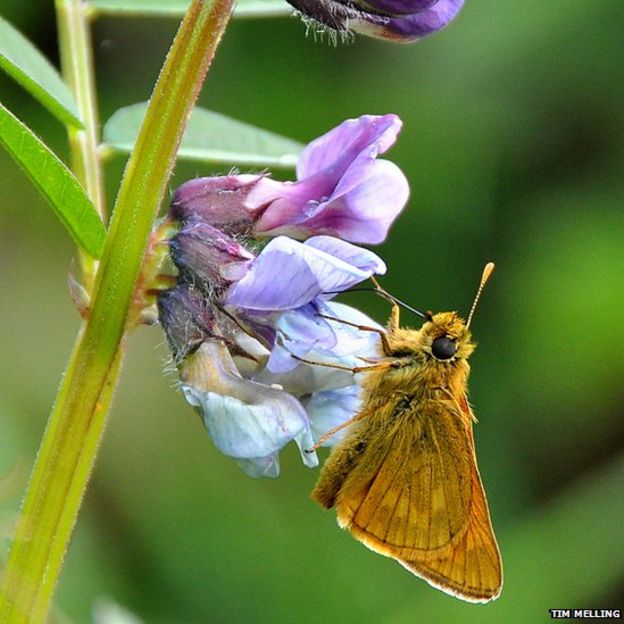
Large Skipper butterfly

Extinctions of species like the Large Skipper could happen by 2050 under some warming scenarios
They are concerned that, because of landscape changes in the UK throughout the 20th century, populations of some of the threatened species might be too low for them to recover from frequent droughts.The authors say that even people who are not impressed by the aesthetic appeal of butterflies should still be concerned about their demise.
"Butterflies are important culturally as part of our natural heritage, but there are other functions that could be impacted by their extinction including pollution, pest control and decomposition of waste," said Dr Oliver.
"Those un-swayed by the beauty and importance of having butterflies in the countryside ought to be concerned about the disruption to these functions provided by these species."
 From BBC Science/Encironment

Wikipedia

Search results