To my dear visitors and commenters

Hi, everybody! I've noticed with lots of joy and happiness, that thousands of comments have been written in my posts. It's wonderful that so may people around the world appreciate my work. Therefore, I want to thank you for that and ,at the same time I want to ask you to be this blog's followers. It's fast and easy! Make it be even more visited and spread all over the world! I'm a woman, a teacher of English in Portugal, and I've been away for quite a long time because of my father's health. Unfortunately he died from Covid19 a few months ago. Now I felt it was time to restart my activity in this and other blogs I owe. I've recently created a new one in a partnership with a street photographer, Mr. Daniel Antunes. He's fabulous! https://pandpbydandd.blogspot.com I'd like you to visit it and, who knows, become our followers. The poems, chronicles and thoughts are all mine. Thank you so much! Kisses :-)

Search This Blog

Showing posts with label global warming consequences. Show all posts

Sunday, April 03, 2016

'Drastic' Antarctic melt could double global sea-level rise

Global sea levels could rise by more than double the current best estimate, according to a new analysis of climate change in Antarctica.

Ice melt
The latest model suggests that Antarctic melting could double projections of sea-level rise

The modelling assessment says that Antarctic melting alone could contribute more than a metre to sea level by the end of this century.
By 2500, according to the study, the same source could cause levels across the world to rise by 13m.
The authors say that rapid cuts in carbon emissions could limit this risk.

Competing ideas

In 2013, the Intergovernmental Panel on Climate Change (IPCC) predicted that, without any restrictions on carbon emissions, the seas around the world likely rise by up to 98cm by 2100.
However, the IPCC estimates contained a minimum contribution from Antarctica.
Other analyses since then have projected bigger increases, with a recent studysuggesting that the oceans were rising faster than at any time in the past 2,800 years and by 2100 they could be up to 1.31m higher.
The exact level of Antarctica's impact on these projections has been vigorously debated. Late last year, a research paper suggested that projections of a contribution of a metre or more were not plausible.
But this new study argues that by 2100 the world could see 1.14m of sea-level rise from Antarctica alone.

Additions to the model

The scientists say that their model is able to provide a more accurate prediction because it incorporates the impacts of some physical processes for the first time.
While other models have focussed on the impact of warmer waters melting the ice shelves from below, this new study also includes the effect of surface melt-water and rain trickling down from above and fracturing supporting ice, hastening its slide to the sea.
The model also calculates the impact of the disintegration of floating ice shelves. If this happens, it will reveal walls of ice so tall that they cannot support their own weight.
The scientists involved expect that these extra factors will kick in over the coming decades, as warming from the atmosphere (not just from warmer waters below) becomes the dominant driver of ice loss.
ice melt
The collapse of ice cliffs could be a significant factor in the new projection
"One reason that other models didn't include the atmospheric warming is because it hasn't started to happen just yet," said co-author Dr David Pollard from Penn State University, US.
"In Antarctica, around the edges at sea level, it's just beginning to get up to the melt point in summer.
"With that warming, the flanks of Antarctica will start to melt drastically in about 50 to 100 years - and then it will start to kick in according to our model."
The authors believe that they have demonstrated the accuracy of the new model by correctly replicating sea-level rise in warm periods, millions of years into the past.
"Recently, we looked at the long-standing problem posed by geological evidence that suggests sea level rose dramatically in the past, possibly up to 10 to 20 metres around 3 million years ago, in the Pliocene," said Dr Pollard.
"Existing models couldn't simulate enough ice-sheet melting to explain that."

'Right questions'

If the world continues to emit "business as usual" levels of carbon dioxide over the coming decades, the scientists argue that sea-level rise will be double what has already been estimated for the coming 100 years.
"If these processes do kick in and they end up being as important as we think that they could be, then they really do have a big impact," said Prof Robert DeConto from the University of Massachusetts, Amherst.
"West Antarctica is responding very soon in these simulations and that ends up having a big impact on North America in particular."
Other researchers have praised the development of the new model for including impacts such as surface melt water and ice-cliff collapse, but they are uncertain about the conclusions.
"I have no doubt that on a century to millennia timescale, warming will make these processes significant in Antarctica, as well as Greenland, and drive a very significant Antarctic contribution to sea-level rise," commented Prof David Vaughan of the British Antarctic Survey.
"The big question for me is, how soon could this all begin, and could it be early enough to drive substantially higher sea levels by 2100? I'm not sure, but these guys are definitely asking the right questions."
The authors believe that there is "good news" in their report. If global emissions of carbon are curtailed significantly then the extra factors that substantially boost Antarctic melting will be avoided.
Seas will continue to rise, but not at the runaway rates suggested by this paper,which has been published in the journal Nature.
From BBC news-Science/ Environment


Friday, April 01, 2016

Climate predicts bird populations

Populations of the most common bird species in Europe and the US are being altered by climate change, according to an international study.

Bee-eater (c) Harvey van Diek
Bee-eaters seem to be benefitting from climate change, increasing their population in Europe in recent years

For the first time researchers showed climate to be having a similar, significant impact on bird populations in large, distant areas of the world.
Their study used population-predicting models and three decades of field data, gathered by bird-watching volunteers.
The findings are published in the journal Science.
Led by Durham University scientists, the team developed models that related each species' habitat to long-term climate patterns.
Using annual climate records - from 1980 to 2010 - these models were able to predict where a species had experienced an improvement or a decline in suitable climate.
Wren (c) Steve Willis/Durham University
Climate is remapping habitat for many familiar birds, such as the wren

"We then had this amazing data set collected by thousands of volunteers over decades - where people have gone out and counted birds across different countries in Europe and the United States," explained lead researcher Dr Stephen Willis.
"We can use that to see to what extent our predictions match what people are finding on the ground."
The outlook is different for each species. Increasing temperatures in the UK, for example, allow some species to expand their range and increase their population, while the same temperature patterns have made the UK a less suitable habitat for others.
But the overall trends, this study shows, are strikingly similar in the US and Europe; populations are increasing in species predicted to benefit from climate change and decreasing in those predicted to be negatively affected.
"One important thing is that we're looking at the most common birds," said Dr Willis. "These birds are doing a lot of good in the countryside - eating crop pests and helping our ecosystems work.
"So we need to understand how they'll respond."

Shifting flocks


American Robin (c) US Fish and Wildlife Service
The American robin has declined in some southern states, but increased further north.

The research shows how the climate is gradually remapping the avian habitat across two continents.
In Europe, for example, birds such as the wren have been increasing in northern areas as winters become milder, but declining in some southern countries. The American robin has declined in some southern states, but increased further north.
"This is really the first time anyone's ever looked at changes in climate across two really extensive parts of the world," said Dr Willis. "So we're getting an idea that [the impacts of] climate change on wildlife are more far-reaching than individual countries."
David Noble from the British Trust for Ornithology, who was also involved in the study, told BBC News that the findings highlighted the value of such extensive data sets generated by volunteers.
"The similarities in results between the two continents, despite very big differences in their landscapes, geographic barriers and patterns of vegetation, are compelling evidence for the climate change effects," he added.
Dr Willis agreed, saying: "This is work carried out by thousands upon thousands of volunteers; it really demonstrates the power of citizen science."
The study was carried out in partnership with the RSPB and United States Geological Survey (USGS).
From BBC News- Science/ Environment

Thursday, March 24, 2016

Turtles in trouble as warming beaches turn eggs female

Can you imagine if the temperature decided whether you were born a girl or a boy?
Well that's exactly what happens with turtles.
But experts in Australia are now worried that rising temperatures over time could cause chaos for turtle populations by creating too many female turtles.

From CBBC Newsround


Researchers investigating the impact of rising temperatures on sea turtles are travelling to some of the most remote beaches in Australia to work out which populations are at risk of being feminised into extinction.
In a phenomenon being seen worldwide, warming temperatures are resulting in an increasing number of turtle eggs hatching female.
The race is now on to work out which rookeries are most at risk in Australia, with a University of Western Australia (UWA) team focused on turtle breeding areas on the Kimberley coast.

"This is very fundamental research, and will give us insights fifty years ahead about whether sex ratios will change, where distributions might shift to, and what impact climate change is going to have," team leader Nicki Mitchell said.
Blair Bentley holding a baby turtle on a beach on the Kimberley coast.
The tipping point for sex determination in turtles is thought to be just over 29 degrees Celsius. If the beach sand is any warmer the incubating eggs will hatch female, however if it is any cooler, the hatchlings will be male.
The problem is that beaches are heating up across much of the globe, and that could have big implications for turtle rookeries.
Researcher Blair Bentley said whole populations could be at risk.
"If it keeps getting warmer there are going to be more females being produced, and over time the males will keep dying at a greater rate than they are being replenished, so it's what's called demographic collapse," he said.
"There might still be males in the population, but there'll be far more females, and reproductive success will go down significantly."

Friday, March 18, 2016

Great Barrier Reef coral 'bleaching' level increased

Authorities in Australia have raised the threat level for coral 'bleaching' in the Great Barrier Reef, after divers found that lots of coral had died.

Divers
The Great Barrier Reef is the world's largest living structure, and is home to thousands of plants and animals - it is so big it can even be seen from space.
Divers have found that an increase in the sea's temperature has been putting the coral which grows there under a lot of stress causing 'bleaching', which means a loss of colour.
bleached coral

What is bleaching?

Many types of coral have a special relationship with tiny algae that live in the coral.
These tiny algae produce about 90% of the food the coral needs to grow, and give them their bright colours.
Bleaching happens when sea temperatures get too high or low, causing the algae to get 'stressed out' and leave the coral.
This turn the coral white and leaves it very vulnerable.
An increase of just one degree Celsius for four weeks can cause bleaching. If this continues for more than eight weeks, the coral can die.
diver looking at coral bleaching

Has this happened before?

In 2002 the surface temperature of the sea water in the Great Barrier Reef increased by around 2-3 degrees causing one of the worst bleaching incidents on record, affecting more than 60% of the coral.
While some coral reefs can recover from bleaching in a few years, others don't recover at all.
The Great Barrier Reef Marine Park Authority have now raised the bleaching threat level, and have said that there is a very high risk of mass coral bleaching this month.
The Australian government said it is working closely with the marine rangers to help keep an eye on the coral for the next few months to see how it is doing.
From CBBC Newsround

Friday, February 26, 2016

How Northern European waters soak up carbon dioxid

The seas around the UK and the rest of northern Europe take up a staggering 24 million tonnes of carbon each year.

Stormy waters
Colder, stormy waters at higher latitudes tend to take up most carbon dioxide
It is a mass equivalent to two million double-decker buses or 72,000 747 jets.
The number was produced by scientists studying the movement of carbon dioxide into and out of the oceans.
The team, led by Heriot-Watt University and Exeter University, has produced a software "engine" that will allow other scientists to do the same for different parts of the globe.
"It's a software toolbox essentially, that we've made available," said Exeter's Jamie Shutler.
"We've used it for our own work. We've done extensive checking, and now we're putting it out there for everyone else to use."
The amount of carbon dioxide absorbed by seawater acts as a moderator in the climate system.
It is estimated that a third of all human-produced CO2 emissions, from fossil fuel burning and the like, ends up in the oceans. Another third is taken up by land "sinks", with the rest remaining in the atmosphere.
Researchers are keen to understand how this budget might change over time.
Study
From  BBC News

Sunday, January 17, 2016

Carbon emissions 'postpone ice age'

The next ice age may have been delayed by over 50,000 years because of the greenhouse gases put in the atmosphere by humans, scientists in Germany say.

Ice Age Earth
Earth has been through a cycle of ice ages and warm periods over the past 2.5 million years
They analysed the trigger conditions for a glaciation, like the one that gripped Earth over 12,000 years ago.
The shape of the planet's orbit around the Sun would be conducive now, they find, but the amount of carbon dioxide currently in the air is far too high.
Earth is set for a prolonged warm phase, they tell the journal Nature.
"In theory, the next ice age could be even further into the future, but there is no real practical importance in discussing whether it starts in 50,000 or 100,000 years from now," Andrey Ganopolski from the Potsdam Institute for Climate Impact Research said.
"The important thing is that it is an illustration that we have a geological power now. We can change the natural sequence of events for tens of thousands of years," he told BBC News.
Earth has been through a cycle of ice ages and warm periods over the past 2.5 million years, referred to as the Quaternary Period.
This has seen ice sheets come and go. At its maximum extent, the last glaciation witnessed a big freeze spread over much of North America, northern Europe, Russia and Asia.
In the south, a vast expanse of what are now Chile and Argentina were also iced up.

Friday, January 01, 2016

Delhi begins car rationing to curb pollution

Authorities in the Indian capital, Delhi, have launched major restrictions on private cars to curb alarming levels of pollution.

Cars and autorickshaws move through the central Connaught Place area in New Delhi, India, Thursday, Dec. 24, 2015.
Private cars with even and odd numbers plates are being allowed on alternate days
Private cars with even and odd number plates are being allowed on alternate days from Friday in an initial two-week trial.
Emergency vehicles like ambulances, police cars, fire engines and taxis have been exempted from the order.
Delhi has experienced hazardous levels of pollution this winter.
The local government announced the scheme after a court ordered authorities to tackle pollution levels more than 10 times the World Health Organisation's safe limits.

Exemptions

The government has made several exemptions to make it easier for people to follow the restrictions. The plan will be imposed between 8am and 8pm from Monday to Saturday.
Women will be allowed to drive their cars on all days but they can only be accompanied by women, and children below the age of 12. Cars carrying disabled people will also be allowed on all days.
Along with two wheelers, cars operating on natural gas have been exempted. In cases of medical emergency, people will not be stopped from taking patients to hospitals.
The government has hired around 3,000 private buses to provide shuttle services into the city from residential areas to ease the extra pressure on the public transport network.
Schools have been also shut until the trial ends on 15 January so that their buses can be used as public transport.
The government has launched an app that people can use to book tuk-tuks to improve last-mile connectivity from the Metro stations.
Indian policeman directs traffic on a road before the implementation of the odd-even vehicle scheme in New Delhi, India
The government has hired around 3,000 private buses to provide shuttle services
an Indian worker displays a sticker on his vehicle that indicates it runs on compressed natural gas (CNG) after getting it checked at a pump in New Delhi
Cars operating on natural gas have been exempted
Indian commuters travel on a polluted road near a bus terminus in the Anand Vihar District of New Delhi.
Delhi has been experiencing hazardous levels of pollution this winter
Traffic policemen and several thousand volunteers will check cars at intersections and violators will be fined 2,000 rupees ($30; £20) and asked to return.
"The biggest challenge is to make people realise that this fight against pollution is for them, for their health, for their own good," Delhi Transport Minister Gopal Rai told AFP news agency.

Grim

Critics, however, say the plan is not practical - they say that in a city with an inadequate public transport system and poor last-mile connectivity, the new measures are likely to inconvenience commuters.
"Let's not convince ourselves wrongly that a simple odd-even policy will solve the overall air pollution issue," AFP quoted Arunabha Ghosh, head of the Delhi-based Council on Energy, Environment and Water, as saying.
Indian Volunteers who will be supporting Delhi Government in the odd-even vehicle scheme attend a briefing and training in New Delhi, India, 30 December 2015.
Several thousand volunteers will help police during the drive
"Otherwise, we will be simply kicking the can down the road and we will create a feeling of distrust among citizens and the government machinery."
Delhi resident Pankaj Mehta, who drives 45km (30 miles) to work daily, told AFP that the restrictions would make commuting difficult.
"Rickshaw, then metro, then feeder bus, then walk - back and forth. A travel nightmare," he said.
"But if it makes breathing easier, then it may be worth it."
Environmental activists have welcomed the decision, saying the situation is so grim that urgent drastic steps are needed.
New car sales are soaring in India, with 1,400 extra cars taking to the capital's streets every day.
From BBC News

Thursday, December 17, 2015

Giving Endangered African Penguins a Second Chance at Life

This short video produced by IFAW shows the plight facing endangered African Penguins due to overfishing, pollution, and climate change. But there is hope as IFAW is working with the Southern African Foundation for the Conservation of Coastal Birds (SANCCOB) in Capetown, South Africa to rescue, rehabilitate, and release African penguins back to the wild. 

To learn more, visit www.ifaw.org.


The number of African penguins in South Africa and Namibia has dramatically fallen in the past ten years.
The penguins pair for life and have their chicks - but the number of pairs has dropped from over 30,000 in 2004 to just over 3,000 in 2014.
Nicky Stander, a Penguin Conservationist says: ''There used to be over a million penguins in the 1930's but now the population is down by around 98 per cent.''
Experts say it's because the sardines and anchovies they eat are disappearing.
They believe it's because of over-fishing and the sea getting warmer. (CBBC Newsround)

Saturday, December 12, 2015

COP21: Climate deal 'final draft' reached in Paris

 Organisers of the climate talks in Paris say a final draft text has been reached after nearly two weeks of intensive negotiations.

The Thwaites Glacier in Antarctica
The main goal is to keep the rise of global temperatures under 2C


An official in the office of French Foreign Minister Laurent Fabius told the AFP news agency the draft would be presented to ministers at 10:30 GMT.
No details of the proposed agreement have been released so far. The tentative deal was reached nearly 16 hours after the talks had been scheduled to close.
"We have a text to present," the official said, adding that the draft would be now translated into the UN's six official languages.
Analysts say that this is not a done deal - it will only be finally adopted if there are no objections raised at Saturday morning's ministerial meeting, and even this is unlikely to come before afternoon in the French capital.Mr Fabius, who has presided over the talks, had said earlier that the "conditions were never better" for a strong and ambitious agreement.


Significant progress had been reported on a range of issues, with evidence of real compromise between the parties, the BBC's environment correspondent Matt McGrath in Paris reported earlier.
He added that countries supported a goal of keeping global temperature rises to 2C but agreed to make their best efforts to keep it to 1.5C. However, the language on cutting emissions in the long term was criticised for significantly watering down ambition. 
text
     Eager delegates leaf through an earlier draft text

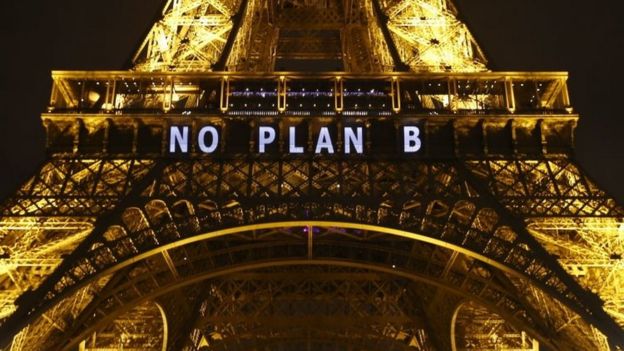
A slogan
 A "No plan B" slogan was displayed at the Eiffel Tower as part of the COP21 forum
The question of different demands on different countries, depending on their wealth and level of development - called "differentiation" at the talks - was said to be the root cause of the difficulties.
Another major difficulty was transparency - richer countries want a single system of measuring, reporting and verifying the commitments countries make as part of this agreement.
It is said to be crucial to the US, which wants to ensure that China is subject to the same sort of oversight as it is. China and India are not keen on this type of oversight.
From BBC News

Friday, October 23, 2015

Snow leopards face 'new climate change threat'

Warmer temperatures are threatening to shrink the habitat of the snow leopard and weaken their struggle against extinction, a report says.

Snow leopard
Snow leopards are a species in crisis, the WWF report says

Conservation charity WWF says more than a third of the animal's mountain living areas could become uninhabitable because of climate change.
It says plants and trees there are not able to survive in warmer temperatures.
The report describes snow leopards as one of the most beautiful and enigmatic big cats.
"But it is also one of the most elusive and endangered," it says.

WWF says that the animal is threatened not just because of climate change but also because of a combination of other factors including:


Snow leopard in Mongolia
The WWF report is accompanied by rare camera trap images of snow leopards in Mongolia

Snow leopard
Snow leopards have been described by WWF as one of the world's most majestically beautiful and enigmatic big cats
Climate change will exacerbate most of these threats, the report says, further increasing the pressure on snow leopards and reducing them to unsustainable numbers in many areas.
"The Himalayas region will face a major crisis if we choose to ignore climate change. Not only do we risk losing majestic species such as the snow leopard, but hundreds of millions of people who rely on water flowing from these mountains may be affected," WWF-UK's Snow Leopard Programme Lead Rebecca May said.
The charity says that India, Nepal and Bhutan's success in increasing the number of endangered species such as tigers and rhinos could be replicated for snow leopards
Snow leopard

Snow leopards

  • Native to the mountains of Central and South Asia, it is estimated that there are some 4,000 to 6,000 worldwide
  • Usually found at elevations of 3,000-4,500m (11,480-14,760ft)
  • Solitary creatures, they usually hunt at dawn and dusk and are able to kill prey up to three times their own weight
  • Mostly feed on wild animals, but will also prey on livestock
  • Their spotted coats change with the seasons - from a thick, white fur to keep them warm and camouflaged in winter to a fine yellow-grey coat in summer
  • Retaliatory killings by farmers are not uncommon but are rarely reported

From BBC News- science/Environment

Friday, October 16, 2015

The polar bears are coming to town

For 15 years, Irish anthropologist Martina Tyrrell has studied the relationship between humans and animals in Arviat, an Inuit community on the west coast of Hudson Bay, where the townspeople are increasingly having to cope with a large and dangerous visitor - the polar bear.


A polar bear walks on a road causing a traffic jam
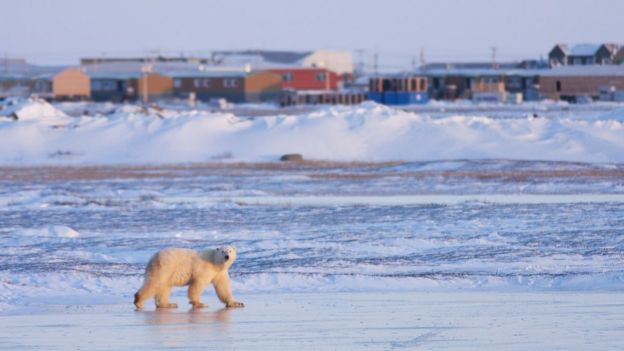
People and polar bears have always lived side-by-side in this part of the world but in the past it was rare for bears to enter the town. Now, every summer and autumn, it's becoming an uncomfortable part of everyday life.
A mother polar bear and two cubs
Polar bears tower over humans, sometimes measuring as much as 12 feet from nose to tail. But Inuit believe that humans and bears have much in common. When bears rear up on their hind legs to sniff the air, to play, to attack or defend themselves, they resemble two-legged humans. And like Inuit, bears are at home on both sea ice and land. At sea they hunt the same marine mammal species for sustenance - humans and bears are rival predators at the top of the food chain.
A bear clambers through a rubbish dump

Polar bears: Key facts

  • Polar bears are the biggest land-based carnivores in the world and live in the Arctic;
  • They mainly eat seals, which they detect using their remarkable sense of smell - bears can smell a seal in the water beneath a metre of compacted snow, and on land from almost 1km (0.6 miles) away:
  • Climate change is currently the single greatest threat to polar bears - their icy habitat is melting away
Source: WWF

Over the past decade, however, encounters have been on the increase. Camping south of the community in summer is no longer safe, and autumn berry picking - an important subsistence activity usually undertaken by women and children - is now fraught with danger. Bears increasingly wander the streets of Arviat, particularly in late autumn.
At this time of year, regular announcements of bear sightings are made on local community FM radio, schools are sometimes closed early and the usually lively streets are eerily quiet. Halloween trick-or-treating, once so wild and fun-filled, has been all but wiped out, for fear of unwanted encounters not with ghosts or demons but with wandering bears.
A bear walks with houses in the distance
What is driving this change in the polar bears' behaviour?
Many Arviarmiut blame polar bear tourism in neighbouring Churchill - 250km to the south - for encouraging the animals to look for food in human settlements.
A map showing Arviat, Churchill and Greenland
But there are other theories. Some Inuit think the bear population in the region is growing. Many scientists, on the other hand, put the blame on habitat loss - according to this theory it's the desperation of hungry bears facing decreased ice seasons in a rapidly warming Arctic that leads them to approach the town. They have always gathered on the coastline at this time of year, awaiting the formation of the sea ice that is their winter hunting ground, but usually at a greater distance.
Whatever the cause, Arviarmiut have had to get used to sharing their community with growing numbers of large, dangerous and unpredictable carnivores. Many towns in the northern Canadian territory of Nunavut are in the same position - Clyde River, Hall Beach and Resolute Bay have all reported problems in the past couple of years.
In Arviat, things reached a critical point four years ago.
Between 2010 and 2011, 11 polar bears were killed by Arviarmiut defending life or property. So, in 2011, with financial support from WWF (Canada), local hunter Leo Ikakhik was hired as a full-time polar bear monitor. Leo patrols the town, responds to sightings, and discourages polar bears through the use of spotlights and bangers. In addition, many homes have been provided with sealed steel bins for storing frozen meat, which was previously stored on roofs in sub-zero temperatures, and electric fences have been erected around sled dog teams. As a result of these measures, defence kills have all but ceased.
But a number of bears are also killed each year by hunters.
 Adapted from BBC News. Magazine

Wikipedia

Search results