To my dear visitors and commenters

Hi, everybody! I've noticed with lots of joy and happiness, that thousands of comments have been written in my posts. It's wonderful that so may people around the world appreciate my work. Therefore, I want to thank you for that and ,at the same time I want to ask you to be this blog's followers. It's fast and easy! Make it be even more visited and spread all over the world! I'm a woman, a teacher of English in Portugal, and I've been away for quite a long time because of my father's health. Unfortunately he died from Covid19 a few months ago. Now I felt it was time to restart my activity in this and other blogs I owe. I've recently created a new one in a partnership with a street photographer, Mr. Daniel Antunes. He's fabulous! https://pandpbydandd.blogspot.com I'd like you to visit it and, who knows, become our followers. The poems, chronicles and thoughts are all mine. Thank you so much! Kisses :-)

Search This Blog

Showing posts with label sea mammals. Show all posts

Wednesday, February 17, 2016

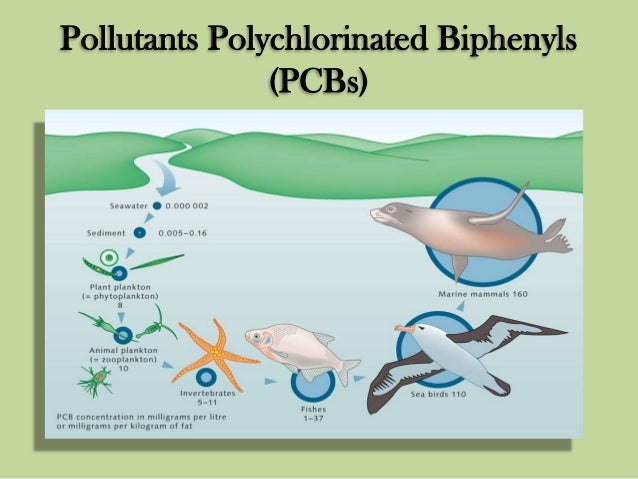
Banned pollutant PCB threatens Europe's whales

Scientists are warning that a banned pollutant could wipe out Europe's killer whales and dolphins.The use of the PCB chemical was prohibited from the 1980s but it still exists in the environment. (BBC News)


A polychlorinated biphenyl (PCB) is a synthetic organic chemical compound ofchlorine attached to biphenyl, which is a molecule composed of two benzene rings. There are 209 configurations of organochlorides with 1 to 10 chlorine atoms. The chemical formula for a PCB is C12H10−xClx. Of the different PCB arrangements and orientations 130 are used commercially.
Polychlorinated biphenyls were widely used as dielectric and coolant fluids in electrical apparatus, cutting fluids for machining operations, carbonless copy paper and in heat transfer fluids. Because of PCBs' environmental toxicity and classification as a persistent organic pollutant, PCB production was banned by the United States Congress in 1979 and by the Stockholm Convention on Persistent Organic Pollutants in 2001. The International Research Agency on Cancer (IRAC), rendered PCBs as definite carcinogens in humans. According to the U.S. Environmental Protection Agency (EPA), PCBs cause cancer in animals and are probable human carcinogens.Many rivers and buildings including schools and other sites are contaminated with PCBs, and there have been contaminations of food supplies with the toxins.
Some PCBs share a structural similarity and toxic mode of action with dioxin. Other toxic effects such asendocrine disruption (notably blocking of thyroid system functioning) and neurotoxicity are known. The maximum allowable contaminant level in drinking water in the United States is set at zero, but because of water treatment technologies, a level of 0.5 parts per billion is the de facto level.
in Wikipedia

Sunday, January 10, 2016

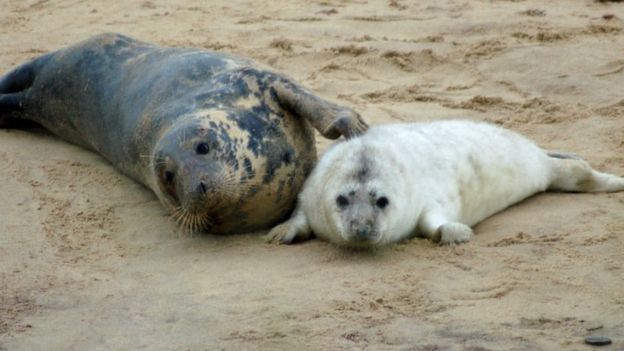
Horsey beach seal births top 1,000 for first time

A record number of grey seal births at a Norfolk beach shows a "major change" in behaviour as the animals become used to humans, marine experts have said.

Seals at Horsey, Norfolk
Seal pups are weaned by their mothers for about three weeks before they enter the sea

The 1.5 mile (2.4km) stretch of dunes at Horsey has hosted 1,018 births so far this winter compared to the previous winter when there were 804. Dr Dave Thompson, biologist at the Sea Mammal Research Unit (SMRU), said: "The colony growth is spectacular.
"These animals used to only breed on islands or sandbanks."
Seal at Horsey, Norfolk
Grey seals are able to shelter in the dunes at Horsey where volunteers try to prevent visitors from disturbing the breeding site
Seals at Horsey, Norfolk
The Sea Mammal Research Unit said grey seals used to breed only on sandbanks or islands not accessed by humans
Colonisation began in 2003 at Horsey, which is privately-owned with public access.
The Friends of Horsey Seals volunteers erect ropes and warning signs and patrol the beach to try to ensure seals are not disturbed during the November to January breeding season.

'Tolerant of humans'

Seals at Horsey, Norfolk
Peter Ansell, of the Friends of Horsey Seals group, said: "It's a milestone for us, given that it's a beach with public access.

"We have no idea when seal numbers will peak, but presume this will be governed by the food chain, of whicht hey are at the top."                                         Grey seal pups will fend for themselves after they have shed their white fur
The SMRU, based at St Andrew's University, monitors the size of the UK seal population.
Its statistics showed the number of pups had risen from 36,816 in 2002 to 51,293 in 2012 - the last year of its fully collated figures from the UK's main breeding sites.
Mr Thompson said pup births at sites in the northern part of the North Sea were static and the trend was for growth in the southern end.
"The Horsey colony growth is spectacular and it shows they've become more tolerant of humans in the vicinity," he said.
"The growth in the southern North Sea is so rapid that it has to be partly down to immigration from northern breeding sites with the seals deciding the habitats are more suitable."
From BBC News

Wednesday, December 30, 2015

Stranded whale rescued from Chile beach

A blue whale has been rescued after getting stranded on a beach in the port city of Iquique in northern Chile, South America.
Fishermen and beach-goers, along with the police and the navy, helped get the 20-metre-long mammal safely back out to deeper water.


The blue whale (Balaenoptera musculus) is a marine mammal belonging to the baleen whales (Mysticeti). At 30 metres (98 ft) in length and 180 tonnes (200 short tons) or more in weight, it is the largest extant animal and is the heaviest known to have existed.


Long and slender, the blue whale's body can be various shades of bluish-grey dorsally and somewhat lighter underneath.There are at least three distinct subspecies: B. m. musculus of the North Atlantic and North Pacific, B. m. intermedia of theSouthern Ocean and B. m. brevicauda (also known as the pygmy blue whale) found in the Indian Ocean and South Pacific Ocean. B. m. indica, found in the Indian Ocean, may be another subspecies. As with other baleen whales, its diet consists almost exclusively of small crustaceans known as krill.
Blue whales were abundant in nearly all the oceans on Earth until the beginning of the twentieth century. For over a century, they were hunted almost to extinction by whalers until protected by the international community in 1966. A 2002 report estimated there were 5,000 to 12,000 blue whales worldwide, in at least five groups. More recent research into the Pygmy subspecies suggests this may be an overestimate.[16] Before whaling, the largest population was in the Antarctic, numbering approximately 239,000 (range 202,000 to 311,000).There remain only much smaller (around 2,000) concentrations in each of the eastern North Pacific, Antarctic, and Indian Ocean groups. There are two more groups in the North Atlantic, and at least two in the Southern Hemisphere. As of 2014, the Californian blue whale population has rebounded to nearly its pre-hunting population.
in Wikipedia


Wikipedia

Search results