To my dear visitors and commenters

Hi, everybody! I've noticed with lots of joy and happiness, that thousands of comments have been written in my posts. It's wonderful that so may people around the world appreciate my work. Therefore, I want to thank you for that and ,at the same time I want to ask you to be this blog's followers. It's fast and easy! Make it be even more visited and spread all over the world! I'm a woman, a teacher of English in Portugal, and I've been away for quite a long time because of my father's health. Unfortunately he died from Covid19 a few months ago. Now I felt it was time to restart my activity in this and other blogs I owe. I've recently created a new one in a partnership with a street photographer, Mr. Daniel Antunes. He's fabulous! https://pandpbydandd.blogspot.com I'd like you to visit it and, who knows, become our followers. The poems, chronicles and thoughts are all mine. Thank you so much! Kisses :-)

Search This Blog

Showing posts with label Water. Show all posts

Tuesday, November 17, 2015

Earth's underground water quantified

The total amount of groundwater on the planet, held in rock and soil below our feet, is estimated to be 23 million cubic km.

Water well
If this volume is hard to visualise, imagine the Earth's entire land surface covered in a layer some 180m deep.
The new calculation comes from a Canadian-led team and is published in the journal Nature Geoscience.
Significantly, little of this water - just 6% - is the kind of bankable resource that is most useful to people.
That small fraction is referred to as "modern" groundwater: it is extractable because it is near the surface, and can be used to supplement above-ground resources in rivers and lakes.
"It's the groundwater that is the most quickly renewed - on the scale of human lifetimes," explained study leader Tom Gleeson from the University of Victoria.
"And yet this modern groundwater is also the most sensitive to climate change and to human contamination. So, it's a vital resource that we need to manage better."

Finite resource

To quantify just how much water is stored in the top 2km of the Earth's surface, Dr Gleeson's team had to combine large data sets with an element of modelling.
They included information on the permeability of rocks and soil, on their porosity, and all that is known about water table gradients, which tell you about inputs from precipitation.
Key to determining the age of all this stored water is a collection of thousands of tritium measurements.
Tritium is a radioactive form of hydrogen that spiked in the atmosphere 50 years ago as a result of thermonuclear bomb tests.
It can therefore be used as a tracer for all the rain that has made its way underground ever since.
Modern groundwater
The map above shows the distribution of this modern groundwater around the globe.
Dark blue shows where it is very quickly renewed. Light blue shows the older groundwater, which is mostly stagnant and non-renewable.
"Old water is highly variable," Dr Gleeson told BBC News.
"Some places it is quite deep, in some places not. In many places, it can be poor quality.
"It can be more saline even than ocean water and it can have lots of dissolved metals and other chemicals that would need to be treated before it could be used for drinking or agriculture."
This puts further emphasis on the modern reserves and the need to manage them in a sustainable way. The study underlines just how unevenly they are spread around the globe.
The next step, Dr Gleeson said, was to try to work out just how fast some water stores were being depleted.
Also writing in Nature Geoscience, Ying Fan, from Rutgers University, US, commented that "this global view of groundwater will, hopefully, raise awareness that our youngest groundwater resources - those that are the most sensitive to anthropogenic and natural environmental changes - are finite".
Hydrological cycle
Modern groundwater is part of the great hydrological cycle on Earth
From BBC News-Science/Environment

Thursday, November 12, 2015

Montreal's St Lawrence river sewage dump angers residents


Authorities in the Canadian city of Montreal are dumping raw sewage into the St Lawrence river.
Officials say the project is necessary so old infrastructure in the sewage treatment system can be replaced.
But the project has caused anger both in Canada and the United States. (BBC News)


The city has said the dump, expected to last up to a week, is necessary while work is carried out to replace ageing parts of the waste treatment system that could create a greater environmental hazard if it unexpectedly broke.
The action prompted outrage from cities and citizens downstream – worried about raw sewage in the water and the possibility of detritus such as condoms washing up on riverbanks. Even some upstream were concerned because of the precedent it was setting.
“It’s surprising, disgusting and outrageous that the city of Montreal took this path, which is the least costly alternative for them,” said Lee Willbanks, from advocacy group Save the River, based in the riverside town of Clayton in New York state. “If Montreal does it, others municipalities might do the same.“
Signs advising against touching the water were posted on the banks of the river directly opposite Montreal’s main port area. Despite the large size of the dump, waste will probably be quickly diluted and swept away by the huge volume of the river and there was no odour or physical signs of the operation, which has generated the Twitter hashtag žflushgate.
In full-page ads in Quebec’s main newspapers on Wednesday, Montreal’s Mayor Denis Coderre defended the operation as vital to protecting the river in the long run.
“As I have repeatedly said, if there were better options we would certainly have considered them,” he said. “But the reality is that the option we have chosen is the one with the least environmental impact.“
The river runs for almost 1,200km (745 miles) from Lake Ontario to the Atlantic Ocean, and features migratory birds and a variety of whales. It forms much of the border between New York state and the Canadian province of Ontario.
The US state is well upstream of Montreal and so is very unlikely to see any effects of the city’s dump. Nevertheless, politicians there were worried about it.
“It shows poor judgment and it doesn’t just affect Canadian waters – we share this water with Canada,” said Phil Reel, a legislator in New York’s Jefferson County, which borders the eastern edge of Lake Ontario and the head of the river. “It’s a resource vital to both communities.”
The operation was delayed until after Canada’s federal election in October. The new environment minister, Catherine McKenna, imposed extra conditions including monitoring, improved cleanup plans, and regular reporting of water quality through mid-2016.(theguardian)
READ MORE


Saturday, October 10, 2015

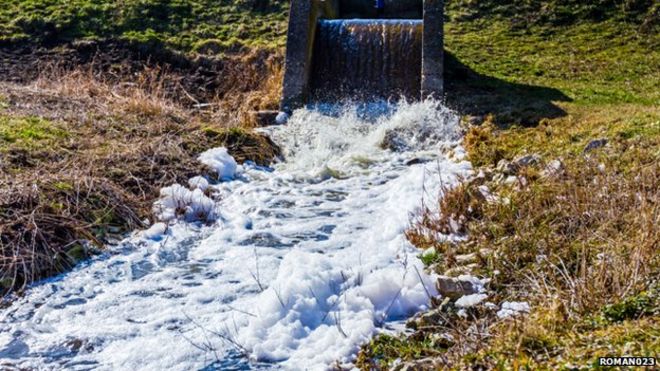
Flammable foam hits the streets of Bangalore-India

Absolutely unbelivable!

An invasion of toxic waste has floated on to the streets of Bangalore and while it looks like fresh snow there is nothing pleasant about this fluffy white cloud.
Toxic foam from the Indian city's giant Bellandur Lake was made after pollution in the lake was disrupted by rain showers.
Bellandur is highly polluted by a consistent flow of raw sewage and chemical waste which builds up and lays underneath the surface of its water.


The foam comes from the vast and highly polluted Bellandur Lake.

  • It is caused by ammonia, phosphate and low dissolved oxygen in the water
  • The white mixture has also been known to catch fire due to the grease in it
  • Bangalore residents have started up a Facebook page to save the lake

  • From MailOnline ( Daily Mail)


  • Tuesday, September 29, 2015

    10 tips on saving water at home

    Cartoon illustration of man having a shower, with egg timer outside shower
    1. Turn off the tap when you brush your teeth – this can save 6 litres of water per minute.
    2. Place a cistern displacement device in your toilet cistern to reduce the volume of water used in each flush. You can get one of these from your water provider.
    3. Take a shorter shower. Shower can use anything between 6 and 45 litres per minute.
    4. Always use full loads in your washing machine and dishwasher – this cuts out unnecessary washes in between.
    5. Fix a dripping tap. A dripping tap can waste 15 litres of water a day, or 5,500 litres of water a year.
    6. Install a water butt to your drainpipe and use the water collected to water your plants, clean your car and wash your windows.
    7. Water your garden with a watering can rather than a hosepipe. A hosepipe uses 1,000 litres of water an hour. Mulching your plants (with bark chippings, heavy compost or straw) and watering in the early morning and late afternoon will reduce evaporation and also save wat
    8. Fill a jug with tap water and place this in your fridge. This will mean you do not have to leave the cold tap running for the water to run cold before you fill your glass.
    9. Install a water meter. When you're paying your utility provider for exactly how much water you use, laid out in an itemised bill, there's an incentive to waste less of the stuff.
    10. Invest in water-efficient goods when you need to replace household products. You can now buy water-efficient showerheads, taps, toilets, washing machines, dishwashers and many other water-saving products. For more information visit the Waterwise website.

    Wednesday, August 19, 2015

    A solution for the drought problem in California?

    The sea of 96MILLION plastic balls that LA hopes will save it from drought: Reservoir is covered in an ocean of black spheres to stop 300million gallons of water evaporating


    Black plastic balls were this week released into the 175-acre Los Angeles Reservoir in Sylmar, California
  • They are designed to cover the water, prevent evaporation and protect it from dust, rain, chemicals and wildlife
  • The polyethylene balls, around the size of an apple, cost 36 cents each and are black to help deflect the UV rays.

  • With no apparent relief to California's record-breaking drought, Los Angeles has turned to more unusual methods to protect the city's water.
    Officials recently released 96 million floating 'shade balls' into the 75-acre Los Angeles Reservoir in Sylmar, California.
    The black plastic balls are designed to help protect the water against dust, rain, chemicals and wildlife, as well as prevent 300 million gallons of water from evaporating each year. 


  • With no apparent relief to California's record-breaking drought, Los Angeles has turned to more unusual methods to protect the city's water. City officials recently released ninety six million floating 'shade balls' into the Los Angeles Reservoir to cover the complex' water
    The balls work by floating on the surface and blocking the sun's rays.

    As well as protecting against evaporation, they also prevent the chemical reaction that creates the carcinogenic compound bromate.
    For most people, exposure to bromate - created from naturally-occurring bromide in water -is unlikely to be cause problems.
    But some people who ingest large amounts of bromate have suffered nausea, vomiting, diarrhea and abdominal pain.

    The balls also form a protective barrier across the surface that helps keep birds, animals and other contaminants out.
    Dr Brian White, a now-retired Los Angeles Department of Water and Power (LADWP biologist), was the first person to think of using shade balls for water quality.

    HOW DO THE SHADE BALLS WORK? 

    • The plastic black balls, around the size of an apple, cost 36 cents each.
    • They floating on the surface and block the sun's rays to prevent water from evaporating.
    • By doing this, they prevent the chemical reaction that creates the carcinogenic compound bromate.
    • The balls also form a protective barrier across the surface that helps keep birds, animals and other contaminants out away. 
    From Mailonline

    Tuesday, August 18, 2015

    Bug-killing book pages clean murky drinking water

    Scientists in America have designed a drinkable book that can save lives by making polluted water safe to consume.

    It's an instruction manual with information on how and why water should be filtered.
    Once read, its pages can be torn out and used to turn dirty water into drinkable water.


    The "drinkable book" combines treated paper with printed information on how and why water should be filtered.
    Its pages contain nanoparticles of silver or copper, which kill bacteria in the water as it passes through.
    In trials at 25 contaminated water sources in South Africa, Ghana and Bangladesh, the paper successfully removed more than 99% of bacteria.
    The resulting levels of contamination are similar to US tap water, the researchers say. Tiny amounts of silver or copper also leached into the water, but these were well below safety limits.
    The results were presented at the 250th national meeting of the American Chemical Society in Boston, US.
    Dr Teri Dankovich, a postdoctoral researcher at Carnegie Mellon University in Pittsburgh, developed and tested the technology for the book over several years, working at McGill University in Canada and then at the University of Virginia.
    "It's directed towards communities in developing countries," Dr Dankovich said, noting that 663 million people around the world do not have access to clean drinking water.
    "All you need to do is tear out a paper, put it in a simple filter holder and pour water into it from rivers, streams, wells etc and out comes clean water - and dead bacteria as well," she told BBC news.
    The bugs absorb silver or copper ions - depending on the nanoparticles used - as they percolate through the page.
    "Ions come off the surface of the nanoparticles, and those are absorbed by the microbes," Dr Dankovich explained.
    According to her tests, one page can clean up to 100 litres of water. A book could filter one person's water supply for four years.
    A page of the book, showing printed instructions
    Instructions are printed on the book's pages, in English as well as the local language
    Dr Dankovich had already tested the paper in the lab using artificially contaminated water. Success there led to the field trials which she conducted over the past two years, working with the charities Water is Life and iDE.
    In these trials, the bacteria count in the water samples plummeted by well over 99% on average - and in most samples, it dropped to zero.
    "Greater than 90% of the samples had basically no viable bacteria in them, after we filtered the water through the paper," Dr Dankovich said.
    "It's really exciting to see that not only can this paper work in lab models, but it also has shown success with real water sources that people are using."
    One location gave the paper a particularly tough challenge.

    Wednesday, August 05, 2015

    Humpback whale numbers 'increasing' around Australia

    New research suggests that humpback whale populations in waters around Australia are increasing faster than anywhere else in the world.


    The seas around the country are a popular area for this type of whale, but many decades of legal and illegal hunting, saw their numbers dip dangerously low and they were considered to be an endangered species.
    However, conservation efforts now seem to be paying off because scientists say that humpback whales have recovered so well, they are "a symbol of hope."
    Whale hunting is still a problem in other parts of the world so these results will be looked at closely to see how to help numbers increase globally. (CBBC Newsround)

    Friday, July 17, 2015

    Fifty sharks spotted swimming in West Sussex, England

    Up to fifty sharks have been spotted swimming in waters near Selsey in West Sussex.


    In June, a few sharks had been spotted at Medmerry, and half a dozen were also spotted in nearby PSRB Pagnam Harbour, but the huge number was unprecedented.
    Mr Hughes told the Chichester Observer: "We do not know if the spectacle is going to repeat itself.
    “Those wanting to look for the sharks can view from the new footpaths around the perimeter of Medmerry.
    “Anyone new to the area should pick up a trail map and get advice from the RSPB Pagham Harbour visitor centre at Sidlesham.” ( From The Mirror)

    Sharks Seen Swimming In UK Estuary

    The sharks were identified as smooth hound sharks, which can grow to around 1.5 metres in length.
    The RSPB's Peter Hughes, who filmed the event on Thursday, said: "It was astonishing. There were just these huge fish everywhere in knee-deep water.
    "We knew in time that Medmerry was going to be a great place for wildlife, but I don’'t think anyone expected this. We assume they were coming in to feed on the crabs and other marine life that have made their home at Medmerry."
    Footage courtesy of RSPB warden Peter Hughes
    From CBBC Newsround

    Sunday, June 28, 2015

    Call for more protection for seagrass meadows

    Seagrasses - the underwater plants that act as nursery grounds for young fish - need more protection, say scientists.

    Seagrass is found in shallow water around the coast of the UK
    Seagrass is found in shallow water around the coast of the UK
    Monitoring of seagrass meadows off the North Wales coast found areas damaged by the likes of boat moorings, anchors and vehicles crossing at low tide had reduced value to the ecosystem.
    Fewer species of fish were found where seagrass was degraded, according to research published in PeerJ journal.
    The seagrass studied was near the village of Porthdinllaen, in Gwynedd.
    Researchers at Swansea University studied areas with both high and low cover over a 28-hectare stretch of sea bed.
    They also sampled fish living in the underwater meadows of flowering plants.
    Plaice in seagrass
    There was a three-fold reduction in the diversity of fish species and invertebrates, such as prawns, shrimp, juvenile cod and juvenile plaice, in areas of low cover, said lead researcher Dr Richard Unsworth.
    He said that in the areas that had become damaged, there was "a reduction in diversity of the species and in the value of the habitat for juvenile fish".
    The seagrass is in a special area of conservation, which is a strictly protected site under the European Habitats Directive.
    However, despite this protection it was still being degraded, he said.
    "We have a lot of legislation in the UK already to conserve a lot of marine habitats but these mechanisms do not have enough financial clout," said Dr Unsworth.

    Impacts

    Dr Jean-Luc Solandt of the Marine Conservation Society said the study reaffirmed that seagrass meadows are important habitats that should be protected.
    "This research shows that disturbance to seagrass beds negatively impacts on ecosystems, and the capacity for these habitats to support a wealth of species.
    "It is further evidence that protection measures are needed to preserve these diverse but fragile places."
    Seagrasses are also found in several marine conservation zones off England.
    Some marine conservation zones have already designated, with others due for consideration next year.
    Conservation groups, backed by MPs, have been calling for a full network of protected zones to be created around the coastline of the UK.
    From BBC -Science

    Seagrasses are the only flowering plants that are able to live in seawater and able to pollinate while submerged. Seagrass often grow in large groups giving the appearance of terrestrial grassland – a kind of underwater meadow. There are four species of seagrass in the UK, two species of tasselweeds and two zostera species commonly known as eelgrass.

    What is it?

    The plants’ roots are anchored in mud, sand or fine gravel acting to stabilize the seabed and prevent erosion, which has the further effect of helping to stabilise and defend the wider coastline. The leaves are narrow and long, forming a three-dimensional habitat allowing a wide range of species to inhabit the area. The density of the grasses causes the water currents to slow down and allows nutrients to settle, in turn attracting wildlife.
    Where is it found?
    Seagrass is dependent on high levels of light for photosynthesis to grow and can therefore only be found in shallow water to a depth of around 4 metres. They are found around the coast of the UK in sheltered areas such as harbours, estuaries, lagoons and bays. ( From The Wildlife Trust)

    Wednesday, May 27, 2015

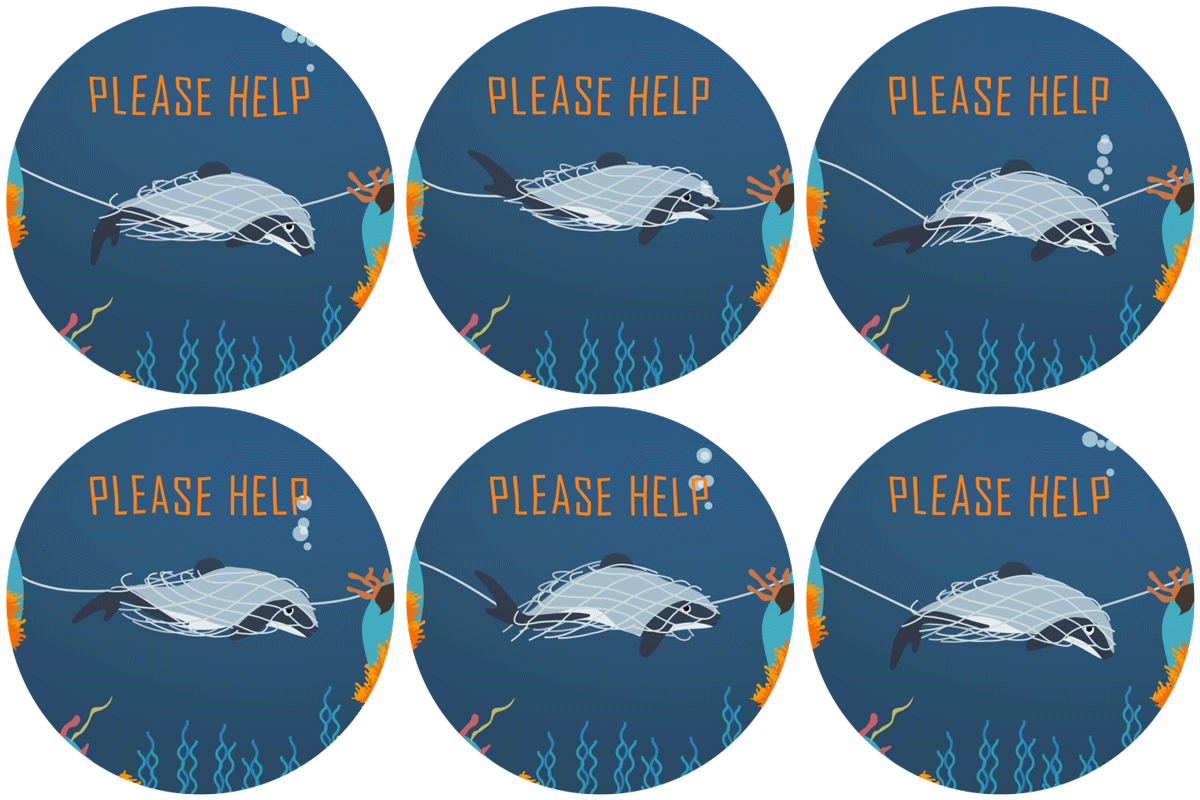
    Rare Maui's dolphin 'critically endangered'

    The smallest and rarest marine dolphin in the world could be extinct within 15 years if protection is not stepped up, experts have warned.

    dolphin leaping
    Maui's dolphins are less than 1.5m long and only found off the west coast of New Zealand

    Conservation organisation Nabu say there are fewer than 50 Maui's dolphins left on the planet now.
    The organisation said fishing should be banned in the waters off New Zealand, where the species live.
    Dolphins are often caught in fishing nets which can harm and even kill them.


    Change
    "New Zealand has to abandon its current stance, which places the interests of the fishing industry above conservation," said Dr Barbara Maas from Nabu.
    A spokesperson for the New Zealand minister for conservation said no comment would be made until after the scientific committee reported its findings and recommendations in June.
    The number of dolphins has declined since the 1970s.
    Scientists say the main threat is fishing using trawling nets. It's thought the nets kill five Maui's dolphins each year.
    From CBBC Newsround

    Saturday, May 16, 2015

    Arctic pollution rules 'not enough'

    New guidelines have been passed to prevent pollution from ships in polar waters.


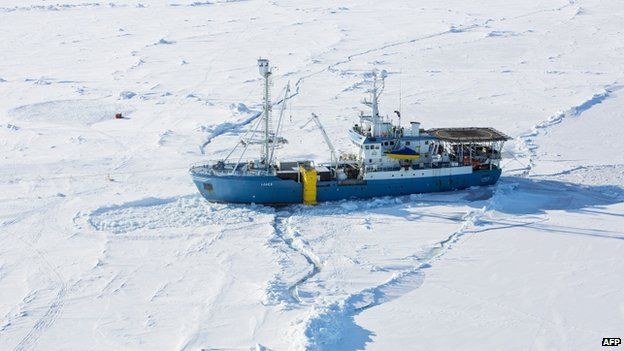
    The Jonathan Arctica, one of the world's first Polar class supply ships, at shipyard in Gdansk, Poland, 22 April 2015

    The Polar Code, passed at a meeting in London of the International Maritime Organization (IMO), ban ships from releasing oil, sewage, chemicals and waste into the sea.
    The measures are set to come into force in 2017.
    But environmentalists say the regulations do not go far enough.
    WWF said a strong, legally binding Polar Code was particularly urgent in the Arctic, where new sea routes are expected to open up in coming decades.
    IMO member states should "honour the original vision of the Polar Code, which saw environmental protection as a priority," said Rod Downie, WWF-UK's Polar Programme Manager.
    Norwegian research vessel Lance at 83 degrees north in the Arctic Ocean
    "That means additional measures to reduce the risk of invasive marine species, more stringent requirements for oil spill response, banning the use and restricting carriage of heavy fuel oil by ships in the Arctic, reducing air emissions and black carbon, and addressing underwater noise," he said
    .

    Ice retreat
    The IMO is the United Nations agency with responsibility for the safety and security of shipping and the prevention of marine pollution by ships.
    A spokesperson for the IMO said many of the things not specifically addressed in the Polar Code are addressed, or will be addressed, by other measures.
    The Arctic is the fastest warming region of the planet.
    If the polar ice retreats it could speed up the rise in global temperatures and change the world's weather patterns.
    It could also open up a faster route for commercial cargo ships between Europe and Asia, and boost trade in ports in Arctic countries such as Russia, Norway and Canada.

    From BBC Science/ Environment

    Tuesday, April 21, 2015

    Arran diver wins prestigious environmental award

    A diver from the Isle of Arran has won one of the world's most prestigious environmental awards.

    Howard surveying the seabed
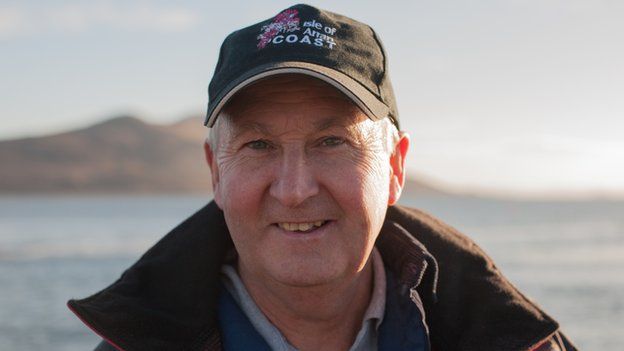
    Howard Wood is to receive the Goldman Environmental Prize at a ceremony in San Francisco later.
    It is in recognition of his work over 20 years to protect the island's marine environment and allow it to recover.
    The prize, worth $175,000 (£117,000), can be spent by the winner "to pursue their vision of a renewed and protected environment".
    Mr Wood was one of the founders of the Community of Arran Seabed Trust (Coast) and played a key role in the campaign to set up the country's first no take zone, which prohibits fishing in part of the island's Lamlash Bay.
    Mr Wood told BBC Scotland the news had come "completely out of the blue".
    Howard Wood
    Speaking before travelling to San Francisco, he said: "The work of Coast goes back to before 1995, when we could see that the seabed around Arran was being basically dredged away.

    "We wanted to have a trial area to find out what happens when you close a small area to all fishing.
    "It took us years to get there, but we did get there in 2008."
    Since then, the no take zone has allowed the seabed to regenerate.
    A recent study showed there had been an increase in the size of scallops and an increase in the number of juvenile scallops in the area.
    Coast is actively promoting sustainable fishing methods such as creeling, hand diving for scallops and angling.
    It has recently led a successful campaign to establish one of Scotland's first marine protected areas (MPAs).
    Coast is also calling on the Scottish government to implement tougher restrictions, to ensure effective protection for the south Arran marine protected area.
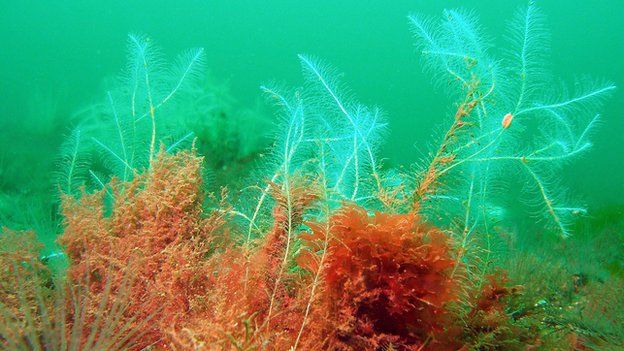
    Seabed recovering in no take zone
    This area of seabed is recovering in a 'no take' zone
    A network of MPAs was designated in Scottish waters in July 2014, but campaigners say very few statutory measures to manage the damaging effects of bottom-towed fishing have so far been implemented for these areas.
    Mr Wood said: "Scotland has a legacy of vested interests controlling access to public marine resources and there is still a great deal of work to be done to overturn decades of mismanagement.
    "If people really understood how Scotland's marine resources have been plundered over the years, they would be appalled."
    The Scottish government has congratulated Mr Wood on his award and defended its record.
    Dredged seabed
    In comparison to the recovering seabed, this is the scene of a dredged seabed.
    A spokesman said: "Scotland's Marine Protected Areas network, which includes the largest MPA in the EU, helps protect and enhance our marine environment so that the rich diversity of life in the waters around Scotland, and the benefits they bring, can be enjoyed for generations to come.
    "We recently consulted on potential management measures for MPAs and will shortly implement measures that take account of all views received.
    "The current preferred management approach would achieve the conservation objectives of the protected features and reduce the footprint of trawling and dredging considerably."
    Mr Wood is one of six winners of this year's Goldman Environmental Prize, who are drawn from Kenya, Myanmar, Haiti, Canada, Honduras and Scotland.
    From BBC Science

    Monday, April 06, 2015

    The dystopian lake filled by the world’s tech lust

    Hidden in an unknown corner of Inner Mongolia is a toxic, nightmarish lake created by our thirst for smartphones, consumer gadgets and green tech, discovers Tim Maughan.

    " I’d seen some photos before I left for Inner Mongolia, but nothing prepared me for the sight "
    — The alien environment at Baotou lake

    (Credit: Liam Young/Unknown Fields)
    Black sludge pours into the lake - one of many pipes lining the shore (Credit: Liam Young/Unknown Fields)

    From where I'm standing, the city-sized Baogang Steel and Rare Earth complex dominates the horizon, its endless cooling towers and chimneys reaching up into grey, washed-out sky. Between it and me, stretching into the distance, lies an artificial lake filled with a black, barely-liquid, toxic sludge.
    Dozens of pipes line the shore, churning out a torrent of thick, black, chemical waste from the refineries that surround the lake. The smell of sulphur and the roar of the pipes invades my senses. It feels like hell on Earth.
    Welcome to Baotou, the largest industrial city in Inner Mongolia. I'm here with a group of architects and designers called the Unknown Fields Division, and this is the final stop on a three-week-long journey up the global supply chain, tracing back the route consumer goods take from China to our shops and homes, via container ships and factories.
    You may not have heard of Baotou, but the mines and factories here help to keep our modern lives ticking. It is one of the world’s biggest suppliers of “rare earth” minerals. These elements can be found in everything from magnets in wind turbines and electric car motors, to the electronic guts of smartphones and flatscreen TVs. In 2009 China produced 95% of the world's supply of these elements, and it's estimated that the Bayan Obo mines just north of Baotou contain 70% of the world's reserves. But, as we would discover, at what cost?
    Element of success
    Rare earth minerals have played a key role in the transformation and explosive growth of China's world-beating economy over the last few decades. It's clear from visiting Baotou that it's had a huge, transformative impact on the city too. As the centre of this 21st Century gold-rush, Baotou feels very much like a frontier town.
    Workers in a factory in Shenzhen make MP3 players (Credit: Kate Davies/Unknown Fields)
    Workers in a factory in Shenzhen make MP3 players (Credit: Kate Davies/Unknown Fields)
    In 1950, before rare earth mining started in earnest, the city had a population of 97,000. Today, the population is more than two-and-a-half million. There is only one reason for this huge influx of people - minerals. As a result Baotou often feels stuck somewhere between a brave new world of opportunity presented by the global capitalism that depends on it, and the fading memories of Communism that still line its Soviet era boulevards. Billboards for expensive American brands stand next to revolution-era propaganda murals, as the disinterested faces of Western supermodels gaze down on statues of Chairman Mao. At night, multicoloured lights, glass-dyed by rare earth elements, line the larger roads, turning the city into a scene from the movie Tron, while the smaller side streets are filled with drunk, vomiting refinery workers that spill from bars and barbecue joints.

    Even before getting to the toxic lake, the environmental impact the rare earth industry has had on the city is painfully clear. At times it’s impossible to tell where the vast structure of the Baogang refineries complex ends and the city begins. Massive pipes erupt from the ground and run along roadways and sidewalks, arching into the air to cross roads like bridges. The streets here are wide, built to accommodate the constant stream of huge diesel-belching coal trucks that dwarf all other traffic.
    A coal mine in Baotou (Credit: Liam Young/Unknown Fields)
    A coal mine in Baotou (Credit: Liam Young/Unknown Fields)
    From BBC News

    Thursday, March 26, 2015

    River health revealed in 'shocking' figures

    Just 17% of England's rivers are judged to be in good health, according to Environment Agency figures.


    Rivers can become polluted from farms, roads and sewage works
    Rivers can become polluted from farms, run-off from roads and sewage works
    This is down from 29% with a good ecological status in 2014. The analysis is shocking, say environmentalists.
    Problems are caused by over-abstraction and pollution from farms, run-off from roads and effluent from sewage works - as well as invasive species.
    The Environment Agency says the figures look bad because the EU's assessment criteria have been tightened.

    "Threatens wildlife"

    The EU asks nations to grade rivers into poor, moderate, good and high. Governments should aim for rivers to be "good" - that is relatively unaffected by human activity. "High" refers to upland streams in sparsely-populated areas.
    The statistics show 0.08% of England's rivers are high quality; 17.06 good; 62.4% moderate; 17.22% poor and 3.24% bad.
    Rose O'Neill from WWF said: "The figures released today are shocking and show us that things are worse than we thought. This is unacceptable and threatens wildlife and livelihoods.
    "It's clear that we are failing our rivers and the wildlife they impact. We need to see government action to restore these rivers, for example by reducing abstraction and tackling pollution.
    More than 27 tonnes of ammonium leaches from an Oxford wetland into the River Thames every year, reports the Natural Environment Research Council
    Researchers take a sample of water from River Thames at Oxford for analysis. Photograph: Dr Daren Gooddy/NERC
    The Environment Agency feels aggrieved by the ratings.
    Previously it used to judge a river based on various chemical tests. Now a river must be subjected to many tests on chemistry, flow and wildlife - and if it fails any single test it cannot achieve "good" status.
    It says if you examine the tests individually, 74% of them achieve the highest two scores of good or high status.

    Extra measures

    A spokesman said the agency has improved or stabilized the condition of nearly 2,000 miles of rivers.
    He said: "The Environment Agency will continue to work closely with farmers, businesses and water companies to reduce pollution and improve water quality wherever, and however, possible."
    Wildlife groups reject the phrase "wherever possible". They think the agency should be tougher with polluters and farmers who reduce the flow of rivers by taking out too much water.
    The future criteria for measuring the health of river are currently under discussion.
    Blueprint for Water, a coalition of 16 environmental and fishing organisations, urges the public to respond to the Agency's current consultation on River Basin Management Plans.
    Farmers are concerned about who pays for the extra measures needed to meet the EU's rules under the Water Framework Directive.

    From BBC Environment

    Wikipedia

    Search results