To my dear visitors and commenters

Hi, everybody! I've noticed with lots of joy and happiness, that thousands of comments have been written in my posts. It's wonderful that so may people around the world appreciate my work. Therefore, I want to thank you for that and ,at the same time I want to ask you to be this blog's followers. It's fast and easy! Make it be even more visited and spread all over the world! I'm a woman, a teacher of English in Portugal, and I've been away for quite a long time because of my father's health. Unfortunately he died from Covid19 a few months ago. Now I felt it was time to restart my activity in this and other blogs I owe. I've recently created a new one in a partnership with a street photographer, Mr. Daniel Antunes. He's fabulous! https://pandpbydandd.blogspot.com I'd like you to visit it and, who knows, become our followers. The poems, chronicles and thoughts are all mine. Thank you so much! Kisses :-)

Search This Blog

Showing posts with label Science. Show all posts

Saturday, February 20, 2016

Awesome time-lapse of the sun over a year


This amazing timelapse footage of the sun was filmed over a whole year by the NASA
It was released to mark the six year anniversary of Nasa's Solar Dynamics Observatory, which was set up to capture changes in the sun. A photo was taken every 12 seconds over the course of a year.
(CBBC Newsround)


NASA’s Solar Dynamics Observatory (SDO) is always following the sun as it orbits the Earth. As part of its ongoing mission, the SDO captures high-resolution images of the sun at regular intervals, allowing scientists to monitor solar activity such as sun spots, solar flares, and coronal mass ejections. NASA’s multi-year mission just completed its sixth year of data collection and commemorated that milestone by releasing a stunning time-lapse video of the past year in review.
The six-minute video shows the sun over a period of just over a year, starting from January 1, 2015 and ending on January 28, 2016. The first half of the video shows the time-lapse with some celestial-inspired background music, while the second half explains the features and wavelengths that you are seeing. The ultra-high-definition images are shown on YouTube at a rate of approximately 30 frames per second with a resolution of 3,840 by 1,260 pixels. Each frame of the video corresponds to 2 hours of time on Earth. On its website, NASA also provides a downloadable version of the video that has a 59.94 fps frame rate with each frame representing one hour.

Friday, February 12, 2016

Einstein's gravitational waves 'seen' from black holes 100 years after his prediction

Scientists have made a huge discovery about the universe - they have detected the waves made after two black holes collided.

Black holes can't be seen, but scientists know they exist because of the way they move things around them in the universe.
In a far away galaxy, two black holes smashed together more than a billion years ago.
The shock waves from this crash have just reached earth, and scientists were able to detect the signal for the first time.

Prof. Stephen Hawking says discovery of gravitational waves provides ‘completely new way


They have observed the warping of space-time generated by the collision of two black holes more than a billion light-years from Earth.
The international team says the first detection of these gravitational waves will usher in a new era for astronomy.
It is the culmination of decades of searching and could ultimately offer a window on the Big Bang.
The research, by the Ligo Collaboration, has been published today in the journalPhysical Review Letters.
The collaboration operates a number of labs around the world that fire lasers through long tunnels, trying to sense ripples in the fabric of space-time.
From BBC News

Wednesday, January 20, 2016

First flower blooms in space on International Space Station

Astronauts have grown the first flower in space on-board the International Space Station.

Zinnia blooming in space
The zinnia flower is the first to grow in space
The orange zinnia flowers can be eaten and were grown in the 'Veggie' laboratory, which was installed on the space station in 2014.
Growing their own food in space is a big step for astronauts because it means they could go on longer missions in the future.
They've grown lettuce before but the zinnia is the first to bloom flowers.
It shows that it may be possible to grow other flowering crops like tomatoes.
Scott Kelly with lettuce on ISS
Scott Kelly took this selfie with his crop of lettuce in the Veggie Laboratory
Growing plants in space might be trickier than you think - watering flowers is much more difficult in a place without gravity!
Another problem was that the high levels of moisture in the air inside the space station led to mould growing on some leaves.
The astronauts cleaned the plants, cut away the mouldy leaves, and set up a fan to try and dry out the crop. But the high speed fan did its job a bit too well, and the plants got too dry.
Astronaut Scott Kelly took charge of the flowers, and worked hard to revive them over Christmas, and on 12 January, a few petals started to peak out.
When the flowers finally bloomed, Scott shared the photo saying 'first ever flower grown in space makes its debut!'
From CBBC Newsround

Sunday, May 10, 2015

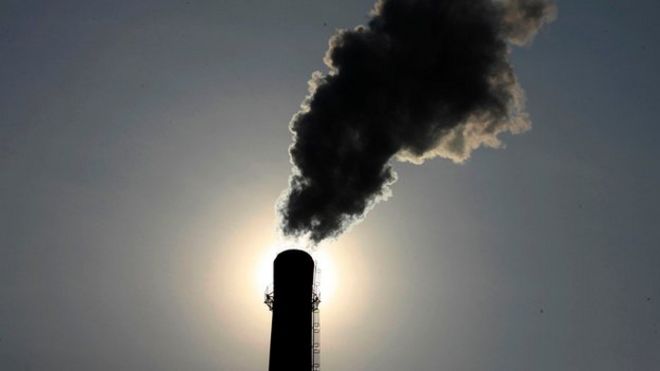
Global carbon dioxide (CO2) concentrations have reached a new monthly record of 400 parts per million, according to scientists.
Chimney
The milestone was announced by the US National Oceanic and Atmospheric Administration (Noaa).

They said it was the first month that the entire globe broke 400ppm, reaching levels that haven't been seen for about two million years.
Noaa's Pieter Tans said that reaching the mark was "a significant milestone".
Scientists announced that CO2 had passed the 400 ppm level for the first time in the Arctic in 2012, and then at Mauna Loa in Hawaii in 2013.
"It was only a matter of time that we would average 400 parts per million globally," said Mr Tans, lead scientist at Noaa's Global Greenhouse Gas Reference Network.
He added that CO2 has risen more than 120 parts per million since pre-industrial times.
"Half of that rise has occurred since 1980," he said.
Noaa collects its data on global carbon dioxide concentration on air samples taken from 40 sites around the world, including some remote islands.
From BBC Science/Environment

Sunday, April 26, 2015

Nepal quake 'followed historic pattern'

Nepal's devastating magnitude-7.8 earthquake on Saturday was primed over 80 years ago by its last massive earthquake in 1934, which razed around a quarter of Kathmandu to the ground and killed over 17,000 people.

Saturday, March 07, 2015

World's first lagoon power plants unveiled in UK

Plans to generate electricity from the world's first series of tidal lagoons have been unveiled in the UK.

Swansea Bay lagoon scheme
The proposed Tidal Lagoon Swansea Bay project would be the world's first man-made, energy-generating lagoon
The six lagoons - four in Wales and one each in Somerset and Cumbria - will capture incoming and outgoing tides behind giant sea walls, and use the weight of the water to power turbines.
A £1bn Swansea scheme, said to be able to produce energy for 155,000 homes, is already in the planning system.
Energy Secretary Ed Davey says he wants to back the project.
The cost of generating power from the Swansea project will be very high, but the firm behind the plan says subsequent lagoons will be able to produce electricity much more cheaply.
It says the series of six lagoons could generate 8% of the UK's electricity for an investment of £30bn.
As well as Swansea, the proposed lagoon sites are Cardiff, Newport, and Colwyn Bay in Wales; Bridgwater in Somerset; and West Cumbria.
Each will require engineering on a grand scale. In Swansea, the sea wall to contain the new lagoon will stretch more than five miles and reach more than two miles out to sea.
The Cardiff lagoon could include up to 90 turbines set in a 14-mile (22km) breakwater around Cardiff Bay and could generate power for about 14 hours each day.
A planning application for the project is expected in 2017.
If approved, it could be generating power by 2022.
Swansea Bay lagoon scheme
Some anglers fears the lagoon might affect migrating fish, but planners say the new sea wall would act as a reef

Swansea Bay lagoon scheme
The firm proposing the lagoon say they want it to become a venue for culture and sports

The cost would be funded by electricity bill-payers under the existing government scheme to promote home-grown, low-carbon energy.
Tidal Lagoon Power is in negotiations with the government over how much it can charge for its power.
It wants £168 per MWh for electricity in Swansea, reducing to £90-£95 per MWh from a second, more efficient lagoon in Cardiff.
'Energy dance'
The £90 figure compares favourably with the £92.50 price for power from the planned Hinkley nuclear station, especially as the lagoon is designed to last 120 years - at a much lower risk than nuclear.
Mr Davey told BBC News: "I can't make a decision on this yet because discussions are ongoing. But I'm very excited by the prospect of tidal power.
"We have got some of the biggest tidal ranges in the world and it would be really useful if we could harness some of that clean energy."


From BBC Sci/ Environment

Sunday, August 10, 2014

Potato power: the spuds that could light the world

With a simple trick, the humble spud can be made into a battery, so could potato powered homes catch on?
(Thinkstock)
Mashed, boiled, baked or fried? You probably have a preference for your potatoes. Haim Rabinowitch, however, likes his spuds “hacked”.
For the past few years, researcher Rabinowitch and colleagues have been pushing the idea of “potato power” to deliver energy to people cut off from electricity grids. Hook up a spud to a couple of cheap metal plates, wires and LED bulbs, they argue, and it could provide lighting to remote towns and villages around the world.
They’ve also discovered a simple but ingenious trick to make potatoes particularly good at producing energy. A single potato can power enough LED lamps for a room for 40 days,” claims Rabinowitch, who is based at the Hebrew University of Jerusalem.
The idea may seem absurd, yet it is rooted in sound science. Still, Rabinowitch and his team have discovered that actually launching potato power in the real world is much more complex than it first appears.
While Rabinowitch and team have found a way to make potatoes produce more power than usual, the basic principles are taught in high school science classes, to demonstrate how batteries work.
To make a battery from organic material, all you need is two metals – an anode, which is the negative electrode, such as zinc, and a cathode, the positively charged electrode, such as copper. The acid inside the potato forms a chemical reaction with the zinc and copper, and when the electrons flow from one material to another, energy is released. 


This was discovered by Luigi Galvani in 1780 when he connected two metals to the legs of a frog, causing its muscles to twitch. But you can put many materials between these two electrodes to get the same effect. Alexander Volta, around the time of Galvani, used saltwater-soaked paper. Others have made “earth batteries” using two metal plates and a pile of dirt, or a bucket of water.

Super spuds
Potatoes are often the preferred vegetable of choice for teaching high school science students these principles. Yet to the surprise of Rabinowitch, no one had scientifically studied spuds as an energy source. So in 2010, he decided to give it a try, along with PhD student Alex Goldberg, and Boris Rubinsky of the University of California, Berkeley.
“We looked at 20 different types of potatoes,” explains Goldberg, “and we looked at their internal resistance, which allows us to understand how much energy was lost by heat.”
They found that by simply boiling the potatoes for eight minutes, it broke down the organic tissues inside the potatoes, reducing resistance and allowing for freer movement of electrons– thus producing more energy. They also increased the energy output by slicing the potato into four or five pieces, each sandwiched by a copper and zinc plate, to make a series. “We found we could improve the output 10 times, which made it interesting economically, because the cost of energy drops down,” says Goldberg.
“It’s low voltage energy,” says Rabinowitch, “but enough to construct a battery that could charge mobile phones or laptops in places where there is no grid, no power connection.”
Their cost analyses suggested that a single boiled potato battery with zinc and copper electrodes generates portable energy at an estimated $9 per kilowatt hour, which is 50-fold cheaper than a typical 1.5 volt AA alkaline cell or D cell battery, which can cost $49–84 per kilowatt hour. It’s also an estimated six times cheaper than standard kerosene lamps used in the developing world.
Which raises an important question – why isn’t the potato battery already a roaring success?
In 2010, the world produced a staggering 324,181,889 tonnes of potatoes. They are the world’s number one non-grain crop, in 130 countries, and a hefty source of starch for billions around the world. They are cheap, store easily, and last for a long time. 


With 1.2 billion people in the world lacking access to electricity, a simple potato could be the answer– or so the researchers thought. “We thought organisations would be interested,” says Rabinowitch. “We thought politicians in India would give them out with their names inscribed on them. They cost less than a dollar.” 

Yet three years on since their experiment, why haven’t governments, companies or organisations embraced potato batteries? “The simple answer is they don’t even know about it,” reasons Rabinowitch. But it may be more complicated than that.


First, there’s the issue of using a food for energy. Olivier Dubois, senior natural resources officer at the United Nations Food and Agriculture Organisation (FAO), says that using food for energy – like sugar cane for biofuels – must avoid depleting food stocks and competing with farmers.

From BBC -Future
READ THE WHOLE ARTICLE

Wikipedia

Search results