This blog was created because I'm very much concerned about our Planet and the many environmental issues which deserve being known by everybody. Some are real catastrophes while others are achievements of great importance for the survival of numerous endangered species or the health of the only planet we've got: E A R T H !
To my dear visitors and commenters
Hi, everybody!
I've noticed with lots of joy and happiness, that thousands of comments have been written in my posts. It's wonderful that so may people around the world appreciate my work. Therefore, I want to thank you for that and ,at the same time I want to ask you to be this blog's followers. It's fast and easy!
Make it be even more visited and spread all over the world! I'm a woman, a teacher of English in Portugal, and I've been away for quite a long time because of my father's health.
Unfortunately he died from Covid19 a few months ago. Now I felt it was time to restart my activity in this and other blogs I owe. I've recently created a new one in a partnership with a street photographer, Mr. Daniel Antunes. He's fabulous!
https://pandpbydandd.blogspot.com
I'd like you to visit it and, who knows, become our followers. The poems, chronicles and thoughts are all mine.
Thank you so much!
Kisses :-)
Search This Blog
Showing posts with label The Power of Nature. Show all posts
Showing posts with label The Power of Nature. Show all posts
Europe's rarest seabird will be extinct within 60 years, according to a new analysis.
The bird breeds in caves off Mallorca
Urgent action is needed to stop the Balearic sheerwater being drowned in fishing lines and nets, say scientists.
The bird breeds in the Balearic Islands, sometimes stopping off in British waters as it migrates north.
Research shows the global population is not sustainable in the long term. There are about 3,000 breeding pairs left.
The main threat to the bird is becoming entangled in fishing gear, according to findings published in the Journal of Applied Ecology.
Other risks include hunting by the likes of cats and other small mammals.
Prof Tim Guilford of the Department of Zoology at the University of Oxford is co-researcher on the study.
He told BBC News: "The survival of adults from one year to the next and especially of young adults is much lower than we thought.
"The species is unsustainable - it is on the road to extinction."
Night fishing
Estimates suggest about half of deaths in adult birds are due to accidental capture in fishing lines and nets.
Fishing on the seabed is a particular risk as birds can become entangled and drown when lines are immersed, say researchers in the UK and Spain.
Changes such as setting fishing gear at night when the bird does not dive "could make a massive difference", said Prof Guilford.
"The science shows just how serious the problem is, but also that there is a technically simple solution - the setting of demersal long-lines at night," he added.
The Balearic shearwater (Puffinus mauretanicus) is one of the rarest seabirds in the world.
The seabird is classified as critically endangered on the IUCN Red List of species.
It breeds on cliffs and small islets and lays only one egg.
Agricultural activities are considered to be one of the main drivers to reduce poverty and improve food security among the planet's undernourished population, which is estimated to be 800-850 million people.
Climate change is widely expected to have a destabilising effect on food production systems, the authors observe, and previous studies have concluded that adaptation "will be required if food production is to be increased in both quantity and stability to meet food security needs during the 21st Century".
Co-author Julian Ramirez-Villegas from the University of Leeds, UK, said the study carried out by the CGIAR research programme on Climate Change, Agriculture and Food Security (CCAFS) set out to quantify for the first time when changes to food production were likely to happen.
"Rather than focusing on what we need to do by a certain time, we know that there is a range of options and then we put deadlines on these options," he told BBC News.
The team assessed when areas growing nine of Sub-Saharan Africa's staple crops - which account for half of the region's food production - would have to undergo "transformational adaptation", which refers to a fundamental shift in an area's food production system. For example, stop growing crops and switch to livestock farming instead.
Dr Ramirez-Villegas said the study found that six of the nine crops assessed were "stable in respect to transformation and adaptation".
"It does not mean there will not be impacts, for example the yields might decrease," he added.
"But there are three - beans, maize and bananas - that are more unstable and are therefore projected to have large amounts of area under transformational change.
"In the case of beans, in particular, we see about 60% of the area in need of transformation and adaption (under a high warming scenario - +3.0C/5.4F) because the climate shifts away from the conditions were you can actually grow the crop."
'Climate-smart' crops
However, he added that it was not all bad news as technological advancements offered hope of increasing resilience to changes in the growing conditions.
One example was "climate smart" crop varieties. In 2015, researchers reported a breakthrough in the development of temperature-resilient beans that could help sustain a vital source of protein for millions of people around the globe.
"Also, in the longer term, where transformation is unavoidable, you can shift crops," Dr Ramirez-Villegas explained.
"Just because people are no longer able to grow one crop, it does not mean that people have no options. In most cases, we find that there are alternative crops that remain suitable for those places."
He said the team found that there were only "very specific pockets" where farmers would have to shift away from the nine staple crops that were assessed in the study.
"In those cases, livestock might constitute an alternative livelihood option, or people might completely change their livelihood by migrating, for example, or by completely changing the land-use," he suggested.
In order to maximise the options available to farmers to cope with projected climatic changes, Dr Ramirez-Villegas said that there were two areas that needed addressing.
"We need to work on the barriers to the adoption of technologies, as we know that in Sub-Saharan Africa, adoption levels are sometimes low," he observed.
"What we also need to do is to put planned adaptation into national development plans."
In a separate study, published in The Lancet, researched warned that climate change could be responsible for more than half-a-million deaths by the middle of the century.
The research was described as the strongest evidence yet that "climate change could have damaging consequences for food production and health worldwide".
A Moroccan city is being powered at night by solar energy, thanks to salt.
The newly-opened plant at Ouarzazate harnesses the Sun's warmth to melt salt to 500C. The salt holds its heat and powers a steam turbine in the evening.(BBC News)
The new site near the city of Ouarzazate -- famous as a filming location for Hollywood blockbusters like "Lawrence of Arabia" and "Gladiator" -- could produce enough energy to power over one million homes by 2018 andreduce carbon emissions by an estimated 760,000 tons per year, according to the Climate Investment Funds(CIF) finance group.
As His Majesty Mohammed VI of Morocco pressed a button on 4 February 2016, the first phase of the three-part project was set in motion.From CNN
Two rectangular towers with a height of 80 and 112 meters and 800 trees and 5000 bushes decorating the external facade Stefano Boeris Bosco Verticale brings the nature right into the heart of Milan. A nearly identical building project is now planned to bring the vertical Forest to Lausanne, Switzerland.
Italian architect Stefano Boeri designed these beautiful towers, whose inauguration ceremony took place in 2014. The two towers are located in Porta Nuova, in the north of Milans centre, and are a symbiosis between architecture and nature. On 40.000m exposed surface, approx. 3.000m are covered in trees. It is scarcely surprising that Stefano Boeris Vertical Forest won the Internation Highrise Award in 2014.
His idea of a Vertical Forest was now even awarded the contract for to build a Bosco Verticale v2 in Lausanne, Switzerland. The construction of the residental and office buildings, called Tour des Cdres, is scheduled for 2017.
Powerful hurricanes in Mexico, drought in Ethiopia, flash-floods and mudslides in southern California - all have been attributed to the El Nino weather phenomenon.
Occurring every few years, the current El Nino is one of the strongest recorded and could contribute to making 2015 the hottest year on record.
Erosion is problem on large parts of the UK coastline.
Now a scheme in Scotland, which gets the public logging at risk sites, is set to be expanded into England during 2016.
Archaeologist Tom Dawson, from the University of St Andrews, has been talking to BBC Weather World's Nick Miller about what Scotland's Coastal Heritage at Risk Project is trying to.
Vanuatu is on the front line in the climate change debate, with rising sea levels putting the very future of the low-lying archipelago in jeopardy.
Islanders hope some sort of deal can be reached at the climate change conference Paris to make sure that whatever happens, their home will be as well prepared as possible.
They raised their concerns with the BBC's Matthew Price. (BBC Science/Environment)
At the World Forestry Congress 2015 - held in Durban, South Africa - it was said that the rate of deforestation across Africa is four times the world average.
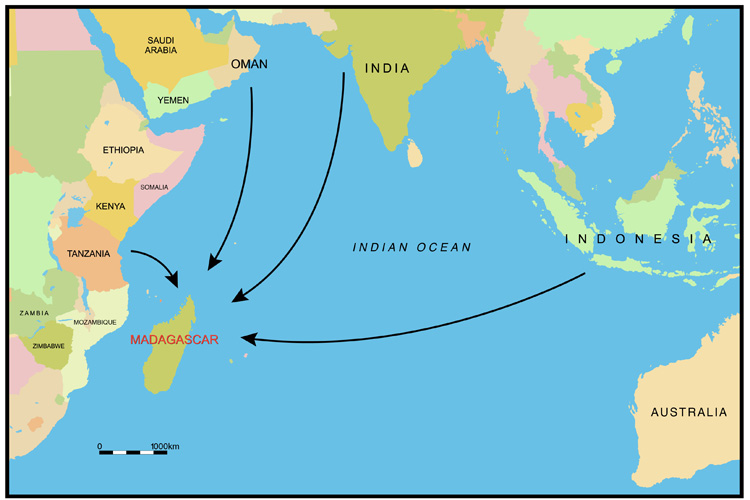
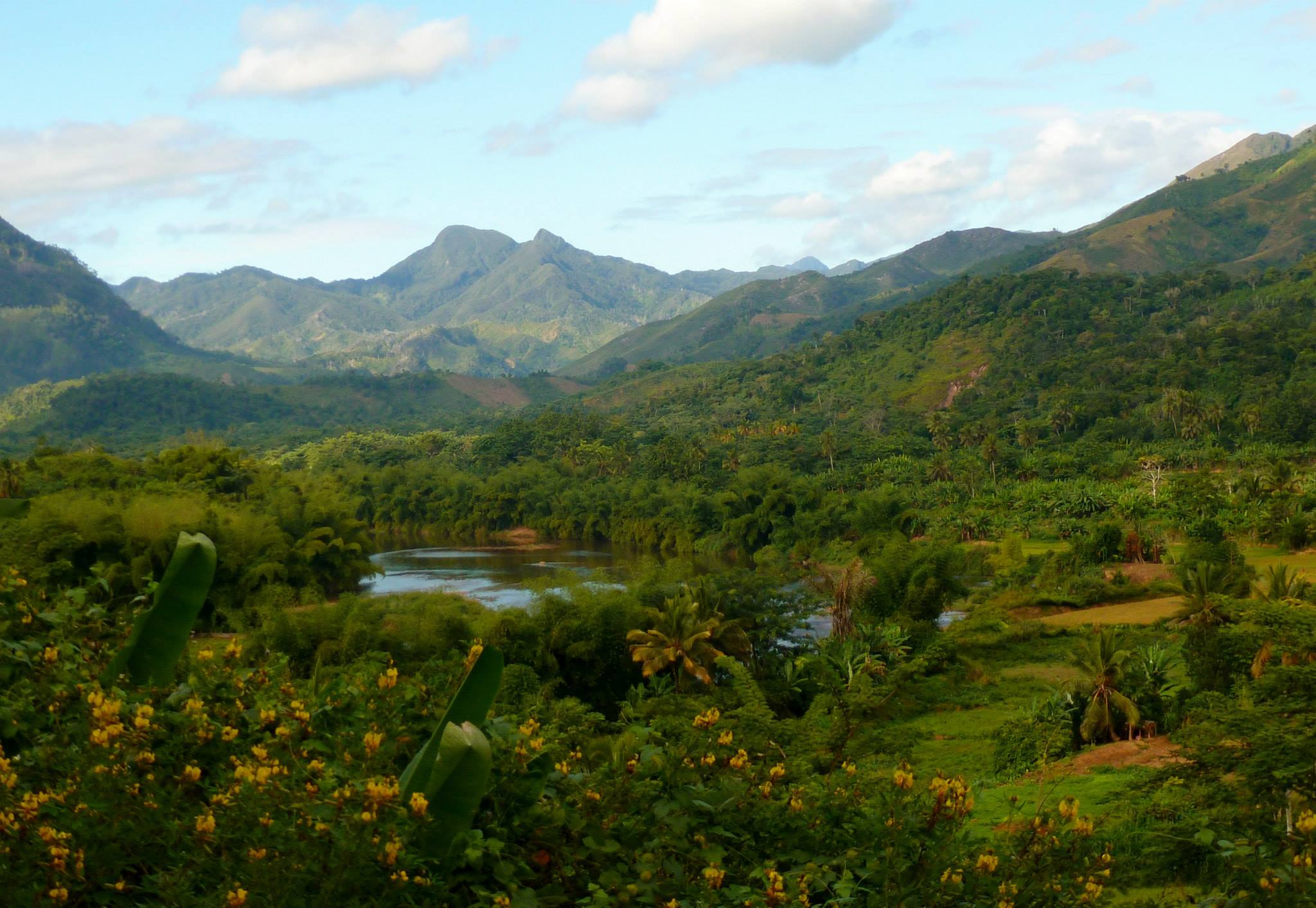
One of the most vulnerable countries is Madagascar, which has lost thousands of hectares of its unique forest to illegal logging and urbanisation over the past 50 years.
But things there are changing because of several ongoing projects, which could not only slow the rate of deforestation, but potentially bring in millions of dollars for the country and its people.
The island of Madagascar has a massive array of plant life, the majority of which is found nowhere else on earth.
The rainforests are a major draw for tourists however, they also hold allure for scientists hoping to discover something new and hopefully profitable.
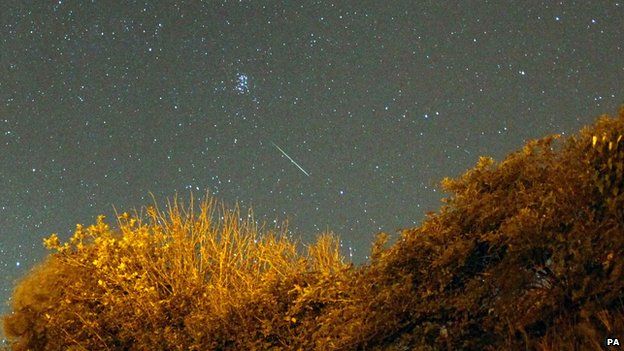
Stargazers are getting ready to enjoy the spectacular Perseid meteor shower.
Time exposure photograph of polar stars during a meteor shower
Up to 100 shooting meteors an hour will streak across the sky in the beautiful natural firework show, visible around the world.
Those hoping to catch a glimpse of the shower shouldn't be disappointed this year.
Astronomers say they're expecting extra-dark skies which will create perfect stargazing conditions.
Up to 100 shooting meteors per hour will streak across the sky
What causes the Perseid meteor shower?
The Perseids are actually tiny pieces of the Swift-Tuttle comet that can be seen every year when the Earth passes through a cloud of the comet's debris.
They're bits of ice and dust, which can be as small as a grain of sand or as big as a pea.
The fragments were left behind when Swift-Tuttle passed close to Earth in 1992.
The meteors appear to come from a point in the constellation of Perseus, hence the name Perseid.
They hit the Earth's atmosphere at a whopping speed of 134,000 mph, but don't pose any danger to us on Earth.
It's best to find a wide open space away from tall buildings, trees and artificial light
When and how can I see it?
The celestial show is expected to hit its peak overnight on Wednesday.
Unlike some other cosmic events, spectators don't need special technology to watch the Perseids unfold.
It's best to find a wide open space away from tall buildings or trees, and with as little light as possible. The more of the sky you can see, the better.
This year the Moon's glow will not interfere with meteor-watching, as it will be approaching its darkest or "new" phase, experts say.
Although many people believe that butterflies are creatures that love the warmth, periods of extremely hot and dry weather can significantly reduce populations.
In this study, British researchers looked at the impact of an extreme drought event in 1995 on butterfly species. This was the most arid summer since records began in 1776.
They identified six species, including the Cabbage White and the Speckled Wood butterflies, that were particularly sensitive to heat.
They then looked at what might happen to these creatures under different levels of warming up to 2100.
If emissions of carbon dioxide continue on a "business as usual" model, and warming is more extreme, then extinctions of some of these species could begin in England as early as 2050.
Restoring habitat connections could help mitigate the worst warming impact on butterflies
"We looked at the extent to which populations crashed from the drought and how long it takes them to recover," said lead author Dr Tom Oliver from Nerc Centre for Ecology and Hydrology.
"What we're asking is, as droughts become more frequent whether the return time of the drought was more frequent than the recovery of the butterflies."
"And when that was the case you'd get this gradual population erosion and in those places you'd get local extinctions."
The researchers say that areas of the south east of England would be worst affected.
However they argue that under less extreme warming conditions, changes to butterfly habitats could ameliorate the worst impacts.
The team found that restoring connections between habitats that have been fragmented by human activities such as agriculture, was capable of making a big difference.
Under a low emissions scenario, bridging these connections could improve the probability of butterfly survival by 50%.
"If our habitats are very fragmented, the impacts will be much more severe. In places where it isn't those populations might persist," said Dr Oliver.
"It allows us to buy time until we get those global emission cuts in place."
The researchers believe their study is a conservative estimation of how warming might impact these fragile species.
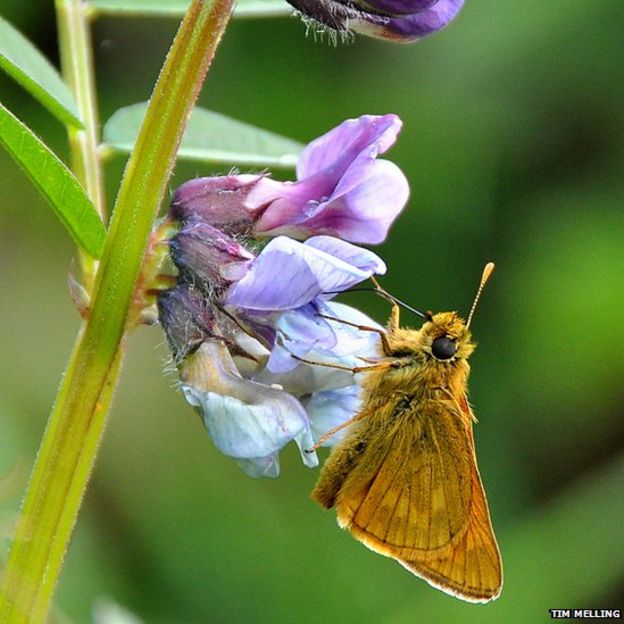
Extinctions of species like the Large Skipper could happen by 2050 under some warming scenarios
They are concerned that, because of landscape changes in the UK throughout the 20th century, populations of some of the threatened species might be too low for them to recover from frequent droughts.The authors say that even people who are not impressed by the aesthetic appeal of butterflies should still be concerned about their demise.
"Butterflies are important culturally as part of our natural heritage, but there are other functions that could be impacted by their extinction including pollution, pest control and decomposition of waste," said Dr Oliver.
"Those un-swayed by the beauty and importance of having butterflies in the countryside ought to be concerned about the disruption to these functions provided by these species."
Conservation charities are working with the government in northern Peru in South America where a big campaign's started to help save the Giant Manta Ray and make sure the species is protected forever.
There are concerns that over-fishing and destruction of habitat could be harming the species.
Changing attitudes about the species starts in the classroom and kids have been helping out.
Fin-tastic facts:
They're the largest ray in the world (up to 8m wide!)
They can make migrations across the oceans, finding their way by following topographical maps using ocean landmarks, such as seamounts.
They're also extremely intelligent and possess the largest brain of any fish.
When swimming around divers, mantas can be extremely curious, often coming in for a closer inspection and swimming repeatedly through divers' bubbles.
New research suggests that humpback whale populations in waters around Australia are increasing faster than anywhere else in the world.
The seas around the country are a popular area for this type of whale, but many decades of legal and illegal hunting, saw their numbers dip dangerously low and they were considered to be an endangered species.
However, conservation efforts now seem to be paying off because scientists say that humpback whales have recovered so well, they are "a symbol of hope."
Whale hunting is still a problem in other parts of the world so these results will be looked at closely to see how to help numbers increase globally. (CBBC Newsround)
Up to fifty sharks have been spotted swimming in waters near Selsey in West Sussex.
In June, a few sharks had been spotted at Medmerry, and half a dozen were also spotted in nearby PSRB Pagnam Harbour, but the huge number was unprecedented.
Mr Hughes told the Chichester Observer: "We do not know if the spectacle is going to repeat itself.
“Those wanting to look for the sharks can view from the new footpaths around the perimeter of Medmerry.
“Anyone new to the area should pick up a trail map and get advice from the RSPB Pagham Harbour visitor centre at Sidlesham.” ( From The Mirror)
The sharks were identified as smooth hound sharks, which can grow to around 1.5 metres in length.
The RSPB's Peter Hughes, who filmed the event on Thursday, said: "It was astonishing. There were just these huge fish everywhere in knee-deep water.
"We knew in time that Medmerry was going to be a great place for wildlife, but I don’'t think anyone expected this. We assume they were coming in to feed on the crabs and other marine life that have made their home at Medmerry."
Climate change is threatening the survival of bumblebees, significantly reducing the habitats in which they can survive, researchers say.
Across Europe and North America bumblebees have lost ground to climate change
They say the natural ranges of these key pollinators are being compressed in both Europe and North America.
The analysis indicates that warming is having a greater impact than pesticides or land use change.
To ensure bees survive, humans may have to help move them to cooler areas, the European and American researchers add.
Century of data
Many creatures, including butterflies, have responded to a warming climate by moving towards the poles or towards higher ground.
Bumblebees have dealt with the increasing heat by disappearing in large numbers from portions of their southern ranges, but the insects seem to have baulked at moving north.
Climate change can significantly reduce the habitats in which bees can survive
The study was carried out by a team of scientists from Europe, the US and Canada.
They examined more than 420,000 historical and current records of bumblebee observations between 1901 and 2010 relating to 67 different species.
Taking the period between 1901 and 1974 as their baseline, the researchers found that in recent decades when temperatures have increased, the bees started to die off in the southern part of their ranges in both Europe and North America, at the same time.
"These species are at serious and immediate risk, from rapid human induced climate change," said lead author Prof Jeremy Kerr from the University of Ottawa.
'Impacts large'
"The impacts are large and they are under way - they are not just something to worry about at some vague future time."
The researchers say the losses amount to a retreat of around 300km or around 9km a year from the bumblebees' traditional southern limits in Europe and North America.
"This is a surprise," said Dr Leif Richardson, one of the authors, from the University of Vermont.
Researchers say that temperatures are having a greater impact than pesticides or land changes
The researchers argue that the bees are "hitting a wall" on their northern ranges. They believe the insects are struggling to go further towards the pole because the lack the capacity to rapidly grow a new population when they move.
"This population growth rate limitation we suspect may be implicated as the key limitation on their capacity to track shifting climate conditions northward and into colder areas," said Prof Kerr.
Bumblebees are seen as critically important for pollinating not just food crops but many wild plants and flowers as well.
Pollination by insects is a key to the production of around one third of the food and drinks that humans consume.
The larger bodies of bumblebees allow them to generate more heat so they can fly earlier and later in the day and in colder weather than most bee species, including honeybees.
Many species have been in decline in recent years, with two - Cullem's bumblebee and the Short-haired bumblebee - going extinct in the UK this century.
The authors believe that the squeeze has not been caused by two other significant threats to the bees' survival: pesticides and land use changes.
When it comes to animals threatened with extinction, the cute and cuddly ones tend to get the most attention. But what about the ugly ones that go unnoticed when their numbers start to dwindle? Mary Colwell speaks up for the burbot.
"When you are furry, when you're lovable, you often fare better in people's interests than if you're bald and rather ugly," says Richard Sabin, curator of mammals at the Natural History Museum in London, referring to the popular appeal of animals such as pandas.
It was never going to bode well for the burbot then. The fish is "fat looking and a little bit flabby and soft" - a description offered by the museum's fish curator, James Maclaine.
He isn't the only one who doesn't swoon at its looks. "People have mixed feelings about the burbot," he says. "There's a 19th Century account by a man called Pennant who calls it 'a very delicate fish for the table, though of disgusting appearance when alive'."
It is true that burbot are… characterful. They are long and sinuous, commonly growing to more than a metre in length, but can get much larger. They look very much like eels - they are often called eelpout - and when caught, will wrap themselves around the angler's arms and legs.
With large squashed heads, small eyes, downturned mouths full of razor sharp teeth and tubes protruding from their nostrils, they are not exactly pretty. They are also exceedingly slimy and under the chin is a single long, fleshy feeler called a barbel, giving the impression of a goatee beard.
These characteristics are important. They are all adaptations to the cold, dark world at the bottom of northern lakes and rivers.
These were ice-age fish that once swam unhindered in a glacial world, until the ice retreated 10,000 years ago leaving some remnant populations throughout the northern hemisphere, including eastern England.
Natural Histories is a series about our relationships with the natural world
Listen toBarboton BBC Radio 4 on Tuesday 7 July at 11:00 BST or online after broadcast
The burbot is the only member of the cod family that lives in fresh water. For several months a year burbot can be trapped under ice - they need cold temperatures to spawn but all that slime and flabbiness provide excellent protection.
Their teeth are essential for catching a huge variety of food. "They're a very voracious predator," says Steve Simpson, marine biologist and lover of burbot at Exeter University. "There are reports of them eating birds, eating snakes, eating frogs - they really will eat anything they encounter."
Because their world is dark, they don't need big eyes. They use their barbels to detect vibrations and catch their prey. They may not be beautiful but they are perfectly adapted to their gloomy, chilly world.
Although still present throughout the rest of Europe and North America, the only burbot in England today can be found in the vaults of the Natural History Museum in London, preserved in pickling jars. Once a proud member of Britain's piscatorial family, the fish disappeared from British waters in the 1960s - the Angling Times offered a reward of £100 to anyone who found one in the UK, but that money lies unclaimed.