To my dear visitors and commenters

Hi, everybody! I've noticed with lots of joy and happiness, that thousands of comments have been written in my posts. It's wonderful that so may people around the world appreciate my work. Therefore, I want to thank you for that and ,at the same time I want to ask you to be this blog's followers. It's fast and easy! Make it be even more visited and spread all over the world! I'm a woman, a teacher of English in Portugal, and I've been away for quite a long time because of my father's health. Unfortunately he died from Covid19 a few months ago. Now I felt it was time to restart my activity in this and other blogs I owe. I've recently created a new one in a partnership with a street photographer, Mr. Daniel Antunes. He's fabulous! https://pandpbydandd.blogspot.com I'd like you to visit it and, who knows, become our followers. The poems, chronicles and thoughts are all mine. Thank you so much! Kisses :-)

Search This Blog

Showing posts with label Natural phenomena. Show all posts

Saturday, February 20, 2016

Australia town consumed by 'hairy panic'


A fast-growing tumbleweed called "hairy panic" is clogging up homes in a small Australian town.

'Hairy panic' tumbleweeds invade Australian town

Extremely dry conditions mean the weeds pile up each day outside a row of homes at Wangaratta, in Victoria's northeast.
Frustrated residents are forced to clear out the weeds for several hours every day, with piles of hairy panic at times reaching roof height.
A nearby farmer is being blamed for failing to tend to his paddock.
"It's physically draining and mentally more draining," resident Pam Twitchett told Prime7 News Albury.
From BBC News

Sunday, February 07, 2016

Taiwan earthquake: Felled building 'reinforced with tin cans'

Rescuers in Taiwan are working to find more than 100 people still missing more than 24 hours after the island was hit by a powerful earthquake.
At least 124 people are missing after the collapse of the 17-storey block, officials say.
Rupert Wingfield-Hayes saw evidence that concrete used to construct the building was reinforced with tin cans.
From BBC News

Massive 'El Nino wave' overturns car in Chile

High waves pounded Chile's coastline from Arica to Los Lagos on January 25. Photo: REUTERS/Rodrigo Garrido
A Chilean government vehicle driving by the coast has been flipped over by a huge wave, and its driver dramatically rescued.
Waves up to 16ft (5m) struck Vina del Mar on 24 January after powerful El Nino storms.
People been warned to stay away from beaches, particularly when the high tide comes in. (BBC News)


Bystanders recorded the waves, reaching up to 5m in height, coming to close for comfort after the powerful storm rocked the coast in Vina del Mar city in Chile on January 25.

The passengers miraculously escaped as passersby come to their rescue, The Telegraph reported, also adding these waves were the biggest in the region since 2003.

Local media said sightseers were warned of the potential danger these waves can cause.


Saturday, December 26, 2015

How is El Nino affecting countries around the world?

Powerful hurricanes in Mexico, drought in Ethiopia, flash-floods and mudslides in southern California - all have been attributed to the El Nino weather phenomenon.
Occurring every few years, the current El Nino is one of the strongest recorded and could contribute to making 2015 the hottest year on record.
But what is El Nino?
BBC News Science/Environment

Friday, December 25, 2015

The secrets revealed by coastal erosion

Erosion is problem on large parts of the UK coastline.


Now a scheme in Scotland, which gets the public logging at risk sites, is set to be expanded into England during 2016.
Archaeologist Tom Dawson, from the University of St Andrews, has been talking to BBC Weather World's Nick Miller about what Scotland's Coastal Heritage at Risk Project is trying to. 
(BBC News-Science/ Environment)

Wednesday, August 12, 2015

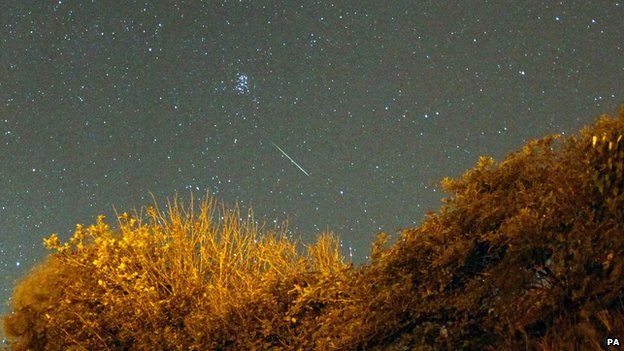
Guide: How to watch the Perseid meteor shower

Stargazers are getting ready to enjoy the spectacular Perseid meteor shower.

Time exposure photograph of polar stars during a meteor shower.
Time exposure photograph of polar stars during a meteor shower
Up to 100 shooting meteors an hour will streak across the sky in the beautiful natural firework show, visible around the world.
Those hoping to catch a glimpse of the shower shouldn't be disappointed this year.
Astronomers say they're expecting extra-dark skies which will create perfect stargazing conditions.
The Perseids
Up to 100 shooting meteors per hour will streak across the sky

What causes the Perseid meteor shower?

The Perseids are actually tiny pieces of the Swift-Tuttle comet that can be seen every year when the Earth passes through a cloud of the comet's debris.
They're bits of ice and dust, which can be as small as a grain of sand or as big as a pea.
The fragments were left behind when Swift-Tuttle passed close to Earth in 1992.
The meteors appear to come from a point in the constellation of Perseus, hence the name Perseid.
They hit the Earth's atmosphere at a whopping speed of 134,000 mph, but don't pose any danger to us on Earth.
Perseid meteor shower
It's best to find a wide open space away from tall buildings, trees and artificial light

When and how can I see it?

The celestial show is expected to hit its peak overnight on Wednesday.
Unlike some other cosmic events, spectators don't need special technology to watch the Perseids unfold.
It's best to find a wide open space away from tall buildings or trees, and with as little light as possible. The more of the sky you can see, the better.
This year the Moon's glow will not interfere with meteor-watching, as it will be approaching its darkest or "new" phase, experts say.
From CBBC newsround

Wednesday, July 15, 2015

Great white shark rescued from beach

A great white shark has been rescued after it was stranded on a beach at Chatham, Massachusetts in the US.


Witnesses say the seven-foot male shark got stuck as the tide went out.
Members of the public kept the shark alive and wet by splashing it with buckets of water until officials arrived.
The harbour master then attached a line to his rear caudal fin and pulled it back into open waters to release it safely back into the sea. ( From CBBC Newsround)
Witnesses said the two-metre male was stranded by a receding tide. ( From The Guardian)


Local harbour master Stuart Smith was able to attach a rope to the shark and, with the help of colleagues, dragged it back into the sea ending the rescue at around 5pm.
“Twenty, 25 years ago, they wouldn’t be exactly helping the shark. They’d be harming the shark. But now every single person on that beach was trying to assist it,” Mr Smith told the Boston Globe. “The people on the beach made the difference.”
Greg Skomal, a biologist from the state’s Division of Marine Fisheries, was also on hand to help, attaching an acoustic tag to the animal to enable researchers to track its movements along the Cape Cod coast.

He also praised the actions of the crowd, noting that when the great white eventually started swimming roughly a mile out to sea spectators “started clapping on the shoreline”.
Although the video does not appear to show the shark swimming, it has been reported that the fish survived – despite appearing close to death in much of the video. ( From The Independent)

Saturday, June 06, 2015

Roadside verges 'last refuge for wild flowers'

More than 700 species of wild plants - almost half of the native flora of the British Isles - are found on road verges, according to a study.

Pyramidal orchid on the roadside
Many plants once found in meadows now only thrive beside roads, where they provide essential habitat for insects, says charity Plantlife International.
But it says one in 10 of the plants is at risk of extinction, in part because councils cut verges too early.
Local authorities say shorter verges are safer for drivers and pedestrians.
Dr Trevor Dines, botanical specialist for the charity, said more than 97% of meadows had been destroyed in England since the 1930s, with road verges becoming the last stretches of natural habitat for wildlife such as bees and other insects.
Cow parsley
Road verges can be a haven for wild plants like cow parsley
"Most of our farmland is now hostile to many of our wild plants and other wildlife due to the loss of wild flower meadows and the use of herbicides and fertilisers," he told BBC News.
"The roadside verges are often the last refuge for wild flowers and the wildlife there depends on them.
"It's almost as if plants have been squeezed out of farmland and now they're being squeezed out of road verges from bad management."
The Local Government Association has said keeping road verges well-maintained means motorists have a good line of sight and allows pedestrians to walk more safely alongside busy roads.

Full flower


Bluebells
Around one in ten of these wild plants is threatened with extinction

Plantlife International says road verges are of particular importance to rare plants such as Deptford pink, tower mustard and spiked rampion.
They also act as wildlife corridors and provide pollen and nectar for bees, butterflies and moths.
The wild plant conservation charity says many of Britain's road verges are being cut down in full flower threatening the wildflowers and the wildlife that depends on them.
It is calling on members of the public to sign a petition urging councils to do more to enhance the wildlife value of road verges.

Its management principles for road verges include:
  • Allowing plants to complete their full life cycle, ie to grow, flower and set seed
  • Removing grass cuttings
  • Allowing flowers to return over time as they spread naturally.
Dr Dines added: "If we just give them a chance, wildflowers can return."

From BBC Science/Environment

Saturday, May 16, 2015

Why is sea ice so important?

After Norwegian scientists described profound changes in the Arctic as a "new era" for sea ice,BBC Weather's Tomasz Schafernaker reports for BBC Global on why it is so important.


New research from the British Antarctic Survey has revealed that both air temperature and warm ocean currents are contributing to the thinning of the Larsen C ice shelf in the Antarctic Peninsula. The team behind the study predict that the ice shelf could collapse within a century, with major consequences for global sea levels.


From BBC News-Weather


Sunday, April 12, 2015

Acidic oceans helped fuel extinction

Acidic oceans helped fuel the biggest mass extinction in the history of life on Earth, a study says.

Siberian Traps
The researchers studied rocks from the United Arab Emirates, which retain a record of acidic changes in the water
The exact causes behind the Permian-Triassic mass extinction have been much debated.
Two separate pulses of CO2 into the atmosphere - a "one-two punch" - may have helped fuel the die-off, new research suggests.
Acidic OceansChanges to ocean acidity would have been one of the consequences, according to the study in Science journal.
Computer models suggested that this CO2 may have been released by massive bouts of volcanism from the Siberian Traps, now represented as a large region of volcanic rock in northern Eurasia.
The Permian-Triassic mass extinction, which took place 252 million years ago, wiped out more than 90% of marine species and more than two-thirds of the animals living on land.
The event is thought to have played out over a 60,000-year period and acidification of the oceans lasted for about 10,000 years.
The team led by Dr Matthew Clarkson from the University of Edinburgh analysed rocks unearthed in the United Arab Emirates - which were on the ocean floor at the time.
The rocks preserve a detailed record of changing oceanic conditions at the time. They then developed a climate model to work out what drove the extinction.

The researchers think the rapid rate of release of carbon was a crucial factor in driving the ocean acidification.
The carbon was released at a similar rate to modern emissions. Dr Clarkson commented: "Scientists have long suspected that an ocean acidification event occurred during the greatest mass extinction of all time, but direct evidence has been lacking until now.


"This is a worrying finding, considering that we can already see an increase in ocean acidity today that is the result of human carbon emissions."

From BBC News

Thursday, April 02, 2015

Boost for endangered butterflies

Good news for butterflies - the warm weather at the start of last year boosted their numbers.
The High Brown Fritillary
The critically endangered High Brown Fritillary

A study by Butterfly Conservation and the Centre for Ecology and Hydrology looked at 56 different types of butterflies and found that numbers of 32 types were on the up.
Around 100,000 more butterflies were counted across the UK than in the previous year.
This was due to both the warm, wet spring, which was good for emerging caterpillars, and wildlife-friendly farming schemes to restore the woodland and moorland slopes where it breeds, said Butterfly Conservation.
But lots of species did have a drop in their numbers too. Butterflies that emerge in high summer struggled in the colder August weather, including the Chalk Hill Blue, Adonis Blue and the two "cabbage white" species.
The small white
The small white butterfly declined

High Brown Fritillary

It was good for species like the High Brown Fritillary.
They were was once found in lots of places across England and Wales, but now they're down to a single colony in Wales and around Morecambe Bay and on Dartmoor in England.
Dr Tom Brereton from Butterfly Conservation said: "The High Brown Fritillary is one of only two butterflies classed as critically endangered in the UK so it is fantastic news that numbers are at their highest level for more than a decade."
From CBBC Newsround


Wednesday, February 25, 2015

US sea level north of New York City 'jumped by 128mm'

Sea levels along the northeast coast of the US rose to record levels during 2009-2010, a study has found.
Satellite image

Sea levels north of New York City rose by 128mm in two years, according to a report in the journal, NatureCommunications.
Coastal areas will need to prepare for short term and extreme sea level events, say US scientists.
Climate models suggest extreme sea level rises will become more common this century.
"The extreme sea level rise event during 2009-10 along the northeast coast of North America is unprecedented during the past century," Prof Jianjun Yin of the University of Arizona told BBC News.
"Statistical analysis indicates that it is a 1-in-850 year event."


They identified what they call an extreme sea-level rise during 2009-10, when the coastal sea level north of New York City jumped by 128mm.
"When coastal storms occur, extreme sea levels can lead to elevated storm surge," said Prof Jianjun Yin.
"In addition to long-term and gradual sea level rise, coastal communities will need to prepare for short and extreme sea level rise events."
Commenting on the study, Prof Rowan Sutton, a climate scientist at the National Centre for Atmospheric Science, University of Reading, said climate models suggest an increase in such events.
"This study identifies a record breaking high sea level event that occurred along part of the US east coast in 2009-10.
"There is strong evidence that the likelihood of such events has been increased by climate change, and that we should expect more such events in the future.


Tidal records

Scientists at the University of Arizona and National Oceanic and Atmospheric Administration (NOAA) in New Jersey studied records of tidal levels along the east coast of the US and Canada.
They divided the coastline into three areas: north of New York City, New York City to Cape Hatteras on the coast of North Carolina, and south of Cape Hatteras.
"This example illustrates how individual extreme events are influenced by multiple factors - in this case the global rise in sea levels, regional changes in ocean circulation and wind patterns."
Dr Dan Hodson, also from the University of Reading, said the analysis underlined the importance of understanding the connections between surges in sea levels and ocean currents.
"Sea level change is a complex phenomenon, especially on the regional scale, where changes to the global ocean circulation can play a major role," he said.
"The east coast of North America is quite close to an area of active, fast ocean currents, and so is quite sensitive to changing ocean circulation."
He said the Atlantic Meridional Overturning Circulation (AMOC), a major current in the Atlantic Ocean, had implications for Europe and Africa as well as the US.
Research at the University of Reading has shown how it could make British summers wetter and may influence rainfall patterns in parts of Africa.
From BBC News

Friday, November 14, 2014

Climate change 'will make lightning strike more'

Lightning fork (c) BBC
Global warming will significantly increase the frequency of lightning strikes, according to US research.

The research, published in Science, was carried out with the help of data from a US network of lightning detectors.
The teams says they have calculated how much each extra degree in temperature will raise the frequency of lightning.
"For every two lightning strikes in 2000, there will be three lightning strikes in 2100," said David Romps, at the University of California, Berkeley.
As well as triggering more wild fires, he said, this would alter the chemistry of the atmosphere.
The team's work reveals a new method of working out the relationship between temperature and lightning storms, by estimating the heat energy available to "fuel" storm clouds.
"As the planet warms, there will be more of this fuel around, so when thunderstorms get triggered, they will be more energetic," said Prof Romps.
He and his colleagues calculated that every 1C rise in global temperature would lead to an increase in the frequency of lightning strikes by 12%.They validated their calculations against a year of data from the US National Lightning Detector Network, which detects an electromagnetic pulse every time lightning strikes in the US.
"The resulting data is exquisite," said Dr Romps. "The position and time of every lightning strike is very accurately recorded."
Changing the atmosphere
As well as triggering half of the wildfires in the US, each lightning strike - a powerful electrical discharge - sparks a chemical reaction that produces a "puff" of greenhouse gases called nitrogen oxides.

"Lightning is the dominant source of nitrogen oxides in the middle and upper troposphere," said Prof Romps.
And by controlling this gas, it indirectly regulates other greenhouse gases including ozone and methane.
Prof Romps said that this was an example of a large response to "what sounds like only a few degrees of warming".
A scientist at the UK Met Office said it was important to understand future lightning patterns, but cautioned that there were still uncertainties in the researchers' model that needed to be tested further.
The Met Office added that the application of this forecast to other parts of the world could be limited by the fact that rainfall patterns were very uncertain in many regions.
Prof Romps said that if the Earth did warm by the expected 4C during the 21st Century, the change in lightning would be "the least of our worries".
"A big chunk of the [carbon dioxide] we put into the atmosphere during this century will persist [there] for 100,000 years; a long-lived legacy, indeed."
Changing the atmosphere
As well as triggering half of the wildfires in the US, each lightning strike - a powerful electrical discharge - sparks a chemical reaction that produces a "puff" of greenhouse gases called nitrogen oxides."Lightning is the dominant source of nitrogen oxides in the middle and upper troposphere," said Prof Romps.
And by controlling this gas, it indirectly regulates other greenhouse gases including ozone and methane.
Prof Romps said that this was an example of a large response to "what sounds like only a few degrees of warming".
A scientist at the UK Met Office said it was important to understand future lightning patterns, but cautioned that there were still uncertainties in the researchers' model that needed to be tested further.
The Met Office added that the application of this forecast to other parts of the world could be limited by the fact that rainfall patterns were very uncertain in many regions.
Prof Romps said that if the Earth did warm by the expected 4C during the 21st Century, the change in lightning would be "the least of our worries".
"A big chunk of the [carbon dioxide] we put into the atmosphere during this century will persist [there] for 100,000 years; a long-lived legacy, indeed."
How lightning strikes
Lightning (c) BBC
It still is not entirely clear what triggers the process of "charging a storm cloud". But scientists do know that, to make lightning, water in all three phases - vapour, liquid, and ice - need to coexist.
Clouds then need to rise quickly enough to lift that liquid and ice and keep them suspended. As ice particles in the storm cloud collide with each other, they exchange charged particles called electrons. This eventually leads to a build-up of charge within the cloud, with negatively charged large ice falling to the bottom and positively charged small ice at the top.
The physical separation of that charge is crucial - the negative charge ultimately discharges downwards in a stream of electrons that is the bolt of lightning.
From BBC Sci/Environment

Monday, July 14, 2014

Freak hailstorm hits a beach in Siberia

Swimmers and sunbathers were forced to run for cover when a freak hailstorm hit a beach in Siberia, Russia, on Saturday.

Seconds earlier: The hailstorm happened on a day which saw temperatures rising to 37C
Dozens were seen taking cover from the hail under sun umbrellas and beach side shacks with corrugated roofing.Towels, beach mats and personal possessions were sent flying by heavy winds.Heavy winds hit the sandy beach in Novosibirsk late on Saturday afternoon as hundreds were cooling off from the hot summer's day by swimming in the Ob, the fifth longest river in the world.Bathers said that minutes before the storm there was no clue about the dramatic cloudburst to come. 
Swimmers and sunbathers were forced to run for cover when hit a freak hailstorm hit a beach in Siberia, Russia, on Saturday.

Bathers ran out of the Ob River clutching their heads as hail the size of golf balls fell from the sky.
Sunbathers run for cover as storm of giant hailstones hits a beach on the Ob River in Siberia

Bathers ran oof the Ob River clutching their heads as hail the size of golf balls fell from the sky.

'It was an attack from the heavens': The shocking moment a Siberian beach was hit by a freak hailstorm on one of the hottest days of the summer

From
  •  BBC News
  • Mail online

Monday, April 21, 2014

Asian air pollution strengthens Pacific storms

Air pollution in China and other Asian countries is having far-reaching impacts on weather patterns across the Northern Hemisphere, a study suggests.


Beijing haze
A thick haze of pollution envelopes Beijing - but scientists say the toxic air travels much further afield

Researchers have found that pollutants are strengthening storms above the Pacific Ocean which feeds into weather systems in other parts of the world.
The effect was most pronounced during the winter.
Lead author Yuan Wang, from the Jet Propulsion Laboratory at the California Institute of technology, said: "The effects are quite dramatic. The pollution results in thicker and taller clouds and heavier precipitation."

Toxic atmosphere

Parts of Asia have some of the highest levels of air pollution in the world.
In China's capital, Beijing, pollutants frequently reach hazardous levels, while emissions in the Indian capital, Delhi, also regularly soar above those recommended by the World Health Organization.
This has dire consequences for the health of those living in these regions, but there is growing evidence that there are other impacts further afield.
To analyse this, researchers from the US and China used computer models to look at the effect of Asia's pollution on weather systems.
The team said that tiny polluting particles were blown towards the north Pacific where they interacted with water droplets in the air.
Buildings are shrouded in smog in Lianyungang, China
Researchers believe the tiny pollutant particles blow over to the north Pacific Ocean
This, the researchers said, caused clouds to grow denser, resulting in more intense storms above the ocean.
Dr Yuan Wang said: "Since the Pacific storm track is an important component in the global general circulation, the impacts of Asian pollution on the storm track tend to affect the weather patterns of other parts of the world during the wintertime, especially a downstream region [of the track] like North America."
Commenting on the study, Professor Ellie Highwood, a climate physicist at the University of Reading, said: "We are becoming increasingly aware that pollution in the atmosphere can have an impact both locally - wherever it is sitting over regions - and it can a remote impact in other parts of the world. This is a good example of that.
"There have also been suggestions that aerosols over the North Atlantic effect storms over the North Atlantic, and that aerosols in the monsoon region over South Asia can affect circulation around the whole of the world."

Saturday, April 12, 2014

Climate change report highlights major impacts

The impact of climate change is being felt across all continents and oceans and it is affecting food security, glaciers and the spread of disease, according to a new report.
Scientists and officials meeting in Japan say the document is the most comprehensive assessment to date of the impacts of climate change on the world.


Temperatures are clearly rising and that is a serious problem. 
Watch the picture below carefully


Wednesday, February 26, 2014

Smell of forest pine can limit climate change - researchers say

New research suggests a strong link between the powerful smell of pine trees and climate change.

The fresh scent of pine trees has a significant impact on climate change

Scientists say they've found a mechanism by which these scented vapours turn into aerosols above boreal forests.
These particles promote cooling by reflecting sunlight back into space and helping clouds to form.
The research, published in the journal Nature, fills in a major gap in our understanding, researchers say.
One of the biggest holes in scientific knowledge about climate change relates to the scale of the impact of atmospheric aerosols on temperatures.
Perfumed air
These particles form clouds that block sunlight as well as reflecting rays back into space.
They can be formed in a number of ways, including volcanic activity and by humans, through the burning of coal and oil.
According to the Intergovernmental Panel on Climate Change (IPCC), they "continue to contribute the largest uncertainty to estimates and interpretations of the Earth's changing energy budget."
One of the most significant but least understood sources of aerosols are the sweet-smelling vapours found in pine forests in North America, northern Europe and Russia.
These aerosols have confounded climate models as scientists haven't been able to accurately predict how many of the particles form.
Now an international team of researchers say they have solved the chemical mystery by which the rich odours become reflective, cooling particles.
They've long understood that the smell of pine, made up of volatile organic compounds, reacts with oxygen in the forest canopy to form these aerosols.
The scientists now found that, in fact, there is an extra step in the process, what they term a "missing link".
They've discovered ultra-low volatility organic vapours in the air that irreversibly condense onto any surface or particle that they meet.
"These vapours are so crazy in structure from what we had known before," said one of the authors, Dr Joel Thornton, from the University of Washington.
From BBC -Environment

Wikipedia

Search results