To my dear visitors and commenters

Hi, everybody! I've noticed with lots of joy and happiness, that thousands of comments have been written in my posts. It's wonderful that so may people around the world appreciate my work. Therefore, I want to thank you for that and ,at the same time I want to ask you to be this blog's followers. It's fast and easy! Make it be even more visited and spread all over the world! I'm a woman, a teacher of English in Portugal, and I've been away for quite a long time because of my father's health. Unfortunately he died from Covid19 a few months ago. Now I felt it was time to restart my activity in this and other blogs I owe. I've recently created a new one in a partnership with a street photographer, Mr. Daniel Antunes. He's fabulous! https://pandpbydandd.blogspot.com I'd like you to visit it and, who knows, become our followers. The poems, chronicles and thoughts are all mine. Thank you so much! Kisses :-)

Search This Blog

Friday, October 30, 2015

UN: Climate plans must go further to prevent dangerous warming

The UN has released its assessment of national plans to limit climate change, submitted by 146 countries.

chimneys
Carbon emissions will be "significantly dented" according to the UN, if all the plans are put into action

Officials say the submissions, in their current form, won't keep global temperatures from rising by more than the 2C danger threshold.
The global total of carbon emissions will continue to grow, although more slowly than over the past two decades.
However the UN report says the plans are a major step forward and the 2C goal is still "within reach".
The UN believes that these national climate plans, called Intended Nationally Determined Contributions (INDCs) will form the cornerstone of a binding, global treaty on climate change that will be agreed at a conference in Paris in December.
According to the UN, the submissions now cover around 86% of global emissions: about four times the amount covered by the Kyoto Protocol, the world's first carbon cutting treaty.
Their assessment is decidedly upbeat about the plans, despite acknowledging that taken together they point to rises in global temperatures of 2.7C above the pre-industrial level.
Scientists have determined that if temperature rises exceed 2C, this will lead to significant and dangerous climate impacts, which will especially hit the world's poor.
UN climate chief, Christiana Figueres, said the plans were an excellent first step: "The INDCs have the capability of limiting the forecast temperature rise to around 2.7C by 2100, by no means enough but a lot lower than the estimated four, five, or more degrees of warming projected by many prior to the INDCs."
Observers say the 2.7C figure is a substantial improvement on 3.1C, which was the estimate when the plans were assessed last December.

UN climate conference 30 Nov - 11 Dec 2015

Climate Change

COP 21 - the 21st session of the Conference of the Parties - will see more than 190 nations gather in Paris to discuss a possible new global agreement on climate change, aimed at reducing greenhouse gas emissions to avoid the threat of dangerous warming due to human activities.
Explained: What is climate change?
In video: Why does the Paris conference matter?

From BBC News

Thursday, October 29, 2015

Lion populations in Africa 'could halve in 20 years'

The number of lions in Africa is rapidly dropping, except in highly-managed areas in the south of the continent, a study has found.
Lion cubs play on the banks of the Makhutswi River on July 21, 2010 in the Edeni Game Reserve, South Africa.
Almost all lion populations that historically exceeded 500 are declining.
The study suggests that lion populations in unprotected areas could be cut in half over the next two decades.
The paper's authors say lions should now be upgraded to an endangered species in Central and West Africa.
The loss of habitat, hunting, and a demand for traditional medicine have all contributed to population decline.
Lions are currently considered "vulnerable" by the International Union for Conservation of Nature, but endangered status means they would be considered at "a very high risk of extinction in the wild".
The study, published in the Proceedings of the National Academy of Sciences of the United States of America, says "many lion populations are either now gone or expected to disappear within the next few decades".
A lion walks across the grassland of the Amboseli National Park, Kenya, in 2007.
The study predicts a 67% chance that lions in West and Central Africa will decline by half.
African lion populations are declining everywhere on the continent, with the exception of Botswana, Namibia, South Africa, and Zimbabwe, which are having success with what the paper calls "small, fenced, intensively managed, and funded reserves".
There is a 67% chance that lions in West and Central Africa will decline by half within 20 years, while East African populations have a 37% chance of being halved in the same time.
Those predictions are based on trends in 47 lion populations, containing more than 8,200 animals.
The decline could lead to a reversal of previous trends, making the protected, managed populations of southern Africa more viable than the East African savannah.
A reduction in lion numbers could also change the local ecosystems, "with the lion no longer playing a pivotal role as apex predator", the study says.
The authors also warned that the African lion could come to rely on the small, managed reserves, "and may no longer be a flagship species of the once vast natural ecosystems across the rest of the continent."
From BBC News- Science/Environment

Friday, October 23, 2015

Snow leopards face 'new climate change threat'

Warmer temperatures are threatening to shrink the habitat of the snow leopard and weaken their struggle against extinction, a report says.

Snow leopard
Snow leopards are a species in crisis, the WWF report says

Conservation charity WWF says more than a third of the animal's mountain living areas could become uninhabitable because of climate change.
It says plants and trees there are not able to survive in warmer temperatures.
The report describes snow leopards as one of the most beautiful and enigmatic big cats.
"But it is also one of the most elusive and endangered," it says.

WWF says that the animal is threatened not just because of climate change but also because of a combination of other factors including:


Snow leopard in Mongolia
The WWF report is accompanied by rare camera trap images of snow leopards in Mongolia

Snow leopard
Snow leopards have been described by WWF as one of the world's most majestically beautiful and enigmatic big cats
Climate change will exacerbate most of these threats, the report says, further increasing the pressure on snow leopards and reducing them to unsustainable numbers in many areas.
"The Himalayas region will face a major crisis if we choose to ignore climate change. Not only do we risk losing majestic species such as the snow leopard, but hundreds of millions of people who rely on water flowing from these mountains may be affected," WWF-UK's Snow Leopard Programme Lead Rebecca May said.
The charity says that India, Nepal and Bhutan's success in increasing the number of endangered species such as tigers and rhinos could be replicated for snow leopards
Snow leopard

Snow leopards

  • Native to the mountains of Central and South Asia, it is estimated that there are some 4,000 to 6,000 worldwide
  • Usually found at elevations of 3,000-4,500m (11,480-14,760ft)
  • Solitary creatures, they usually hunt at dawn and dusk and are able to kill prey up to three times their own weight
  • Mostly feed on wild animals, but will also prey on livestock
  • Their spotted coats change with the seasons - from a thick, white fur to keep them warm and camouflaged in winter to a fine yellow-grey coat in summer
  • Retaliatory killings by farmers are not uncommon but are rarely reported

From BBC News- science/Environment

Tuesday, October 20, 2015

Why is ivory so popular in China?

Say NO to ivory trade!

Elephant with a baby elephant
Up to 30,000 African elephants are killed every year by poachers who want to sell their tusks for ivory.
Prince William will go on Chinese TV today to speak out against the use of ivory.

It's a material found in elephant tusks and China buys and sells more of it than anywhere else in the world.
Prince William has spoken passionately about trying to stop the ivory trade in the past and will use his speech to urge the Chinese government to ban it.
Here is Newsround's guide on why the ivory trade is such a big concern and why China seems so obsessed with it.

What is ivory?

Ivory tusks
Elephants are hunted for their tusks, and the ivory is illegally sold all around the world.

Ivory is a hard white material that is found in the tusks of elephants and other tusked animals like hippos and walruses. Although rhinos have similar looking horns, these aren't actually made from ivory. However, rhinos are also illegally hunted for their horns because they are used in lots of medicines in China and the Far East.
Lots of elephants die as a result of hunters taking their tusks because removing the ivory almost always kills the animals.
It's estimated that up to 30,000 African elephants die every year because they are hunted for ivory.
Selling ivory was banned worldwide in 1989, but the ban has been lifted several times, so there is still a lot of ivory on sale. As well as this, a lot of ivory is sold by poachers who kill elephants illegally.

Why is ivory so popular in China?

A carved ivory ship model
Ivory is often used to make elaborate and expensive ornaments in China.

In China and Hong Kong, ivory is seen as precious material and is used in ornaments and jewellery. It's also sometimes used in traditional Chinese medicine.
Some rich Chinese people think that owning ivory makes them look more successful. Others think that ivory will bring them good luck.
China has the biggest ivory trade in the world and wildlife experts believe that around 70 per cent of the world's ivory ends up there.

Are things changing?

A police officer stands guard next to ivory and ivory sculptures before they are destroyed in Dongguan, Guangdong province 6 January 2014
The Chinese government has started cracking down on illegal ivory and has destroyed lots of tusks and ornaments.

This year China agreed to ban ivory tusks and ornaments coming into the country for twelve months.
The government has said it wants to completely ban ivory sales soon but it is still legal to sell older carvings and ornaments.
Some people don't want ivory to be banned in China because they say that carving it is an old Chinese tradition that should carry on.
But more and more people in China disagree. A recent survey found that 95 per cent of people there wanted ivory to be banned to protect the elephants.

From CBBC Newsround

Friday, October 16, 2015

The polar bears are coming to town

For 15 years, Irish anthropologist Martina Tyrrell has studied the relationship between humans and animals in Arviat, an Inuit community on the west coast of Hudson Bay, where the townspeople are increasingly having to cope with a large and dangerous visitor - the polar bear.


A polar bear walks on a road causing a traffic jam
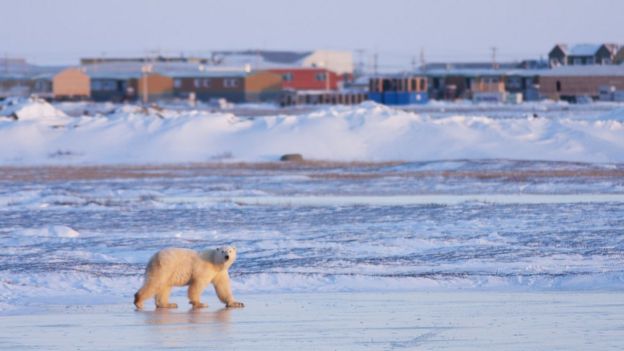
People and polar bears have always lived side-by-side in this part of the world but in the past it was rare for bears to enter the town. Now, every summer and autumn, it's becoming an uncomfortable part of everyday life.
A mother polar bear and two cubs
Polar bears tower over humans, sometimes measuring as much as 12 feet from nose to tail. But Inuit believe that humans and bears have much in common. When bears rear up on their hind legs to sniff the air, to play, to attack or defend themselves, they resemble two-legged humans. And like Inuit, bears are at home on both sea ice and land. At sea they hunt the same marine mammal species for sustenance - humans and bears are rival predators at the top of the food chain.
A bear clambers through a rubbish dump

Polar bears: Key facts

  • Polar bears are the biggest land-based carnivores in the world and live in the Arctic;
  • They mainly eat seals, which they detect using their remarkable sense of smell - bears can smell a seal in the water beneath a metre of compacted snow, and on land from almost 1km (0.6 miles) away:
  • Climate change is currently the single greatest threat to polar bears - their icy habitat is melting away
Source: WWF

Over the past decade, however, encounters have been on the increase. Camping south of the community in summer is no longer safe, and autumn berry picking - an important subsistence activity usually undertaken by women and children - is now fraught with danger. Bears increasingly wander the streets of Arviat, particularly in late autumn.
At this time of year, regular announcements of bear sightings are made on local community FM radio, schools are sometimes closed early and the usually lively streets are eerily quiet. Halloween trick-or-treating, once so wild and fun-filled, has been all but wiped out, for fear of unwanted encounters not with ghosts or demons but with wandering bears.
A bear walks with houses in the distance
What is driving this change in the polar bears' behaviour?
Many Arviarmiut blame polar bear tourism in neighbouring Churchill - 250km to the south - for encouraging the animals to look for food in human settlements.
A map showing Arviat, Churchill and Greenland
But there are other theories. Some Inuit think the bear population in the region is growing. Many scientists, on the other hand, put the blame on habitat loss - according to this theory it's the desperation of hungry bears facing decreased ice seasons in a rapidly warming Arctic that leads them to approach the town. They have always gathered on the coastline at this time of year, awaiting the formation of the sea ice that is their winter hunting ground, but usually at a greater distance.
Whatever the cause, Arviarmiut have had to get used to sharing their community with growing numbers of large, dangerous and unpredictable carnivores. Many towns in the northern Canadian territory of Nunavut are in the same position - Clyde River, Hall Beach and Resolute Bay have all reported problems in the past couple of years.
In Arviat, things reached a critical point four years ago.
Between 2010 and 2011, 11 polar bears were killed by Arviarmiut defending life or property. So, in 2011, with financial support from WWF (Canada), local hunter Leo Ikakhik was hired as a full-time polar bear monitor. Leo patrols the town, responds to sightings, and discourages polar bears through the use of spotlights and bangers. In addition, many homes have been provided with sealed steel bins for storing frozen meat, which was previously stored on roofs in sub-zero temperatures, and electric fences have been erected around sled dog teams. As a result of these measures, defence kills have all but ceased.
But a number of bears are also killed each year by hunters.
 Adapted from BBC News. Magazine

Wikipedia

Search results