To my dear visitors and commenters

Hi, everybody! I've noticed with lots of joy and happiness, that thousands of comments have been written in my posts. It's wonderful that so may people around the world appreciate my work. Therefore, I want to thank you for that and ,at the same time I want to ask you to be this blog's followers. It's fast and easy! Make it be even more visited and spread all over the world! I'm a woman, a teacher of English in Portugal, and I've been away for quite a long time because of my father's health. Unfortunately he died from Covid19 a few months ago. Now I felt it was time to restart my activity in this and other blogs I owe. I've recently created a new one in a partnership with a street photographer, Mr. Daniel Antunes. He's fabulous! https://pandpbydandd.blogspot.com I'd like you to visit it and, who knows, become our followers. The poems, chronicles and thoughts are all mine. Thank you so much! Kisses :-)

Search This Blog

Friday, October 16, 2015

The polar bears are coming to town

For 15 years, Irish anthropologist Martina Tyrrell has studied the relationship between humans and animals in Arviat, an Inuit community on the west coast of Hudson Bay, where the townspeople are increasingly having to cope with a large and dangerous visitor - the polar bear.


A polar bear walks on a road causing a traffic jam
People and polar bears have always lived side-by-side in this part of the world but in the past it was rare for bears to enter the town. Now, every summer and autumn, it's becoming an uncomfortable part of everyday life.
A mother polar bear and two cubs
Polar bears tower over humans, sometimes measuring as much as 12 feet from nose to tail. But Inuit believe that humans and bears have much in common. When bears rear up on their hind legs to sniff the air, to play, to attack or defend themselves, they resemble two-legged humans. And like Inuit, bears are at home on both sea ice and land. At sea they hunt the same marine mammal species for sustenance - humans and bears are rival predators at the top of the food chain.
A bear clambers through a rubbish dump

Polar bears: Key facts

  • Polar bears are the biggest land-based carnivores in the world and live in the Arctic;
  • They mainly eat seals, which they detect using their remarkable sense of smell - bears can smell a seal in the water beneath a metre of compacted snow, and on land from almost 1km (0.6 miles) away:
  • Climate change is currently the single greatest threat to polar bears - their icy habitat is melting away
Source: WWF

Over the past decade, however, encounters have been on the increase. Camping south of the community in summer is no longer safe, and autumn berry picking - an important subsistence activity usually undertaken by women and children - is now fraught with danger. Bears increasingly wander the streets of Arviat, particularly in late autumn.
At this time of year, regular announcements of bear sightings are made on local community FM radio, schools are sometimes closed early and the usually lively streets are eerily quiet. Halloween trick-or-treating, once so wild and fun-filled, has been all but wiped out, for fear of unwanted encounters not with ghosts or demons but with wandering bears.
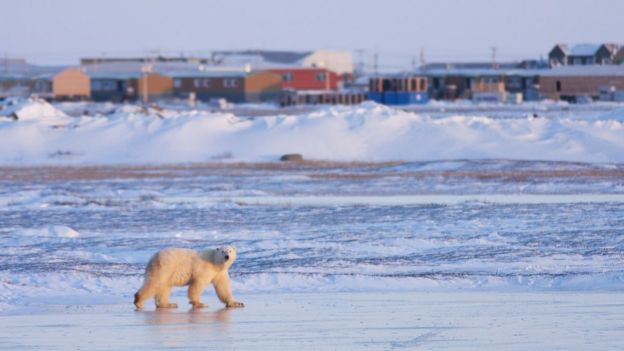
A bear walks with houses in the distance
What is driving this change in the polar bears' behaviour?
Many Arviarmiut blame polar bear tourism in neighbouring Churchill - 250km to the south - for encouraging the animals to look for food in human settlements.
A map showing Arviat, Churchill and Greenland
But there are other theories. Some Inuit think the bear population in the region is growing. Many scientists, on the other hand, put the blame on habitat loss - according to this theory it's the desperation of hungry bears facing decreased ice seasons in a rapidly warming Arctic that leads them to approach the town. They have always gathered on the coastline at this time of year, awaiting the formation of the sea ice that is their winter hunting ground, but usually at a greater distance.
Whatever the cause, Arviarmiut have had to get used to sharing their community with growing numbers of large, dangerous and unpredictable carnivores. Many towns in the northern Canadian territory of Nunavut are in the same position - Clyde River, Hall Beach and Resolute Bay have all reported problems in the past couple of years.
In Arviat, things reached a critical point four years ago.
Between 2010 and 2011, 11 polar bears were killed by Arviarmiut defending life or property. So, in 2011, with financial support from WWF (Canada), local hunter Leo Ikakhik was hired as a full-time polar bear monitor. Leo patrols the town, responds to sightings, and discourages polar bears through the use of spotlights and bangers. In addition, many homes have been provided with sealed steel bins for storing frozen meat, which was previously stored on roofs in sub-zero temperatures, and electric fences have been erected around sled dog teams. As a result of these measures, defence kills have all but ceased.
But a number of bears are also killed each year by hunters.
 Adapted from BBC News. Magazine

Saturday, October 10, 2015

Flammable foam hits the streets of Bangalore-India

Absolutely unbelivable!

An invasion of toxic waste has floated on to the streets of Bangalore and while it looks like fresh snow there is nothing pleasant about this fluffy white cloud.
Toxic foam from the Indian city's giant Bellandur Lake was made after pollution in the lake was disrupted by rain showers.
Bellandur is highly polluted by a consistent flow of raw sewage and chemical waste which builds up and lays underneath the surface of its water.


The foam comes from the vast and highly polluted Bellandur Lake.

  • It is caused by ammonia, phosphate and low dissolved oxygen in the water
  • The white mixture has also been known to catch fire due to the grease in it
  • Bangalore residents have started up a Facebook page to save the lake

  • From MailOnline ( Daily Mail)


  • Tuesday, October 06, 2015

    Wild mammals 'have returned' to Chernobyl

    Removing humans from what is now the exclusion zone around the damaged Chernobyl nuclear reactor has allowed wildlife to return, researchers say.

    Wild boar in Chernobyl exclusion zone (c) Valeriy Yurko
    The team carried out a long-term survey of mammals including wild boars


    They say a long-term census of mammals in the area has shown that wildlife numbers are likely to be "much higher than they were before the accident".
    Professor Jim Smith of the University of Portsmouth led the study, published in the journal Current Biology.
    He stressed that this "does not mean that radiation is good for wildlife".
    "It's just that the effects of human habitation, including hunting, farming, and forestry, are a lot worse," Prof Smith said.
    With the help of with colleagues from the Polesky State Radioecological Reserve in Belarus, the researchers examined data from aerial surveys that counted large mammals including roe deer, elk, wild boar and wolves.
    Roe deer near Chernobyl nuclear power plant (c) Tatyana Deryabina
    Tracks in the snow allowed the researchers to estimate roe deer populations in the exclusion zone
    They also carried out tracking studies in the winter - using footprints in snow to calculate the numbers of different mammal species. And measuring the levels of radioactive contamination in those tracks.
    "The numbers of animals we see in Chernobyl is similar to the populations in uncontaminated nature reserves," Prof Smith said.
    The number of wolves was particularly striking - up to seven times higher than in nearby nature reserves of a comparable size. Prof Smith attributed this to the lack of hunting in the exclusion zone.
    A 30km exclusion zone now surrounds the infamous Chernobyl nuclear power plant. And Prof Smith says the picture from this study reveals what happens in terms of wildlife conservation "when you take humans out of the picture".
    Wolf in Chernobyl exclusion zone (c) Valeriy Yurko
    Researchers think wolves in the exclusion zone have thrived thanks to a lack of hunting
    But, he said, the study did not look at the health effects of radiation on individual animals.
    That is something that Prof Tim Mousseau from the University of South Carolina, has spent many years trying to unpick in his studies of wildlife - particularly bird populations - in the exclusion zone.
    Prof Mousseau said the study was a "very positive move forward in conducting research concerning the potential health and environmental impacts of nuclear accidents".
    "Much more research on this is desperately needed," he added.
    But Prof Mousseau is also troubled by "the characterisation that Chernobyl and the surrounding area is teeming with wildlife".
    "This study only applies to large mammals under hunting pressure, rather than the vast majority of animals - most birds, small mammals, and insects - that are not directly influenced by human habitation," 
    From BBC News- Science/ Environment

    Friday, October 02, 2015

    Plastic in oceans 'threatens food chain'


    As England prepares to introduce a charge for plastic bags, science editor David Shukman reports on the possible threat to the food chain, by the plastics broken down into tiny fragments in our oceans.
    Tests by the Plymouth Marine Laboratory have shown that when minuscule particles of plastic are in the water, the creatures at the bottom of the food chain do ingest them.
    An estimated eight million tonnes of plastic waste is added to the oceans every year.(BBC News)


    Thursday, October 01, 2015

    Plan to save the Scottish wildcat

    Plan to save the Scottish wildcat

    It's been captured by a hidden camera in the Western Highlands.
    Habitat loss, breeding with domestic cats and disease has left the wildcat in trouble.
    It's thought there's now fewer than a hundred left in the world.
    But conservationist say they've found six areas in the Highlands where the species has the best chance of survival.
    They're asking local people, including kids, to get involved in the fight to save wildcats by setting up hidden cameras.
    Experts will use the footage to learn more about the creatures and how they can help them survive.
    Dr Paul O'Donoghue from the wildlife charity, Wildcat Haven, says he wants more people living in the areas to join the project.
    "We have a template for wildcat conservation and we're looking to expand that across the whole of the West Highlands," he said.(CBBC Newsround)

    Read more


    Wikipedia

    Search results