To my dear visitors and commenters

Hi, everybody! I've noticed with lots of joy and happiness, that thousands of comments have been written in my posts. It's wonderful that so may people around the world appreciate my work. Therefore, I want to thank you for that and ,at the same time I want to ask you to be this blog's followers. It's fast and easy! Make it be even more visited and spread all over the world! I'm a woman, a teacher of English in Portugal, and I've been away for quite a long time because of my father's health. Unfortunately he died from Covid19 a few months ago. Now I felt it was time to restart my activity in this and other blogs I owe. I've recently created a new one in a partnership with a street photographer, Mr. Daniel Antunes. He's fabulous! https://pandpbydandd.blogspot.com I'd like you to visit it and, who knows, become our followers. The poems, chronicles and thoughts are all mine. Thank you so much! Kisses :-)

Search This Blog

Sunday, January 10, 2016

Horsey beach seal births top 1,000 for first time

A record number of grey seal births at a Norfolk beach shows a "major change" in behaviour as the animals become used to humans, marine experts have said.

Seals at Horsey, Norfolk
Seal pups are weaned by their mothers for about three weeks before they enter the sea

The 1.5 mile (2.4km) stretch of dunes at Horsey has hosted 1,018 births so far this winter compared to the previous winter when there were 804. Dr Dave Thompson, biologist at the Sea Mammal Research Unit (SMRU), said: "The colony growth is spectacular.
"These animals used to only breed on islands or sandbanks."
Seal at Horsey, Norfolk
Grey seals are able to shelter in the dunes at Horsey where volunteers try to prevent visitors from disturbing the breeding site
Seals at Horsey, Norfolk
The Sea Mammal Research Unit said grey seals used to breed only on sandbanks or islands not accessed by humans
Colonisation began in 2003 at Horsey, which is privately-owned with public access.
The Friends of Horsey Seals volunteers erect ropes and warning signs and patrol the beach to try to ensure seals are not disturbed during the November to January breeding season.

'Tolerant of humans'
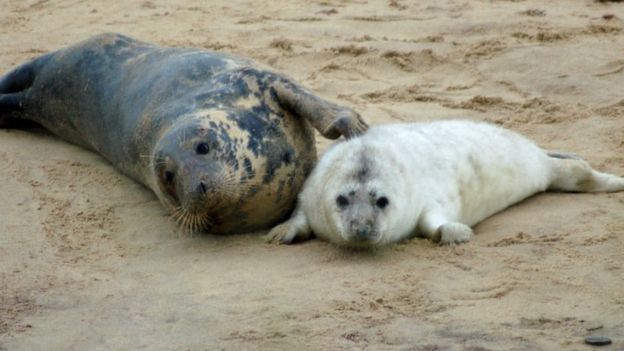
Seals at Horsey, Norfolk
Peter Ansell, of the Friends of Horsey Seals group, said: "It's a milestone for us, given that it's a beach with public access.

"We have no idea when seal numbers will peak, but presume this will be governed by the food chain, of whicht hey are at the top."                                         Grey seal pups will fend for themselves after they have shed their white fur
The SMRU, based at St Andrew's University, monitors the size of the UK seal population.
Its statistics showed the number of pups had risen from 36,816 in 2002 to 51,293 in 2012 - the last year of its fully collated figures from the UK's main breeding sites.
Mr Thompson said pup births at sites in the northern part of the North Sea were static and the trend was for growth in the southern end.
"The Horsey colony growth is spectacular and it shows they've become more tolerant of humans in the vicinity," he said.
"The growth in the southern North Sea is so rapid that it has to be partly down to immigration from northern breeding sites with the seals deciding the habitats are more suitable."
From BBC News

Saturday, January 09, 2016

MILAN’S BOSCO VERTICALE COMING TO LAUSANNE

Stefano Boeri's vertical forest


Two rectangular towers with a height of 80 and 112 meters and 800 trees and 5000 bushes decorating the external facade Stefano Boeris Bosco Verticale brings the nature right into the heart of Milan. A nearly identical building project is now planned to bring the vertical Forest to Lausanne, Switzerland.
Italian architect Stefano Boeri designed these beautiful towers, whose inauguration ceremony took place in 2014. The two towers are located in Porta Nuova, in the north of Milans centre, and are a symbiosis between architecture and nature. On 40.000m exposed surface, approx. 3.000m are covered in trees. It is scarcely surprising that Stefano Boeris Vertical Forest won the Internation Highrise Award in 2014.
His idea of a Vertical Forest was now even awarded the contract for to build a Bosco Verticale v2 in Lausanne, Switzerland. The construction of the residental and office buildings, called Tour des Cdres, is scheduled for 2017.

Wednesday, January 06, 2016

Australian Monitor lizards trained not to eat toxic cane toads

Scientists have worked out a radical solution for Australia's deadly cane toad problem.

Goanna
Goanna numbers have dramatically declined in Australia

They have trained wild monitor lizards, known locally as goannas, not to eat the toxic cane toads.
They did this by feeding the reptiles smaller, younger and less poisonous cane toads. Many that tried the toads once did not make the same mistake again.
The study is published in a Royal Society journal, called Biology Letters.
Lead researcher Georgia Ward-Fear, from the University of Sydney, said: "We've been very surprised by the results, by the amount of time that some of these lizards have actually retained this knowledge and survived in the presence of a high-density of cane toads, which is basically unheard of in the wild."
Cane toad
Smaller cane toads are less of a toxic mouthful than the adult goannas
Cane toads were introduced to Australia in the 1930s to control sugar cane pests. But their numbers have rapidly increased, killing many of the continent's animals, because they are poinonous.
Among the hardest hit are the yellow-spotted monitors (Varanus panoptes). Their population is estimated to have plummeted by 90%. When the toads invade a new area, these yellow-and-black-spotted reptiles feast on the amphibians, and die.
Radiotracking
The research team used radiotrackers to monitor the lizards' survival rates
The scientists say the study suggests goannas have the ability to learn from experience and keep that knowledge over a long period of time.
One of the scientists, Dr Ward-Fear, said: "This study provides the proof of principle that this strategy could be very effective. Employing it in the wild could potentially have a really large positive impact on the goanna population."
From CBBC Newsround

Saturday, January 02, 2016

South Africa's rhinos 'could be extinct in 10 years'!!!

Africa's rhino population could face extinction within 10 years, animal welfare experts have warned.

white rhino
There are now less than 30,000 rhinos in the wild

South Africa has the largest population of the species in the world but their existence is under threat from poaching.
Demand from Asian markets for their horns has led to a dramatic increase in the numbers killed. It is thought more than 1,000 rhinos have been killed in South Africa's game reserves in 2015 alone.( BBC News)

A shocking 1,215 rhinos were poached in South Africa alone during the last year, according to South Africa's National Wildlife Crime Reaction Unit.
This alarming figure is DOUBLE the amount that were poached in South Africa three years ago, and it has risen a staggering 9,000 per cent in just seven years.
There are now less than 30,000 rhinos in the wild and there are fears they will be wiped off the planet by 2026 if the illegal slaughter continues at its rapid rate.
Soaring demand for their horns from Asia has led to 2014 being branded "the worst poaching year on record" by international wildlife charity Save The Rhino.
Katherine Ellis, Office and Communications Manager for Save The Rhino, said: "According to South Africa’s National Wildlife Crime Reaction Unit, 1,215 rhinos were poached in South Africa alone during 2014, making last year the worst poaching year on record.
"This would represent over a 9,000 per cent increase in the number of South African rhinos poached since 2007, when just 13 rhinos were killed."
rhino
Save The Rhinos blamed one factor of this increase in rhino deaths on a soaring demand for horns
At the beginning of the 20th century there were 500,000 rhinos across Africa and Asia, according to Save The Rhino.
This number dramatically fell to 70,000 by 1970 and finally to around just 29,000 left in the wild today.
But if they continue to be poached at their current rates, Save The Rhino warned that they could become extinct in the wild by as soon as 2026.
"Depending on the rate that poaching increases, and also the breeding rate of rhinos, overall rhino deaths could overtake births sometime between 2015 and 2021, which would push rhino populations into decline," said Ms Ellis.
"Sadly if poaching continues to increase at current rates, rhinos could be effectively extinct in the wild as soon as 2026."
But there are crucial moves currently underway which aim at reversing the rhino decline.
These include attempts at thwarting poachers and conservation programmes to help protect the rhinos from both human and natural danger. ( express_logo)

Friday, January 01, 2016

Delhi begins car rationing to curb pollution

Authorities in the Indian capital, Delhi, have launched major restrictions on private cars to curb alarming levels of pollution.

Cars and autorickshaws move through the central Connaught Place area in New Delhi, India, Thursday, Dec. 24, 2015.
Private cars with even and odd numbers plates are being allowed on alternate days
Private cars with even and odd number plates are being allowed on alternate days from Friday in an initial two-week trial.
Emergency vehicles like ambulances, police cars, fire engines and taxis have been exempted from the order.
Delhi has experienced hazardous levels of pollution this winter.
The local government announced the scheme after a court ordered authorities to tackle pollution levels more than 10 times the World Health Organisation's safe limits.

Exemptions

The government has made several exemptions to make it easier for people to follow the restrictions. The plan will be imposed between 8am and 8pm from Monday to Saturday.
Women will be allowed to drive their cars on all days but they can only be accompanied by women, and children below the age of 12. Cars carrying disabled people will also be allowed on all days.
Along with two wheelers, cars operating on natural gas have been exempted. In cases of medical emergency, people will not be stopped from taking patients to hospitals.
The government has hired around 3,000 private buses to provide shuttle services into the city from residential areas to ease the extra pressure on the public transport network.
Schools have been also shut until the trial ends on 15 January so that their buses can be used as public transport.
The government has launched an app that people can use to book tuk-tuks to improve last-mile connectivity from the Metro stations.
Indian policeman directs traffic on a road before the implementation of the odd-even vehicle scheme in New Delhi, India
The government has hired around 3,000 private buses to provide shuttle services
an Indian worker displays a sticker on his vehicle that indicates it runs on compressed natural gas (CNG) after getting it checked at a pump in New Delhi
Cars operating on natural gas have been exempted
Indian commuters travel on a polluted road near a bus terminus in the Anand Vihar District of New Delhi.
Delhi has been experiencing hazardous levels of pollution this winter
Traffic policemen and several thousand volunteers will check cars at intersections and violators will be fined 2,000 rupees ($30; £20) and asked to return.
"The biggest challenge is to make people realise that this fight against pollution is for them, for their health, for their own good," Delhi Transport Minister Gopal Rai told AFP news agency.

Grim

Critics, however, say the plan is not practical - they say that in a city with an inadequate public transport system and poor last-mile connectivity, the new measures are likely to inconvenience commuters.
"Let's not convince ourselves wrongly that a simple odd-even policy will solve the overall air pollution issue," AFP quoted Arunabha Ghosh, head of the Delhi-based Council on Energy, Environment and Water, as saying.
Indian Volunteers who will be supporting Delhi Government in the odd-even vehicle scheme attend a briefing and training in New Delhi, India, 30 December 2015.
Several thousand volunteers will help police during the drive
"Otherwise, we will be simply kicking the can down the road and we will create a feeling of distrust among citizens and the government machinery."
Delhi resident Pankaj Mehta, who drives 45km (30 miles) to work daily, told AFP that the restrictions would make commuting difficult.
"Rickshaw, then metro, then feeder bus, then walk - back and forth. A travel nightmare," he said.
"But if it makes breathing easier, then it may be worth it."
Environmental activists have welcomed the decision, saying the situation is so grim that urgent drastic steps are needed.
New car sales are soaring in India, with 1,400 extra cars taking to the capital's streets every day.
From BBC News

Wikipedia

Search results